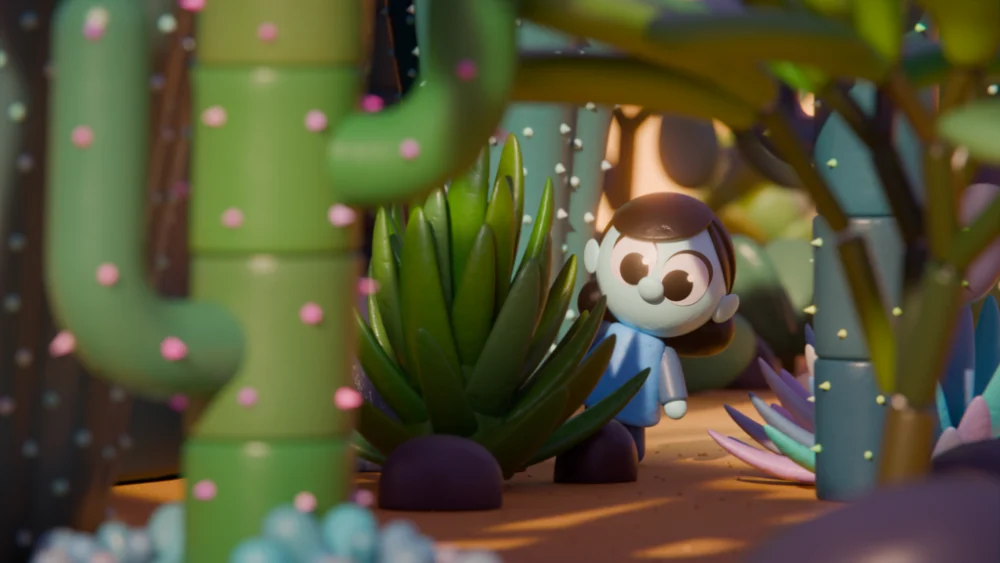
The vibrant world of children’s entertainment has welcomed a new animated character, BipBop, whose debut pilot episode, "BipBop’s Desert Adventure," has been released, showcasing the capabilities of the open-source 3D creation suite, Blender. Created with a dedication to human artistry and powered by the versatile tools of Blender, this independent production highlights the growing accessibility of professional-grade animation for creators outside traditional studio systems. The pilot, a four-minute journey, introduces BipBop, a curious and endearing protagonist, embarking on her first significant adventure in a stylized desert landscape.
This release marks a significant milestone for independent animators and advocates of open-source software. Blender, a free and open-source 3D computer graphics software toolset, has steadily gained traction in professional animation pipelines, VFX, game development, and motion graphics. Its comprehensive feature set, including modeling, rigging, animation, simulation, rendering, compositing, and motion tracking, makes it a powerful alternative to proprietary software. The production of "BipBop’s Desert Adventure" serves as a tangible testament to this evolution, demonstrating that high-quality animated content can be realized without substantial financial investment in software licenses.
The genesis of "BipBop’s Desert Adventure" can be traced to a desire by its creators to produce content that is not only entertaining but also ethically produced. The tagline "made with love, for humans, by humans" underscores a commitment to craftsmanship and a transparent creative process, a philosophy that resonates with a growing segment of the audience. In an industry often characterized by large corporate structures and complex supply chains, this independent approach offers a refreshing perspective. The development of such projects often involves a dedicated team, or even a single individual, leveraging their skills and passion to bring a vision to life.
The Creative Process: From Concept to Screen
While specific details of the production timeline for "BipBop’s Desert Adventure" are not publicly available, the creation of a four-minute animated pilot typically involves several distinct phases. These phases, executed within Blender, would likely include:

- Concept Development and Storyboarding: This foundational stage involves defining the character of BipBop, outlining the narrative arc of the desert adventure, and visualizing key scenes through storyboards. This process helps in establishing the pacing, visual style, and emotional beats of the episode.
- Character Design and Modeling: BipBop and any accompanying elements in the desert environment would be meticulously designed and modeled within Blender. This involves creating 3D meshes that define the character’s form, proportions, and aesthetic. The visual appeal of BipBop, as seen in promotional materials, suggests a focus on a friendly and accessible design, likely incorporating stylized features suitable for a young audience.
- Texturing and Shading: Once modeled, the characters and environments are brought to life with color and surface detail. This involves creating or sourcing textures and applying them to the 3D models, defining their material properties (e.g., the roughness of sand, the sheen of BipBop’s attire).
- Rigging and Animation: This is a critical stage where the characters are given an internal "skeleton" (rigging) that allows animators to pose and move them realistically or expressively. The animation process involves keyframing the character’s movements, bringing BipBop’s actions and expressions to life across the four-minute runtime. The fluidity and expressiveness of these animations are crucial for engaging a young audience.
- Environment Creation and Lighting: The desert setting would be built, incorporating elements like dunes, rocks, and possibly sparse vegetation. Lighting plays a pivotal role in establishing the mood and visual depth of the scene, simulating the harsh yet beautiful conditions of a desert environment. The grading of the desert banner image suggests a deliberate artistic choice in color palette to enhance the visual storytelling.
- Visual Effects (VFX) and Compositing: While the pilot might not feature extensive VFX, any elements like dust particles, atmospheric effects, or subtle environmental interactions would be created and integrated. Compositing then brings all the rendered elements together into the final image sequence.
- Sound Design and Editing: Accompanying the visuals is the crucial element of sound. This includes voice acting (if any), sound effects that enhance the environment and actions, and a musical score that complements the narrative and emotional tone of the episode.
- Rendering and Post-Production: The final 3D scenes are rendered into 2D image sequences, a process that can be computationally intensive. These sequences are then edited together, color-corrected, and finalized to produce the finished film.
Blender’s Role in Independent Animation
The success of projects like "BipBop’s Desert Adventure" is intrinsically linked to the evolution and accessibility of Blender. As of its last major stable release, Blender has continued to enhance its feature set, addressing the needs of a diverse user base. For instance, advancements in its real-time rendering engine, Eevee, have significantly sped up the iteration process for animators, allowing for near-instantaneous previews of their work. Simultaneously, Cycles, its physically-based ray-tracing engine, continues to offer photorealistic rendering capabilities.
The Grease Pencil module within Blender has also revolutionized 2D animation within a 3D environment, allowing artists to draw and animate directly in 3D space. While the "BipBop" pilot appears to be primarily 3D, the continuous development of these integrated tools further empowers independent creators to explore a wider range of artistic possibilities within a single software package.
Market Context and Potential Impact
The children’s entertainment market is a vast and competitive landscape, dominated by major studios and established franchises. However, there remains a significant demand for unique, character-driven content that offers diverse perspectives and values. Independent productions like "BipBop’s Desert Adventure" can carve out a niche by appealing to audiences seeking authenticity and creative innovation.
The success of such pilots often hinges on their ability to capture the imagination of young viewers and resonate with parents. Key metrics for evaluating the success of a pilot episode include viewership numbers, audience engagement (likes, shares, comments), and the potential for the character and story to spawn further episodes or related content. The explicit statement that the show is "made with love, for humans, by humans" suggests an awareness of the current media landscape, where authenticity and creator intent are increasingly valued.

Furthermore, the visual appeal and narrative strength of the pilot can attract the attention of potential investors or distribution partners, enabling the expansion of the "BipBop" universe. The use of Blender also positions the project as technologically forward-thinking and potentially more cost-effective to scale compared to productions reliant on proprietary software. This can be a significant advantage when seeking to secure further funding or partnerships.
Broader Implications for the Animation Industry
The rise of accessible, powerful 3D software like Blender has democratized animation production. This trend has several key implications for the industry:
- Increased Diversity of Content: More creators can now affordably enter the animation space, leading to a broader range of stories, styles, and cultural perspectives being represented on screen.
- Emergence of Independent Studios and Freelancers: The barrier to entry has lowered, allowing small teams and individual artists to compete with larger studios on certain types of projects. This fosters a more dynamic and innovative industry.
- Emphasis on Storytelling and Character: With the technical hurdles reduced, the focus shifts even more towards the quality of the story, character development, and artistic vision, which are the true drivers of audience connection.
- Innovation in Production Workflows: The open-source nature of Blender encourages community-driven development, leading to rapid innovation and the adoption of new techniques and workflows. This can push the entire industry forward.
- Potential for Educational Applications: Blender’s free accessibility makes it an ideal tool for educational institutions and aspiring animators, fostering the next generation of creative talent.
The "BipBop – Pilot Episode" is more than just a new animated short; it represents a confluence of artistic passion, technological accessibility, and a desire to create content that is both engaging and ethically grounded. As BipBop embarks on her adventures, her journey also reflects the evolving landscape of animation production, where innovation and creativity are no longer solely the domain of large, established entities. The success of such independent endeavors can inspire countless other creators to pursue their animated visions, further enriching the global tapestry of digital storytelling. The pilot episode serves as a promising introduction, hinting at the potential for BipBop to become a beloved character in the hearts of young audiences worldwide.
About the Author