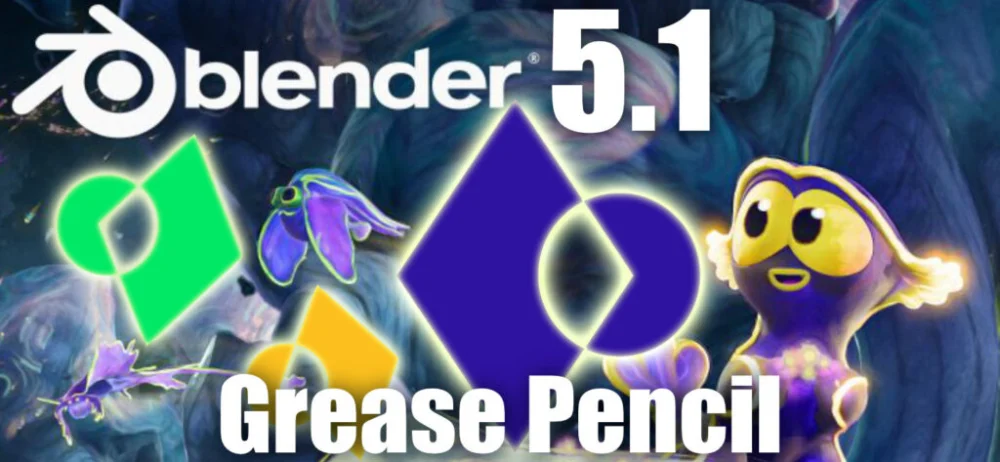
The Blender Foundation has officially released the beta version of Blender 5.1, a significant update poised to redefine 2D animation workflows within the popular open-source 3D creation suite. This latest iteration introduces a suite of groundbreaking enhancements to Grease Pencil, the powerful tool that allows artists to draw and animate directly in a 3D space. Among the most anticipated features are the long-awaited implementation of real fills capable of handling holes, a completely overhauled material workflow, and substantial performance optimizations that promise to accelerate production pipelines.
The release of Blender 5.1 Beta marks a pivotal moment for 2D and 3D hybrid animation. For years, Grease Pencil has been lauded for its unique approach, blending the intuitive feel of traditional drawing with the flexibility of 3D environments. However, certain core functionalities, particularly in the realm of fill tools and material management, have presented challenges for artists aiming for complex, production-ready results. Blender 5.1 Beta directly addresses these limitations, signaling a maturing of the tool and its growing potential for professional animation studios and independent artists alike.
A Deep Dive into Grease Pencil’s Transformative Updates
The most striking advancement in Blender 5.1 Beta is the introduction of "real fills" for Grease Pencil objects. Previously, fill operations often behaved more like solid color strokes, lacking the ability to accurately respect complex boundaries or incorporate holes within a filled area. This limitation frequently necessitated cumbersome workarounds, such as manual line drawing or the use of multiple overlapping fills, which could complicate animation and increase render times.
The new fill system in Blender 5.1 Beta operates with a fundamentally different logic. It now understands and respects the topology of the drawn lines, allowing for fills that precisely adhere to outlines, even when those outlines contain internal gaps or holes. This means artists can now create filled shapes with the confidence that the fill will accurately represent the intended enclosed area, regardless of its complexity. This feature is particularly impactful for character animation, where clean, well-defined fills are crucial for character design and silhouette clarity. Furthermore, it streamlines the creation of backgrounds, props, and environmental elements that often require intricate filled shapes.

Complementing the enhanced fill capabilities is a reimagined material workflow for Grease Pencil. Prior to this update, managing materials for Grease Pencil strokes and fills could be a fragmented process. Artists often found themselves juggling different settings and nodes in ways that felt less integrated than the established material workflows for 3D objects. Blender 5.1 Beta introduces a more cohesive and intuitive material system, bringing Grease Pencil materials closer in parity with the shader node editor commonly used for 3D assets.
This overhaul simplifies the creation and manipulation of complex textures, gradients, and shaders for 2D elements. Artists can now expect a more unified experience, enabling them to leverage a wider range of visual effects and achieve more sophisticated artistic styles within Grease Pencil. This integration is a crucial step towards making Grease Pencil a fully capable standalone animation tool, reducing the need for external compositing or complex workarounds to achieve desired visual aesthetics.
Beyond the core drawing and material features, Blender 5.1 Beta also brings significant performance enhancements. This is a critical aspect for any software aiming for professional adoption, as smooth viewport performance and faster rendering are paramount for efficient production. The development team has focused on optimizing various aspects of the Grease Pencil engine, leading to noticeable improvements in brush responsiveness, stroke drawing speed, and overall scene manipulation. For artists working with complex scenes, heavy stroke counts, or detailed textures, these performance boosts will translate directly into a more fluid and enjoyable creative process, reducing downtime and increasing artistic output.
Background and Chronology of Grease Pencil Development
The evolution of Grease Pencil within Blender has been a remarkable journey. Initially introduced as a simple annotation tool, its potential for full-fledged 2D animation was recognized and systematically developed over several major Blender releases. The significant overhaul in Blender 2.8 marked a turning point, transforming Grease Pencil into a powerful vector-based drawing and animation system. Subsequent releases have incrementally added features, including advanced stroke editing, modifiers, and integration with the 3D environment.
The demand for more robust fill capabilities and a streamlined material system has been a consistent theme in user feedback and feature requests since these foundational developments. Artists have repeatedly highlighted the limitations of existing fill tools when dealing with complex shapes and the desire for a more integrated material pipeline. The development team at the Blender Foundation, in collaboration with the active Blender community, has been diligently working to address these needs.

The release of Blender 5.1 Beta represents the culmination of considerable development effort, likely spanning several months of focused work by dedicated developers and contributors. The timeline leading up to this beta release would have involved extensive coding, internal testing, and potentially early access testing by a select group of artists to gather crucial feedback on the new features. The public beta phase now allows for broader community testing, ensuring that any remaining issues are identified and resolved before the final stable release.
Supporting Data and Technical Implications
While specific benchmark data for Blender 5.1 Beta’s performance improvements will become more widely available as users test the software, the stated goals of the development team indicate significant optimizations. These likely involve algorithmic improvements in how Grease Pencil strokes are rendered and processed, potentially leveraging GPU acceleration more effectively. For example, handling complex stroke data and managing fill algorithms efficiently can be computationally intensive. Optimizations in these areas could lead to a reduction in CPU and GPU load, allowing for more complex animations to be handled within the same hardware constraints.
The new fill system’s ability to accurately detect and fill enclosed areas, even with internal holes, suggests a more sophisticated understanding of vector path data. This implies advancements in the underlying geometry processing and computational geometry algorithms employed by Blender. The implications extend beyond mere convenience; it can lead to cleaner topology for fills, reducing the likelihood of rendering artifacts and simplifying the process of applying effects or deformations to filled areas.
The material workflow overhaul is also likely to involve deeper integration with Blender’s node-based shading system. This could mean exposing more Grease Pencil-specific parameters within the shader nodes or developing new node types tailored for 2D elements. The benefits are manifold: enhanced control over stroke textures, more dynamic fill effects, and the ability to create sophisticated non-photorealistic rendering (NPR) styles with greater ease.
Potential Reactions and Inferred Statements

The release of Blender 5.1 Beta is expected to be met with widespread enthusiasm from the 2D animation and motion graphics communities that utilize Blender. Artists who have been advocating for these features are likely to express their excitement and gratitude for the development team’s responsiveness.
While no direct official statements are provided in the original content, one can infer that the Blender Foundation, through its public announcements and developer blogs, would frame this release as a significant step forward in democratizing professional-grade 2D animation tools. They would likely emphasize the community-driven nature of Blender’s development, highlighting how user feedback directly shapes the software’s trajectory.
The focus on performance improvements suggests an understanding of the practical demands of animation production. This would be framed as a commitment to providing artists with tools that not only offer creative flexibility but also facilitate efficient workflows, allowing them to produce more with less.
Broader Impact and Implications
The enhancements to Grease Pencil in Blender 5.1 Beta have far-reaching implications for the animation industry and beyond.
- Democratization of Advanced 2D Animation: By offering powerful, yet accessible, 2D animation tools within an open-source platform, Blender 5.1 Beta further lowers the barrier to entry for aspiring animators and independent studios. This can foster a more diverse and vibrant animation landscape.
- Increased Adoption in Professional Pipelines: The introduction of features like robust fill tools and an integrated material workflow makes Grease Pencil a more viable option for professional animation projects. Studios that previously might have relied on specialized 2D software may now consider incorporating Blender into their pipelines for 2D elements or hybrid 2D/3D productions.
- Innovation in Visual Styles: The enhanced material system and improved fill capabilities open up new avenues for artistic exploration. Artists can experiment with more complex textures, shaders, and NPR styles, pushing the boundaries of visual aesthetics in animation.
- Streamlined Hybrid Workflows: The continued integration of 2D tools within a 3D environment reinforces Blender’s position as an all-in-one solution. This simplifies hybrid workflows where 2D elements need to interact seamlessly with 3D assets, reducing the need for complex data transfer and integration between different software packages.
- Impact on Motion Graphics: The precision and flexibility of Grease Pencil, now augmented with these new features, make it an increasingly powerful tool for motion graphics designers. Creating intricate animated graphics, title sequences, and visual effects will become more efficient and artistically expressive.
In conclusion, the Blender 5.1 Beta release represents a significant leap forward for Grease Pencil. The introduction of real fills, a revitalized material workflow, and crucial performance optimizations collectively address long-standing user needs and elevate the tool’s potential for professional animation. This update not only empowers individual artists but also signals a growing maturity of Blender as a comprehensive solution for a wide spectrum of creative endeavors, from independent short films to large-scale professional productions. The coming months, leading up to the final stable release, will undoubtedly see a surge in artists exploring and showcasing the capabilities of these transformative new features.
About the Author