Technological Evolution and Product Development Timeline
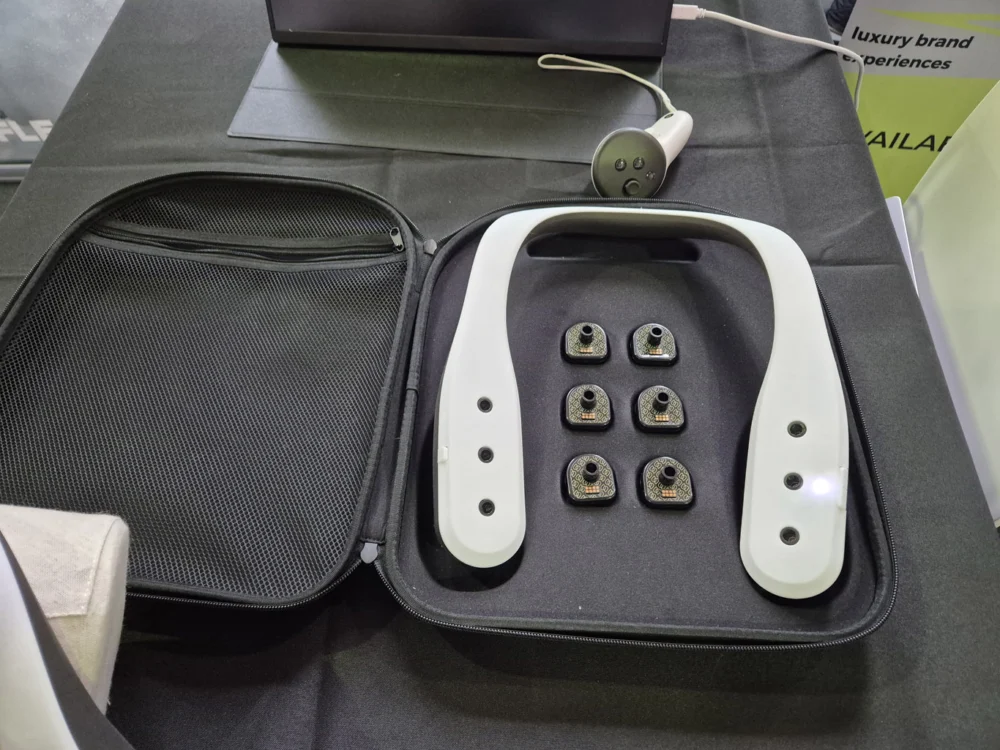
The journey of the Escents device has been characterized by rapid iterative improvements. Initially gaining industry attention at AWE EU 2024, the early prototype was noted for its functional but utilitarian design. Over the subsequent twelve months, the company focused on aesthetic refinement, ergonomic optimization, and the reliability of its scent delivery mechanism. The version presented at United XR Europe reflects a shift toward a consumer-grade finish, featuring a more streamlined chassis and a dedicated protective transit case, signaling the company’s readiness for a broader commercial rollout.
Historically, olfactory integration in VR has faced significant hurdles, ranging from hardware bulk to the "lingering scent" problem, where fragrance particles remain in the air long after a digital event has concluded. Scentient’s development timeline suggests a concentrated effort to address these technical barriers. By moving away from headset-mounted peripherals to a neck-worn collar, the company has sought a balance between user comfort and the physical requirements of vaporizing chemical compounds.

Hardware Architecture and Ergonomic Design Principles
The Escents device operates as a standalone wearable that communicates wirelessly with major XR headsets, including the Meta Quest and Pico series. Unlike haptic vests or controllers, the Escents collar sits on the user’s shoulders, leveraging the body’s natural frame to distribute weight. This design choice avoids adding front-heavy mass to the VR headset itself—a common complaint with early olfactory experiments that attached directly to the face mask.
The internal architecture of the device features six modular slots designed for scent cartridges. Because olfactory sensations cannot be mixed from a base set of "primary smells" in the same way that pixels use Red, Green, and Blue (RGB) values, the device requires specific pre-computed cartridges for every distinct aroma. When the software triggers a scent event, the device vaporizes the corresponding liquid and utilizes a micro-fan system to blow the particles toward the user’s nose.
While the neck-worn form factor improves ergonomics, it introduces a logistical challenge regarding the distance between the emitter and the olfactory receptors. Scentient has addressed this by calibrated "breeze" delivery, ensuring that scent particles reach the user with minimal latency. This mechanism allows for a rapid switching of aromas, a feature the company claims is essential for maintaining the "presence" of the user within a fast-paced virtual simulation.

Olfactory Fidelity and the Mechanics of Scent Delivery
During the United XR demonstrations, Scentient provided a curated selection of six fragrances: jasmine, chocolate, green fig, pine, burnt wood, and petrol. These scents were selected to demonstrate the device’s versatility across different sectors, from environmental simulation (pine and wood) to industrial training (petrol).
Technical analysis of the scent delivery reveals that the device has made significant strides in "scent clearing." One of the primary criticisms of olfactory VR is nose saturation, where the user becomes desensitized to smells or where different aromas bleed into one another. The Escents hardware utilizes a precision vaporization technique that limits the volume of particles released, allowing the user to transition from the smell of chocolate to the smell of pine within seconds without significant residual overlap.
However, the industry continues to grapple with the "chemical" profile of synthesized scents. Much like early digital audio, synthesized aromas can sometimes lack the organic complexity of their real-world counterparts. While the Escents device successfully triggers the intended psychological response—such as hunger when smelling chocolate or alertness when smelling smoke—the fidelity remains in the "emulation" phase rather than perfect replication. For enterprise training and healthcare applications, this level of fidelity is often sufficient to enhance memory retention and emotional engagement.

Software Integration and Developer Support
Scentient has positioned the Escents device as a developer-friendly peripheral. The demonstrations at United XR were built using the Unity Interaction Toolkit, a standard framework for XR development. This choice indicates that Scentient is prioritizing ease of integration for third-party creators. By providing a streamlined SDK, the company aims to encourage developers to "tag" virtual objects with olfactory metadata, allowing the hardware to trigger automatically when a user interacts with an object in the virtual space.
The current software implementation allows for proximity-based triggering. As a user moves their virtual hand or head closer to a scented object, the device can adjust the intensity of the emission. This spatialized olfactory feedback is a critical component in convincing the brain that the scent is originating from a specific point in 3D space, rather than simply being a global ambient smell.
Commercial Availability and Strategic Market Positioning
The Escents device is currently available for pre-order at a price point of £999. This positioning clearly targets the enterprise and high-end research markets rather than the general consumer gaming audience. Scentient has indicated a shipping window for the first production batch in Q1 2026.

The £999 price tag reflects the specialized nature of the hardware and the ongoing costs associated with cartridge replacement. In the professional XR ecosystem, this cost is comparable to other high-end haptic peripherals. Scentient is likely eyeing several key verticals for initial adoption:
- Healthcare and Therapy: Using scents to trigger memories in patients with cognitive decline or to provide exposure therapy for individuals with PTSD.
- Industrial Safety: Training workers to recognize the smell of hazardous leaks (e.g., petrol or gas) in a safe, simulated environment.
- High-End Marketing: Creating "multi-sensory" brand activations where consumers can smell products like coffee or perfume in a virtual storefront.
Broader Implications for the XR Industry
The refinement of the Escents device comes at a time when the XR industry is shifting its focus from "visual-first" to "total immersion." While companies like Meta and Apple have mastered the visual and auditory aspects of spatial computing, the chemical senses have remained largely ignored. Scentient’s progress suggests that the hardware for olfactory VR is maturing, even if the content ecosystem is still in its infancy.
Analysts suggest that the success of devices like Escents will depend heavily on the standardization of scent cartridges. If the industry moves toward a universal format for olfactory data, it could pave the way for wider adoption. For now, Scentient remains a pioneer in a niche but vital field. By addressing the ergonomic and saturation issues that plagued previous attempts at "Smell-O-Vision," the company has provided a viable roadmap for how the sense of smell can finally become a permanent fixture in the digital world.

As the Q1 2026 shipping date approaches, the industry will be watching closely to see if Scentient can scale its production and if developers will embrace the challenge of designing experiences that cater to the human nose as much as the human eye.
About the Author