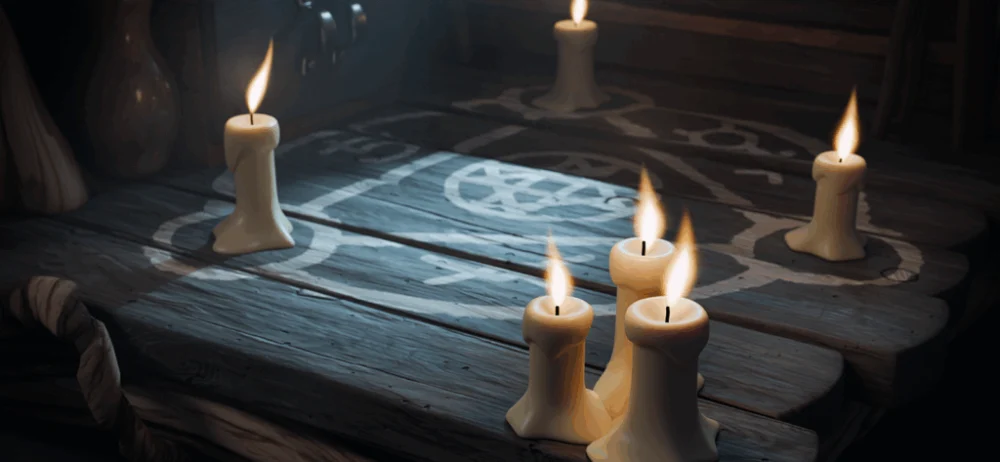
The pursuit of photorealism in 3D rendering often hinges on the meticulous recreation of subtle yet crucial elements, and among these, the ephemeral dance of a candle flame stands as a testament to the challenges and rewards of digital artistry. Polygon Runway, a prominent educator in the 3D modeling and animation space, has released a detailed video tutorial on BlenderNation, offering a sophisticated approach to generating dynamic and visually convincing candle flames. This tutorial, published on February 21, 2026, by the educator known as polygonrunway, delves into advanced texturing and modifier techniques, promising both aesthetic appeal and efficient performance within the Blender environment.
The Art and Science of Digital Fire
Creating realistic fire effects in computer graphics is a multifaceted endeavor that blends artistic intuition with technical expertise. Historically, fire has been one of the most challenging phenomena to simulate due to its inherent complexity: its unpredictable movement, its intricate interplay of light and shadow, and its nuanced color spectrum. Early attempts often relied on sprite-based animations or simplified particle systems, which, while functional, lacked the organic fluidity and detailed texture of real flames.
The evolution of rendering engines and simulation technologies has dramatically advanced the capabilities of 3D artists. Modern software like Blender, with its powerful particle systems, fluid simulations, and sophisticated shader nodes, allows for a much more nuanced and physically accurate representation of fire. However, achieving a convincing candle flame, which is often characterized by its delicate wisps, subtle color gradations, and consistent yet dynamic shape, still requires a deep understanding of Blender’s toolset.

Polygon Runway’s tutorial addresses this challenge by focusing on a workflow that leverages Blender’s procedural capabilities. Instead of relying solely on complex fluid simulations, which can be computationally expensive, the tutorial proposes a method that combines strategic texturing and clever use of modifiers. This approach is particularly valuable for artists who need to create high-quality flames without an excessive render time, making it suitable for a wide range of projects, from architectural visualizations to animated shorts.
Decoding the Techniques: Modifiers and Texturing
The core of polygonrunway’s method lies in the intelligent application of Blender’s modifier stack and the creation of custom textures. While the specifics of the employed modifiers are detailed within the video, the underlying principle is to procedurally generate the shape and motion of the flame. This often involves using modifiers like the Displace modifier, driven by noise textures, to create the organic undulations and flickering characteristic of real flames. The Vertex Weight Proximity modifier might also be employed to control the falloff and density of the flame’s emission, ensuring it appears more concentrated at the wick and dissipates naturally.
Texturing plays an equally critical role. Instead of relying on pre-made texture maps, the tutorial likely guides users in constructing procedural textures that define the color, opacity, and emission properties of the flame. This involves manipulating nodes within Blender’s Shader Editor to create gradients that transition from the deep reds and oranges at the base to the bright yellows and blues at the tip. The emission strength of these shaders would be carefully modulated to simulate the luminous quality of fire. Furthermore, techniques like using a Gradient Texture node combined with Object or Generated coordinates can help achieve a consistent and controllable distribution of color and intensity along the flame’s height.
The emphasis on "performant" candle flames suggests that the tutorial aims to avoid overly dense geometry or computationally intensive simulation setups. This often means employing techniques that fake complexity rather than simulate it entirely. For instance, a carefully sculpted mesh, combined with displacement maps and volumetric shaders, can achieve a convincing result without the need for a full fluid simulation. This efficiency is crucial for game development, real-time rendering applications, and projects with tight deadlines.

The Polygon Runway Educational Approach
Polygon Runway has established a reputation for providing accessible and practical tutorials that demystify complex 3D concepts. Their educational content is often characterized by a clear, step-by-step methodology that breaks down intricate processes into manageable segments. The educator’s background as a designer and illustrator, as indicated by their profile on BlenderNation, likely informs their approach, prioritizing visual appeal and artistic integrity alongside technical accuracy.
Their website, polygonrunway.com, serves as a hub for their educational resources, offering courses and tutorials that cater to a range of skill levels. This particular tutorial, by focusing on a specific, often challenging element like a candle flame, reinforces their commitment to providing artists with the tools to enhance the realism and polish of their 3D scenes.
The publication on BlenderNation, a highly respected platform for Blender news and resources, ensures that this tutorial reaches a broad audience of 3D enthusiasts and professionals. BlenderNation’s commitment to showcasing community-generated content and educational materials makes it an ideal venue for sharing such valuable insights.
Contextualizing the Tutorial: The Growing Demand for Realistic Assets
The release of this tutorial comes at a time when the demand for high-quality, realistic 3D assets continues to surge across various industries. In architectural visualization, accurately rendered lighting and atmospheric effects, such as candle flames, can significantly enhance the mood and realism of a project. In the realm of visual effects for film and television, the ability to create believable fire effects is a fundamental skill. Even in the gaming industry, where performance is paramount, artists are increasingly striving for visual fidelity that pushes the boundaries of real-time rendering.

The ability to efficiently create realistic candle flames, as demonstrated by polygonrunway, addresses a specific need within this broader landscape. Artists can now quickly integrate these elements into their scenes, saving valuable time and resources. This democratizes the creation of sophisticated visual effects, making them accessible to a wider range of creators, from independent artists to larger studios.
Future Implications and Industry Trends
The techniques showcased in this tutorial are indicative of a broader trend in 3D content creation: the increasing reliance on procedural workflows and intelligent shader networks. As software becomes more powerful and artists gain a deeper understanding of its capabilities, there is a discernible shift away from purely manual asset creation towards methods that allow for greater flexibility, scalability, and efficiency.
The emphasis on "performant" flames also highlights the ongoing convergence of real-time and offline rendering. Techniques that optimize asset creation for speed without sacrificing visual quality are highly sought after, as they benefit both applications that require rapid iteration and those that demand high fidelity.
Furthermore, the accessibility of advanced techniques through platforms like BlenderNation and educators like Polygon Runway contributes to the continuous growth and innovation within the 3D art community. By sharing knowledge and best practices, these resources empower artists to push the boundaries of what is possible in digital creation.

The tutorial’s focus on a seemingly simple object like a candle flame underscores the principle that even the most common elements require careful consideration to achieve true realism. It serves as a valuable lesson in observation, attention to detail, and the application of sophisticated digital tools to replicate the nuances of the natural world. As 3D technology continues to evolve, such practical and well-explained tutorials will remain indispensable for artists seeking to elevate their craft and contribute to the ever-expanding universe of digital art and media.
About the Author