The vastness of the universe, estimated to be approximately 13.8 billion years old, presents a profound cosmological riddle: with such an immense head start on evolution, why has humanity not yet encountered or detected any other forms of intelligent life? This perplexing question forms the core of the Fermi Paradox, a contradiction between the high probability of extraterrestrial civilizations existing and the stark lack of empirical evidence for their presence.
The Enduring Mystery: Where Are They?
Coined after a lunchtime conversation in 1950 with physicist Enrico Fermi, the paradox encapsulates humanity’s bewilderment at the apparent cosmic silence. Fermi, pondering the immense age and size of the universe, reportedly asked, "Where is everybody?" This simple query highlighted the disconnect between theoretical predictions and observational reality. Given the billions of galaxies, each containing billions of stars, many of which are likely to host exoplanets, the statistical probability of life emerging elsewhere, and even evolving into advanced civilizations, appears incredibly high. Yet, despite decades of dedicated searching through projects like the Search for Extraterrestrial Intelligence (SETI), no definitive signals or evidence of alien intelligence have been discovered.
The Optimistic Calculations: Decoding the Drake Equation
A significant driver of the high probability estimates is the Drake Equation, formulated by astronomer Frank Drake in 1961. This probabilistic argument attempts to estimate the number of active, communicative extraterrestrial civilizations in the Milky Way galaxy. The equation comprises several variables:
- *R:** The rate of star formation in our galaxy.
- fp: The fraction of those stars that have planets.
- ne: The average number of planets that can potentially support life per star that has planets.
- fl: The fraction of those planets that actually develop life.
- fi: The fraction of planets with life that develop intelligent life.
- fc: The fraction of civilizations that develop a technology that releases detectable signs of their existence into space.
- L: The length of time for which such civilizations release detectable signals into space.
While the values for many of these variables are highly speculative, even conservative estimates, when multiplied across the hundreds of billions of stars in our galaxy, often yield a substantial number of potential civilizations. For instance, if even a tiny fraction of habitable planets develop intelligent, signal-emitting life that lasts for a million years, the galaxy should be teeming with detectable civilizations. The stark contrast between these optimistic calculations and the observed silence forms the crux of the Fermi Paradox.
The Silence of the Cosmos: SETI’s Quest
Since its inception, the SETI program has employed various methods to search for signs of extraterrestrial intelligence. These efforts primarily involve listening for artificial radio signals from space, as radio waves are an efficient and far-reaching method of interstellar communication. Projects like Project Ozma in 1960, and later the more extensive Arecibo Observatory and Allen Telescope Array, have scanned vast swaths of the sky for patterns that would indicate intelligent origin rather than natural astronomical phenomena. Despite these ongoing efforts and significant advancements in radio astronomy, the universe remains eerily quiet from a communicative perspective. This absence of evidence has led scientists and philosophers to explore a range of explanations for the paradox, from the rare conditions required for life to thrive to the possibility of self-destructive tendencies inherent in advanced civilizations.
The Great Filter Hypothesis: A Barrier to Life?
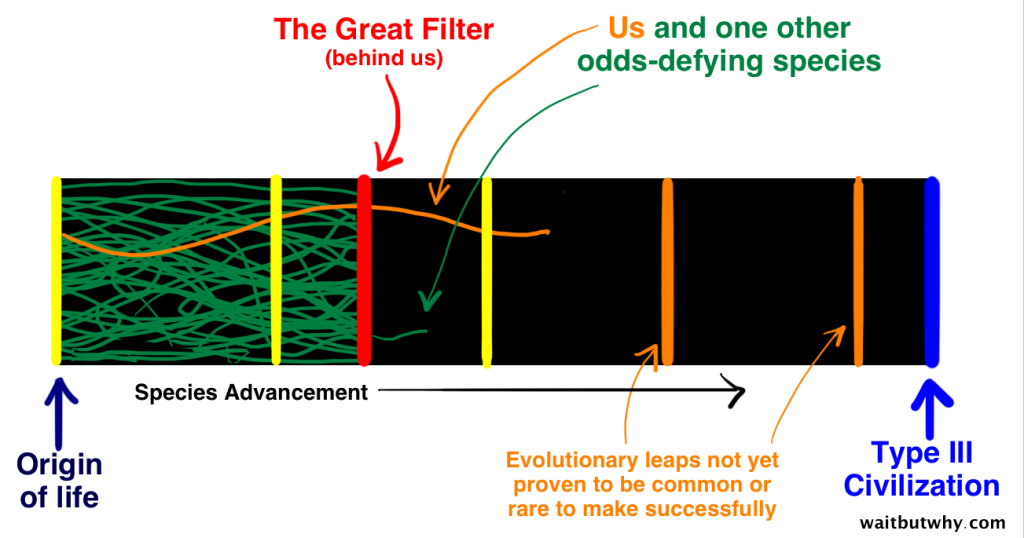
Among the most compelling explanations for the Fermi Paradox is the Great Filter hypothesis, proposed by economist Robin Hanson. This theory posits that at some point in the long evolutionary journey from pre-life to a Type III Kardashev civilization (one capable of harnessing the energy of an entire galaxy), there exists an extremely improbable or impossible step – a "wall" that all or nearly all attempts at life hit. This critical stage, "The Great Filter," could be behind us, indicating humanity has already passed it, or it could lie in our future, presenting an existential threat.
Early Filters: The Rare Earth Hypothesis

One category of potential filters suggests that the emergence of complex, intelligent life is an exceptionally rare occurrence. This aligns with the "Rare Earth Hypothesis," which argues that the combination of astrophysical and geological events necessary to produce and sustain complex life is far more unique than commonly assumed. Potential early filters include:
- Abiogenesis: The initial spark of life from non-living matter might be an exceedingly rare event, requiring precise chemical and environmental conditions.
- Eukaryogenesis: The evolution of eukaryotic cells from prokaryotic ancestors, a fundamental step towards complex multicellular life, may have been a singular event in Earth’s history.
- Sexual Reproduction: The development of sexual reproduction, which enhances genetic diversity and speeds up evolution, could be another unlikely evolutionary leap.
- Multicellularity: The transition from single-celled to multicellular organisms is a complex process with multiple independent evolutionary origins, yet still a significant hurdle.
- Planetary Conditions: Earth’s unique circumstances, such as its position in the galactic habitable zone, the presence of a large moon stabilizing its axial tilt, plate tectonics recycling nutrients, and a strong magnetic field protecting against solar radiation, might be indispensable and extremely rare collectively.
If one or more of these early filters are indeed incredibly rare, it would imply that life, especially complex life, is far less common than suggested by the sheer number of planets. In this scenario, humanity would be among the universe’s few, fortunate survivors, having already navigated the most challenging evolutionary bottlenecks.
Late Filters: Self-Destruction Scenarios
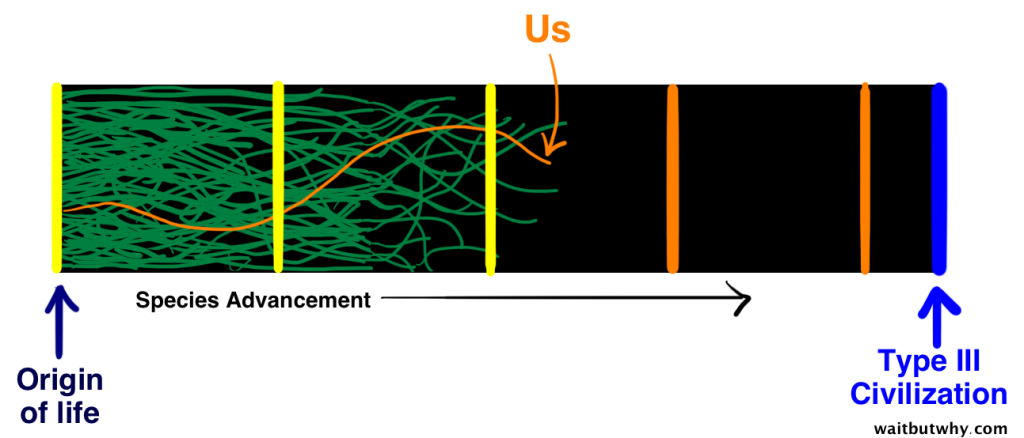
Conversely, the Great Filter might be in humanity’s future, suggesting that most intelligent civilizations eventually succumb to self-destruction or insurmountable challenges before they can achieve interstellar travel or long-term communication. This is a more sobering possibility, implying that humanity’s continued existence is far from guaranteed. Potential late filters include:
- Technological Self-Annihilation: The development of advanced weaponry, such as nuclear arms or biological agents, could lead to global catastrophes. The Cold War era, with its constant threat of nuclear annihilation, offered a stark reminder of this danger.
- Environmental Catastrophe: Unchecked technological growth could lead to irreversible damage to a planet’s ecosystem, such as runaway climate change, resource depletion, or widespread pollution, rendering it uninhabitable.
- Artificial Intelligence Runaway: The creation of super-intelligent AI, if not properly controlled, could lead to unforeseen consequences, potentially surpassing human control and leading to the extinction or subjugation of its creators.
- Pandemics or Biological Threats: Natural or engineered pandemics could decimate intelligent populations before they achieve interstellar capabilities.
- Cosmic Events: While less frequent, events like asteroid impacts, supervolcanic eruptions, or nearby gamma-ray bursts could wipe out civilizations. However, these are often considered less likely to be "filters" because they are external and not necessarily tied to a civilization’s development stage.
If the filter lies ahead, humanity’s current trajectory, marked by technological advancements alongside significant global challenges, becomes a race against time to overcome these potential pitfalls.
Alternative Explanations: From Zoos to Dark Forests
Beyond the Great Filter, other theories attempt to explain the cosmic silence:
- The Zoo Hypothesis: This theory suggests that advanced extraterrestrial civilizations are aware of humanity but deliberately choose not to contact us, treating Earth as a protected natural preserve or a "zoo." They might be observing our development from afar, adhering to a "prime directive" against interference until we reach a certain level of maturity or self-awareness.
- The Dark Forest Theory: Popularized by Chinese science fiction author Liu Cixin, this grim hypothesis proposes that the universe is a "dark forest" where every civilization is a hunter. Any civilization that reveals its presence risks being annihilated by others, leading to a universal strategy of silence and concealment. This fear-driven rationale would explain why no signals are detected – no one dares to broadcast.
- Limitations of Observation: Our current technology might simply be too primitive to detect advanced alien civilizations. They might be using communication methods we don’t understand, or their signals could be too faint, too complex, or too brief for us to register across vast interstellar distances. The observable universe, while immense, is still a tiny fraction of the total cosmos, and our search has only just begun in cosmic terms.
The Time Travel Analogy: A Parallel Paradox
The Fermi Paradox finds a compelling analogy in the absence of time travelers from the future. If time travel were physically possible and achievable, one might reasonably expect to see evidence of visitors from later eras. The non-appearance of such visitors is often cited as implicit evidence against the feasibility of time travel, or at least its widespread development. This parallel suggests that the absence of evidence can, in certain contexts, be a powerful indicator of impossibility or extreme improbability. While it doesn’t categorically prove that time travel is impossible, it raises questions about why, given an "enormous amount of time behind us," such technology hasn’t manifested.
The Transcension Hypothesis: Life Beyond Our Perception
One particularly intriguing explanation, advanced by scientists like Seth Shostak and echoed by technology writers, posits that truly advanced civilizations may evolve beyond large-scale physical existence, becoming imperceptible to our current detection methods. This "Transcension Hypothesis" suggests a shift from the macroscopic to the microscopic, or even the purely informational realm.
This theory draws inspiration from the history of technology itself: computers, once gargantuan mainframes, have relentlessly shrunk in size while vastly increasing in speed and power. Similarly, intelligent life, upon reaching a certain technological apex, might find large physical constructs inefficient and unnecessary. The "real action," as Shostak suggests, might be in "the small things." Advanced civilizations could transition from biological forms to post-biological entities, perhaps residing in vast, distributed computational networks or existing as pure information.
Such civilizations might have little incentive to construct planet-sized megastructures like Dyson spheres, which would be detectable. Instead, they might pursue "the engineering of the small," focusing on nanobots, quantum computing, or even escaping the confines of physical space entirely by uploading consciousness into digital realms. In this scenario, the infinite spaces between words, or the subatomic realms, could be the true domain of hyper-advanced intelligence. If this is the case, our current methods of searching for radio signals or visible megastructures would be fundamentally misguided, akin to searching for a whale in a teacup. We would simply lack the tools to perceive life that has transcended the physical constraints we understand.
Observational Limits and Future Outlook
The current limitations of human observation cannot be overstated. The observable universe, constrained by the speed of light and the age of the cosmos, represents a mere fraction of the total universe. Our detection capabilities for exoplanets and distant signals are still in their infancy. Furthermore, even within our own galaxy, we have only sampled a minuscule portion of the available "listening posts." The possibility remains that life is abundant, but too far, too quiet, too alien, or too advanced for us to perceive.
As technology progresses, with projects like the James Webb Space Telescope offering unprecedented views of exoplanet atmospheres and future radio telescopes expanding our listening range, the search for extraterrestrial intelligence will continue. However, the Fermi Paradox will likely remain a central philosophical and scientific challenge, forcing humanity to confront profound questions about its place in the universe.
Implications for Humanity: Alone in the Void?
The implications of the Fermi Paradox are profound, regardless of which explanation proves true. If the Great Filter is behind us, humanity holds a unique and perhaps terrifyingly rare position in the cosmos, having overcome obstacles that have thwarted countless other potential life forms. This perspective imbues human existence with immense value and responsibility. If the filter lies ahead, it serves as a stark warning, urging humanity to address its existential threats with urgency and wisdom. And if advanced life has transcended our perception, it suggests a future for intelligence that is far more subtle and sophisticated than our current understanding allows, potentially offering a glimpse into our own distant evolutionary path.
Ultimately, the silence of the cosmos is not merely an absence of noise but a profound question mark, inviting humanity to continue its quest for understanding, both of the universe and of its own potential destiny.
About the Author