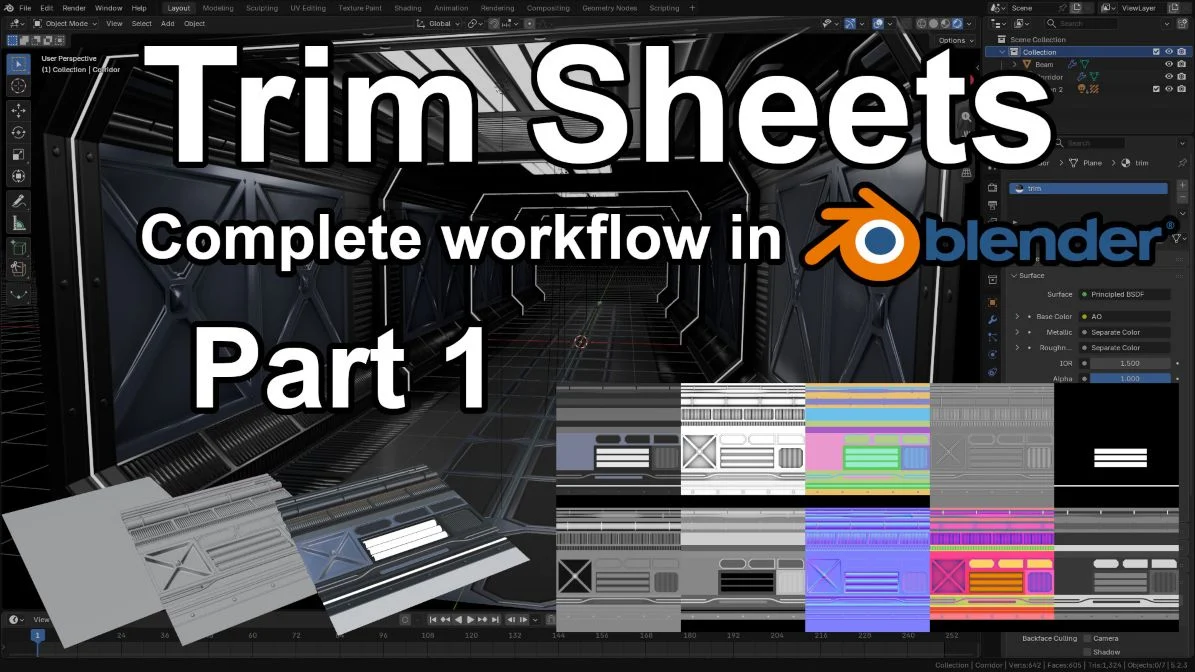
The burgeoning field of real-time 3D asset creation for video games is witnessing a significant development with the release of a new tutorial series by Filip Rachůnek, aiming to demystify and streamline the process of building game-ready assets within the powerful Blender software. This inaugural video, titled "Trim Sheets: The Complete Workflow in Blender, Part 1 (The Introduction)," serves as a foundational entry, meticulously detailing the creation and application of trim sheets—a crucial technique for efficient texturing and optimization in modern game development. The release, dated November 14, 2026, by Community Reporter, signals a growing commitment within the Blender community to share advanced workflows for professional game asset pipelines.
Unveiling the Power of Trim Sheets
Trim sheets, in essence, are a collection of textures tiled together onto a single image file. This technique allows artists to efficiently texture multiple parts of a 3D model by UV unwrapping different elements of the model and assigning them to corresponding sections of the trim sheet. The primary advantage lies in optimization; instead of each model having its own unique texture set, multiple models or multiple parts of a single complex model can share a single texture. This drastically reduces the number of draw calls required by a game engine, a critical factor in maintaining smooth performance, especially on consoles and mobile devices where hardware resources are often constrained.
Rachůnek’s video provides a comprehensive overview, moving beyond a superficial demonstration to offer a deep dive into the practicalities of this workflow. The tutorial begins by establishing the fundamental concept of trim sheets and their indispensable role in game development. It then proceeds to illustrate how these texture atlases can be effectively applied to low-poly models, a common practice in game asset creation to balance visual fidelity with performance requirements. The visual demonstration, embedded within the article, showcases the step-by-step process, offering viewers a tangible understanding of the techniques involved. The accompanying thumbnail image, a visually striking example of a trim sheet, further emphasizes the artistic and technical sophistication that can be achieved with this method.
The Genesis of a New Series: Addressing a Community Need
The introduction of this series is not an isolated event but rather a response to a persistent demand within the 3D art and game development communities. As game development continues its relentless march towards increasingly sophisticated visuals and expansive open worlds, the need for efficient and scalable asset creation pipelines becomes paramount. While Blender has long been a powerful tool for 3D modeling and animation, its application in professional game development workflows, particularly concerning real-time rendering and optimization, has seen a significant surge in recent years.
Filip Rachůnek, a recognized contributor to the Blender community, has evidently identified a gap in readily accessible, in-depth tutorials that bridge the often-complex transition from general 3D modeling to specialized game asset pipelines. This series aims to fill that void, providing aspiring and established game artists with the knowledge and practical skills to leverage Blender’s full potential for creating high-quality, performant game assets. The choice to focus on trim sheets in the inaugural video is strategic, as it represents one of the most fundamental and impactful optimization techniques employed in the industry.
A Timeline of Innovation in Game Asset Creation
The concept of texture atlasing, of which trim sheets are a direct descendant, has been a cornerstone of real-time graphics for decades. Early 3D games, with their extremely limited computational power, relied heavily on such techniques to render complex scenes. The evolution of graphics hardware and rendering techniques has allowed for more detailed textures and more complex shader effects, but the core principle of optimizing texture usage remains vital.
- Early 1990s: The advent of 3D graphics in games saw rudimentary forms of texture atlasing, often involving manual texture mapping and limited color palettes.
- Late 1990s – Early 2000s: As hardware improved, the practice of combining multiple small textures into larger atlases became more prevalent. This reduced memory overhead and improved loading times.
- Mid-2000s onwards: With the rise of sophisticated game engines like Unreal Engine and Unity, and the increasing complexity of game worlds, techniques like trim sheets, normal map baking, and PBR (Physically Based Rendering) workflows became industry standards. This period saw a greater emphasis on optimizing workflows to create visually stunning assets that also performed exceptionally well.
- 2010s – Present: The widespread adoption of Blender as a professional tool in game development, coupled with advancements in GPU technology, has fueled a demand for advanced tutorials and best practices. Developers and artists are continuously seeking efficient ways to create and manage large numbers of assets for increasingly demanding platforms. Rachůnek’s series arrives at a time when this demand is at its peak, offering a timely and relevant contribution to the field.
Supporting Data and Industry Relevance
The impact of efficient texturing on game performance cannot be overstated. Industry benchmarks and developer insights consistently highlight the importance of reducing draw calls and texture memory.
- Draw Calls: Each object that needs to be rendered by the GPU requires a draw call. By sharing textures across multiple objects, a single draw call can be used to render many elements that would otherwise require individual calls. This can lead to significant performance gains, sometimes in the order of tens or even hundreds of percent, depending on the complexity of the scene.
- Texture Memory: High-resolution textures consume substantial amounts of VRAM (Video Random Access Memory). Trim sheets allow artists to consolidate multiple texture maps into a single, larger texture. While the overall texture data might be similar, the ability to reuse that data across many models means that the total amount of unique texture memory required by the game can be drastically reduced. This is particularly crucial for platforms with limited VRAM, such as current-generation consoles and mobile devices.
- Asset Reusability: The discipline of creating trim sheets encourages modular design principles. Artists are incentivized to create reusable texture elements that can be applied to a wide variety of game assets, from architectural elements and props to character details. This not only aids in performance but also accelerates the asset creation process, allowing teams to populate game worlds more rapidly.
- Industry Adoption: Major game development studios worldwide employ trim sheet workflows as a standard practice. Titles known for their detailed environments and strong performance, such as many AAA open-world games, rely heavily on these optimization techniques. The principles taught in Rachůnek’s series are directly applicable to creating assets for these high-profile projects.
Analysis of Implications: Empowering a New Generation of Game Artists
The introduction of this comprehensive trim sheet workflow tutorial by Filip Rachůnek has several significant implications for the Blender and game development communities:
- Democratization of Advanced Techniques: By providing free, high-quality educational content, Rachůnek is making sophisticated game development techniques accessible to a broader audience. This empowers independent developers, smaller studios, and aspiring artists who may not have the resources to attend expensive specialized training.
- Elevating Blender’s Standing in Game Development: As Blender continues to gain traction as a viable alternative to proprietary software in the game industry, tutorials like this reinforce its capabilities. They showcase how Blender can be seamlessly integrated into professional game asset pipelines, potentially attracting more studios to adopt the software.
- Fostering a Culture of Optimization: The emphasis on trim sheets inherently promotes a mindset of efficiency and optimization. This is a crucial skill for any game developer, as performance is often as important as visual fidelity in delivering a successful game. By teaching these principles early, the series helps to cultivate a generation of artists who understand the balance between aesthetics and technical constraints.
- Potential for Future Series: The success of this initial video could pave the way for further installments exploring other critical aspects of game asset creation in Blender, such as hard-surface modeling, retopology, UV unwrapping strategies, baking normal maps, and PBR material creation. This would create a valuable, cohesive resource for anyone looking to master Blender for game development.
While specific statements from industry leaders or official responses from game development studios regarding this particular tutorial are not available at this time, the general sentiment within the game development community is one of appreciation for well-produced, practical educational content. The availability of such resources directly addresses the ongoing need for skilled artists who can navigate the technical demands of modern game development. The implications of this series are far-reaching, promising to equip a new wave of creators with the essential tools and knowledge to build the visually stunning and performant games of the future.
About the Author