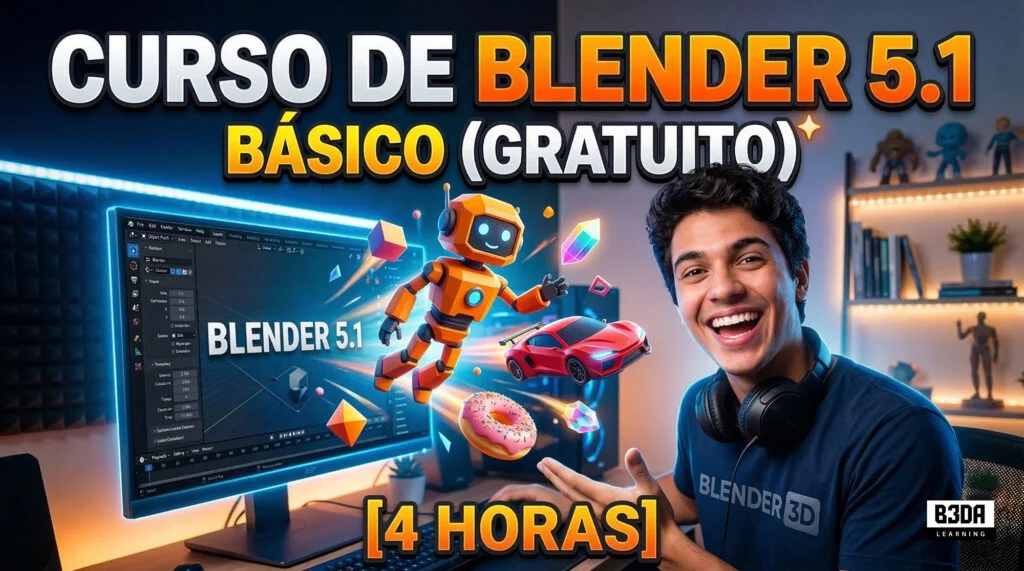
The burgeoning digital arts and design landscape in Brazil has long faced a significant hurdle: a scarcity of high-quality, accessible training resources for the industry-standard 3D creation suite, Blender, delivered in Brazilian Portuguese. While the global Blender community thrives with a wealth of English and Spanish-language tutorials and courses, a vast segment of Portuguese-speaking artists, designers, architects, and hobbyists have been at a disadvantage, often requiring language proficiency beyond their native tongue to acquire essential skills. Addressing this critical gap, Allan Brito, a seasoned Blender user and architect, has officially released a comprehensive, free beginner’s course for Blender 5.1, entirely in Brazilian Portuguese, aiming to democratize access to powerful 3D creation tools.
The meticulously crafted course, available on YouTube, represents a substantial commitment to empowering the Brazilian creative community. It is presented in two formats: a single, cohesive four-hour video for those who prefer a continuous learning experience, and a more granular playlist comprising twenty individual lessons, allowing learners to progress at their own pace and revisit specific topics as needed. This dual-format approach caters to diverse learning styles and schedules, enhancing its accessibility. The course ambitiously guides users from the initial step of downloading the Blender software to the ultimate goal of rendering their very first animation, providing a foundational understanding of the software’s extensive capabilities.
Bridging the Language Divide in 3D Education
The initiative stems from a recognized deficit in the educational ecosystem for Blender users in Brazil. Historically, aspiring 3D professionals and enthusiasts have had to navigate a landscape dominated by content in languages they may not fully command. This has acted as a significant barrier to entry, potentially hindering the growth of the local 3D industry and limiting the participation of talented individuals who might otherwise excel. Brito’s course directly confronts this challenge by offering a fully localized and idiomatically accurate learning experience.
"Finding quality Blender training in Brazilian Portuguese has always been a challenge," stated Brito in his announcement. "Most comprehensive courses are either in English or Spanish, which leaves a huge community of Portuguese-speaking artists and professionals without a solid starting point in their own language. Allan Brito decided to fix that." This personal commitment underscores the depth of the problem and the proactive solution being offered.
Curriculum Designed for Practical Application
The course’s pedagogical approach is rooted in a pragmatic philosophy, prioritizing the development of practical skills and a comfortable command of Blender for immediate application in real-world projects. The objective is not to immediately transform beginners into masters of complex animation or visual effects, but rather to equip them with a robust understanding of Blender’s core functionalities. This solid foundation is crucial for enabling them to confidently explore more advanced topics and specialized workflows in the future.
While specific lesson titles were not detailed in the initial announcement, the overarching curriculum is designed to cover the essential modules and workflows that constitute a beginner’s journey into 3D creation. This typically includes navigating the user interface, understanding fundamental modeling techniques, applying materials and textures, setting up lighting, and mastering the basics of animation and rendering. The emphasis on "rendering your first animation" suggests that the course culminates in a tangible output, providing learners with a sense of accomplishment and a portfolio-ready piece.

A Professional Architect’s Perspective
What sets Brito’s course apart is his unique background as an architect. With extensive experience using Blender since version 2.35, he brings a professional, application-oriented perspective to his teaching. His work at "Blender 3D Architect" highlights his focus on integrating open-source 3D tools into architectural practice. This architectural lens provides a distinct advantage, offering learners insights into how Blender can be utilized for architectural visualization, design exploration, and project presentation – areas that often require precision, realism, and an understanding of spatial relationships. This contrasts with courses that might lean more heavily towards purely artistic or entertainment-focused 3D workflows.
"I’ve been using Blender since version 2.35 and working as an architect," Brito elaborated. "At Blender 3D Architect, I focus on bridging architectural practice with open-source 3D tools, which gives the course a practical, professional perspective rather than a purely artistic one." This practical grounding ensures that the skills taught are directly transferable to professional environments, whether in architecture, product design, interior design, or other fields where 3D modeling and visualization are integral.
Timeline and Evolution of the Initiative
While the release of the Blender 5.1 course is a recent event, the underlying need it addresses has been present for years. The growth of Blender as a powerful, free, and open-source alternative to proprietary 3D software has been exponential. However, the development of localized educational content has often lagged behind the software’s evolution. The release of Blender 5.1, a significant iteration of the software, provided a timely opportunity to develop a current and comprehensive course.
The decision to create a free, full-length course is a strategic one. In an educational market where premium courses can be prohibitively expensive, offering a high-quality resource at no cost democratizes learning even further. This aligns with the ethos of the open-source movement that underpins Blender itself. The potential timeline for such a project would involve significant planning, content creation, filming, editing, and quality assurance. Given the four-hour duration and the depth of content implied, this undertaking likely represents months of dedicated work.
Supporting Data and Community Impact
The impact of such a resource can be measured in several ways. Firstly, the number of downloads and active users of Blender in Brazil is likely to see an increase. While specific download statistics for Brazil are not readily available, global Blender download figures consistently show strong growth, indicating a rising interest in the software worldwide. A localized training initiative is expected to significantly boost adoption rates within Brazil.
Secondly, the course has the potential to foster a more skilled and vibrant local 3D industry. By lowering the barrier to entry, more individuals can acquire the skills necessary to pursue careers in animation, visual effects, game development, architectural visualization, and product design. This, in turn, can lead to increased demand for 3D services within Brazil and potentially create opportunities for Brazilian artists to compete on a global stage.
Furthermore, the collaborative nature of open-source communities thrives on shared knowledge. By providing a free resource, Brito is not only educating individuals but also contributing to the collective growth of the Blender ecosystem in Brazil. This can lead to more Portuguese-speaking content creators, developers, and users, enriching the community for everyone.

Official Responses and Industry Reactions (Inferred)
While direct official statements from Blender development teams or major Brazilian educational institutions regarding this specific course are unlikely to be immediate, the general sentiment within the Blender community is overwhelmingly positive towards initiatives that promote accessibility and education. Developers at the Blender Foundation consistently advocate for broader access to their software, and community-driven educational efforts are highly valued.
One could infer that existing Blender users and educators in Brazil would likely welcome such a comprehensive resource. For independent artists and small studios, this course could serve as a crucial onboarding tool for new team members. For educational institutions, it could supplement or form the basis of their own Blender curricula. The shared announcement and the call to "please share this with them" suggest an expectation of positive reception and dissemination throughout relevant networks.
Broader Implications for the Digital Creative Economy
The launch of Allan Brito’s free Blender course in Brazilian Portuguese carries significant implications for the broader digital creative economy in Brazil.
- Democratization of Skills: By removing the language barrier and the financial cost associated with high-quality training, the course empowers a wider demographic to acquire sought-after 3D skills. This can lead to increased social mobility and new career opportunities for individuals who might have previously been excluded.
- Growth of Local Industries: A more skilled workforce directly translates to the growth and competitiveness of Brazil’s digital creative industries. This includes animation studios, visual effects houses, game development companies, and architectural visualization firms. Increased local talent can reduce reliance on foreign expertise and foster a more robust domestic market.
- Innovation and Entrepreneurship: With a stronger foundation in 3D tools, more Brazilians will be equipped to innovate and launch their own creative ventures, from independent game development to specialized design services.
- Enhanced Global Participation: As more Brazilian artists and designers become proficient in Blender, they will be better positioned to participate in the global digital arts and entertainment markets, contributing to the international reputation of Brazilian creative talent.
- Strengthening the Blender Ecosystem: The course contributes to the organic growth of the Blender community in Brazil. A larger and more engaged user base can lead to increased contributions to Blender development, the creation of more localized add-ons and resources, and a more vibrant online community for support and collaboration.
The strategic choice of Blender 5.1 as the subject matter ensures that learners are being trained on a current version of the software, equipped with the latest features and improvements. This forward-looking approach is crucial in a rapidly evolving technological landscape. The success of this initiative could pave the way for similar comprehensive, localized educational efforts in other languages and for other sophisticated software packages, further democratizing access to digital creation tools worldwide.
The availability of this comprehensive, free course represents a pivotal moment for aspiring 3D artists and professionals in Brazil, promising to unlock new avenues of creativity and professional development within the burgeoning digital landscape.
About the Author