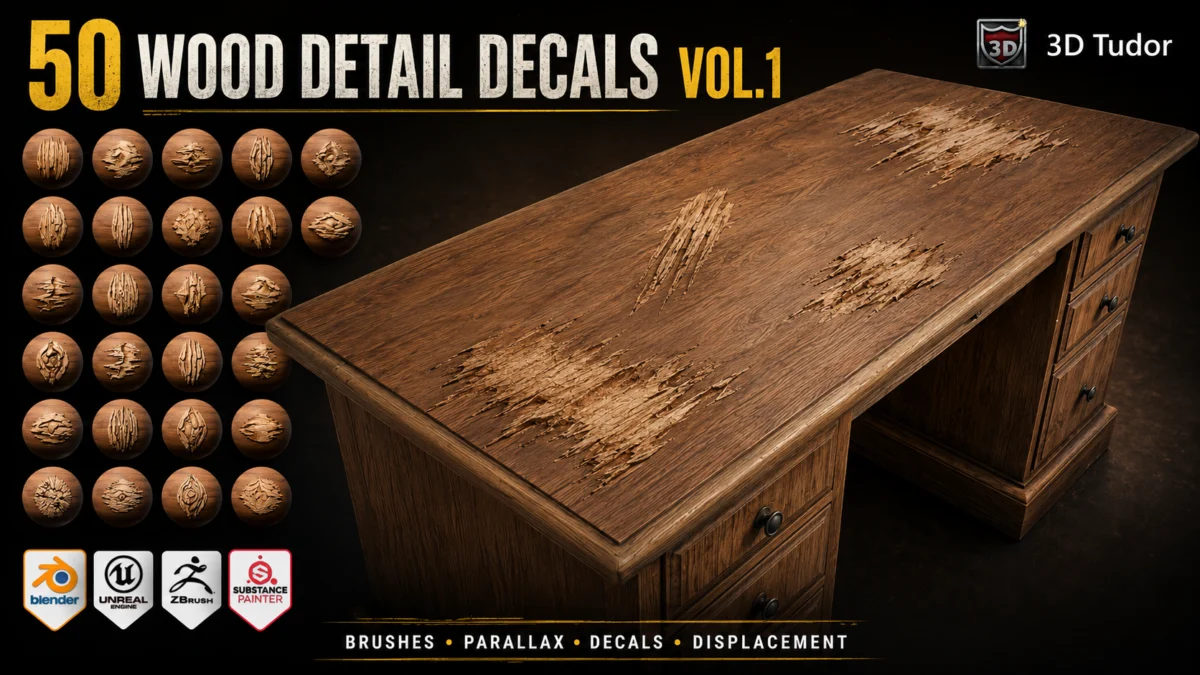
A new resource for 3D artists, the "WoodDetail Decal Pack Vol.1," has been released by 3D Tudor, offering a comprehensive collection of 50 distinct wood surface detail designs. These assets are engineered for a wide array of applications across popular 3D software and game engines, including Blender, Substance Painter, Unreal Engine 5, and ZBrush. The pack aims to address a common challenge in 3D asset creation: achieving believable and finished wooden surfaces that go beyond basic geometry and texturing.
Addressing the "Unfinished" Aesthetic in 3D Wood Assets
The creation of wooden assets, ranging from structural elements like beams and cabin walls to decorative items such as barrels and market stalls, is a foundational aspect of building immersive environments, particularly within the fantasy, RPG, and stylized genres. While achieving the correct form, foundational material properties, and effective lighting are critical initial steps, the surface treatment often determines the final perceived quality of a wooden object. A common pitfall identified by 3D Tudor is the tendency for wooden assets to appear sterile or incomplete if surface imperfections, character, and age are not adequately represented.
"A wooden beam without knots, splits, grain changes, plank seams, worn edges, bark detail, or weathered marks can look like it has just been installed by a very enthusiastic fantasy carpenter," states Neil, the creator behind 3D Tudor, highlighting the problem this new pack seeks to solve. The "WoodDetail Decal Pack Vol.1" is specifically designed to bridge this gap, providing artists with the tools to imbue their wooden creations with the nuances that convey history, wear, and natural characteristics.
A Multifaceted Toolkit for Diverse Workflow Needs
The core offering of the "WoodDetail Decal Pack Vol.1" is its versatility, providing 50 unique wood detail designs that can be deployed in multiple ways. These include:
- Decals: Flat or projected images that can be applied to surfaces to add immediate visual information without altering the underlying mesh. This is ideal for quick environmental dressing and adding detail to background elements.
- Parallax Surface Details: Utilizing shader-driven techniques, parallax mapping creates an illusion of depth without the need for additional geometry. This is positioned as a solution for mid-range assets where flat decals might be too simplistic, but full displacement is computationally expensive.
- Real Displacement: For high-fidelity close-up renders, particularly within Blender’s Cycles renderer, this workflow allows the wood details to contribute to the actual geometry of the surface, providing tangible relief and physical presence.
- Sculpt Brushes: Integrated into Blender, these brushes allow artists to directly sculpt the wood details onto their meshes. This method is particularly useful for creating unique surface imperfections and can be baked into normal maps for game assets.
- Substance Painter Stencils: Designed for use within Substance Painter’s texturing workflow, these stencils enable artists to paint detailed wood features directly onto their models, facilitating a highly iterative and flexible texturing process.
- Unreal Engine Deferred Decals: Optimized for integration into Unreal Engine 5, these decals can be dynamically placed and managed within the game engine’s rendering pipeline.
- ZBrush Alpha Brushes: For sculptors working in ZBrush, these alpha brushes provide a direct way to stamp detailed wood textures onto high-resolution models, a crucial step in creating detailed assets for baking and further refinement.
Shot-Distance Flexibility: A Key Design Principle
A significant design consideration behind the "WoodDetail Decal Pack Vol.1" is "shot-distance flexibility." This principle acknowledges that not all wooden elements in a scene require the same level of detail or the same treatment. For instance, a distant fence in a game environment will have different fidelity requirements compared to a hero prop intended for a cinematic close-up. By offering multiple application methods, the pack empowers artists to tailor their approach based on the asset’s intended viewing distance and its role within the scene, optimizing performance and visual fidelity.
This flexible approach is structured around four primary use-modes:
- Quick Environment Dressing (Decals): For rapidly populating scenes with believable wooden elements, flat alpha-cut decals are the most efficient. They can be applied to walls, beams, fences, stalls, doors, and planks without modifying the base mesh, significantly speeding up the scene assembly process.
- Mid-Shot Assets (Parallax): When a flat decal lacks sufficient depth but full geometric subdivision is not feasible, parallax mapping offers a shader-based solution. This technique provides a convincing sense of depth, making assets appear more substantial without increasing polygon counts.
- Hero Close-Ups (Real Displacement): For assets that will be viewed at very close range, such as in portfolio pieces or cinematic sequences rendered in Blender Cycles, real displacement is essential. This workflow ensures that the surface details have genuine physical relief, contributing to a highly realistic and tactile appearance.
- Sculpting Workflows (Sculpt/Alpha Brushes): The inclusion of Blender sculpt brushes and ZBrush alpha brushes caters to artists who prefer a more direct, mesh-based approach to detail creation. This method allows for the integration of wood imperfections directly into the model’s geometry, which is particularly beneficial for assets intended for real-time applications where details are often baked into normal maps.
A Unified Design Library Across Production Stages
The "WoodDetail Decal Pack Vol.1" is designed to be a cohesive resource that can accompany an asset throughout its production lifecycle. Artists are not mandated to utilize every software integration. Instead, the pack’s strength lies in the ability for the same set of wood detail designs to be adapted and used across different stages of development and within various software environments. This continuity ensures that the artistic vision for the wood’s surface characteristics remains consistent, regardless of the tools employed.
Stylized Realism: Targeting a Specific Aesthetic
3D Tudor explicitly positions this pack as catering to "stylized realism" rather than photogrammetry. This means the details are not intended to be direct 3D scans of real-world wood. Instead, the 50 designs are crafted to be clear, readable, and effective at typical game and portfolio viewing distances, while harmonizing well with hand-painted textures, stylized PBR workflows, and broader fantasy environment art styles. This approach allows for artistic interpretation and control, ensuring the wood details enhance the overall aesthetic rather than strictly mimicking reality.
The pack’s applicability is broad, with Neil suggesting it would be particularly effective for:
- Fantasy villages and settlements
- Tavern interiors and exteriors
- Cabin construction and detailing
- Barrel and crate modeling
- Bridge and boardwalk designs
- Plank walls and fencing
- Market stall structures
- RPG-centric environments
- Hero props requiring significant surface detail
- Portfolio showcase scenes
- Cinematic close-up renders
- Game-ready asset detailing
Strategic Application for Enhanced Storytelling
The optimal time to integrate these wood details, according to 3D Tudor, is after the foundational modeling and primary texturing stages are complete. This "final surface detail pass" is where the asset’s narrative is truly brought to life. By strategically applying details like seams to break up uniform planks, knots to add character to beams, splits along edges for a sense of damage, or bark textures on exposed timbers, artists can imbue their creations with a history and believability that elevates them beyond mere geometric representations. This method ensures that each detail serves a purpose, contributing to the overall story of the asset without creating unnecessary geometric complexity.
Technical Considerations and Rendering Compatibility
The pack’s primary showcase renderer is Cycles, particularly for the real displacement workflow, which leverages its advanced ray-tracing capabilities for accurate lighting and surface interaction. However, for decal, parallax, and sculpt-brush applications, compatibility extends to EEVEE, Blender’s real-time rendering engine, offering a more immediate feedback loop for certain workflows.
The "WoodDetail Decal Pack Vol.1" is currently available for purchase on Gumroad, with a preview video also accessible to showcase the pack’s features and potential applications.
Broader Implications for 3D Content Creation
The release of specialized asset packs like the "WoodDetail Decal Pack Vol.1" reflects a growing trend in the 3D art industry towards providing modular, versatile tools that streamline complex workflows. For independent artists and smaller studios, such resources can significantly reduce development time and cost, allowing them to achieve higher production values. The emphasis on shot-distance flexibility also aligns with the demands of modern game development and real-time rendering, where efficient asset creation without compromising visual fidelity is paramount.
Furthermore, the pack’s focus on stylized realism provides artists with a framework for developing unique artistic styles. By offering a curated set of details, 3D Tudor empowers artists to experiment and push creative boundaries within established aesthetic genres. The ability to transition these details across different software platforms also underscores the increasing interoperability and collaborative potential within the digital art pipeline. As 3D environments become more detailed and immersive, the demand for high-quality, easily implementable surface detailing solutions is likely to continue to grow, making resources like this pack valuable assets for a wide range of creative professionals.
About the Author