The landscape of modern video game development is constantly evolving, with increasing demands for realism, complexity, and player immersion. A cornerstone of this evolution is sophisticated Artificial Intelligence (AI) that governs the behavior of non-player characters (NPCs) and adversaries. In a significant development for game creators, Unreal Engine 5 (UE5), Epic Games’ flagship development platform, has streamlined the process of implementing fundamental AI functionalities, such as characters chasing or following a player, to an extent that dramatically lowers the barrier to entry for developers of all scales. This enhancement, primarily driven by UE5’s intuitive Blueprint visual scripting system, allows for the creation of dynamic AI behaviors with just a handful of nodes, marking a pivotal moment in accessible game design.
The ability for AI characters to intelligently pursue a player is not merely a cosmetic feature; it is fundamental to countless game genres, from survival horror and action-adventure to role-playing games and simulations. Historically, implementing robust AI pathfinding and pursuit logic required extensive coding in languages like C++, often demanding specialized AI programming expertise. This often posed a significant challenge for independent developers and smaller studios with limited resources, forcing them to either simplify AI behaviors or invest heavily in a specialized workforce. Unreal Engine 5’s latest refinements, however, address this challenge head-on by integrating advanced AI functionalities into its visual scripting paradigm, making complex interactions surprisingly straightforward to configure.
The Evolution of Game AI and Unreal Engine’s Role

The journey of AI in video games has seen remarkable advancements, from the rudimentary pattern-based movements of early arcade games to the complex decision-making algorithms seen in today’s AAA titles. Early game AI often relied on simple state machines, where characters would switch between predefined behaviors (e.g., "patrol," "attack," "flee") based on direct triggers. As hardware capabilities grew, so did the sophistication of AI, incorporating pathfinding algorithms like A* search, behavioral trees, and more recently, utility-based AI and even machine learning techniques.
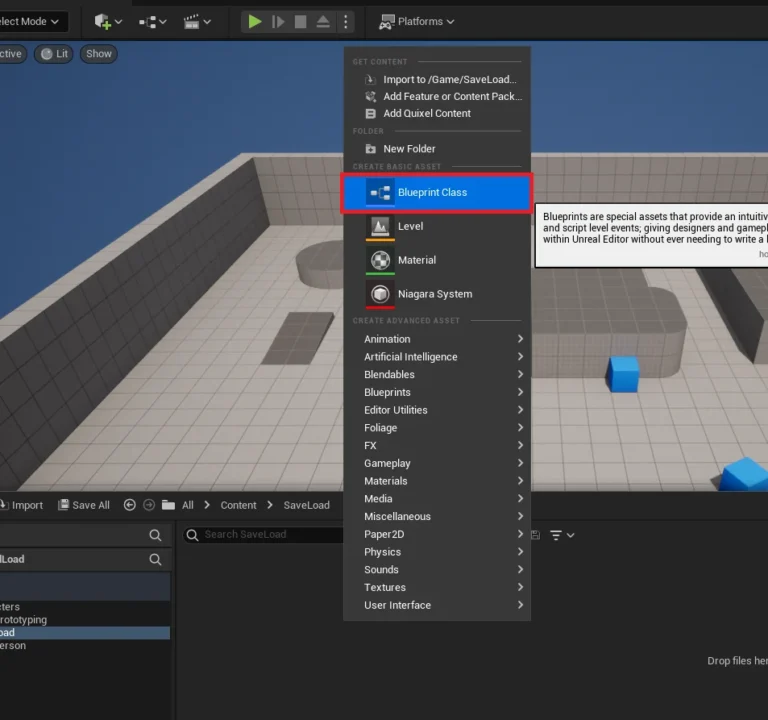
Unreal Engine, developed by Epic Games, has consistently been at the forefront of this evolution, providing developers with powerful tools to craft immersive experiences. Its robust rendering capabilities, physics engine, and comprehensive suite of development tools have made it a preferred choice for both indie creators and large studios. A key differentiator for Unreal Engine, particularly since UE4 and now refined in UE5, is its Blueprint visual scripting system. Blueprints allow developers to create gameplay elements, UI, and complex logic using a node-based interface, eliminating the need to write lines of code. This graphical approach democratizes game development, enabling designers, artists, and even those with limited programming backgrounds to contribute directly to game mechanics.
The integration of AI features into the Blueprint system exemplifies Epic Games’ commitment to accessibility without compromising power. The previous iteration of Unreal Engine already provided foundational AI tools, including NavMeshes (navigation meshes) which define walkable areas for AI, and basic movement commands. The current developments in UE5 build upon this, making the "AI following" behavior a prime example of how these tools can be combined with remarkable simplicity.
Simplified AI Pursuit: A Technical Insight into UE5 Blueprints
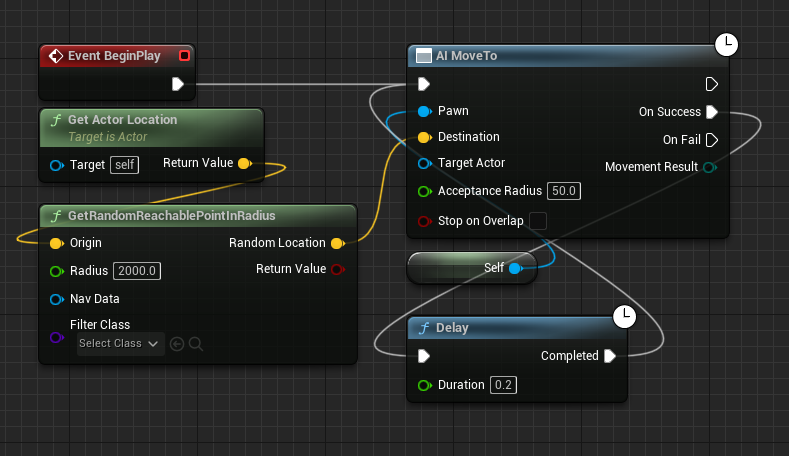
The core mechanism for enabling AI characters to chase players in Unreal Engine 5 leverages a combination of existing navigation tools and new, intuitive Blueprint nodes. The process, as demonstrated in recent developer guides, involves a streamlined approach to pathfinding and target acquisition.
The foundation for any intelligent AI movement within Unreal Engine is the NavMesh. A NavMesh acts as a navigable surface that AI characters can traverse, automatically calculating optimal paths while avoiding obstacles. Assuming a properly configured NavMesh is in place—a prerequisite for any sophisticated AI movement—the implementation of player-following AI becomes remarkably efficient.
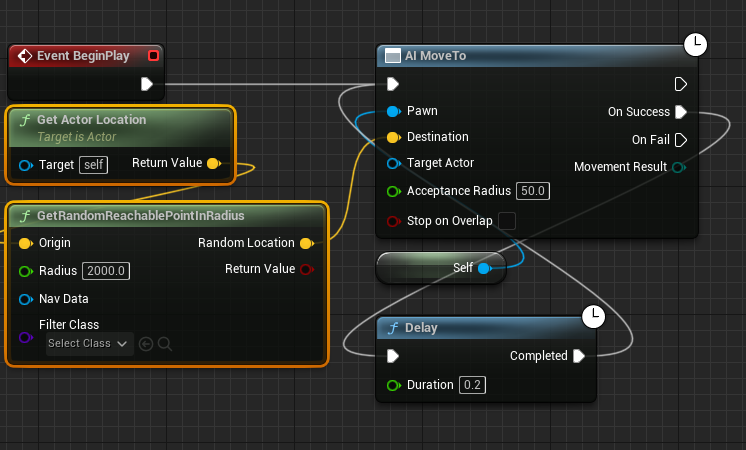
Developers typically begin with an existing AI movement script, which might involve simple patrolling or moving to random points. To transition this into player-following behavior, certain nodes within the Blueprint graph are modified. Specifically, nodes responsible for determining a random target location, such as "Get Actor Location" (when used to determine a random point) and "GetRandomReachablePointInRadius," are removed. These nodes, designed for non-player-specific movement, are replaced with logic that explicitly targets the player character.

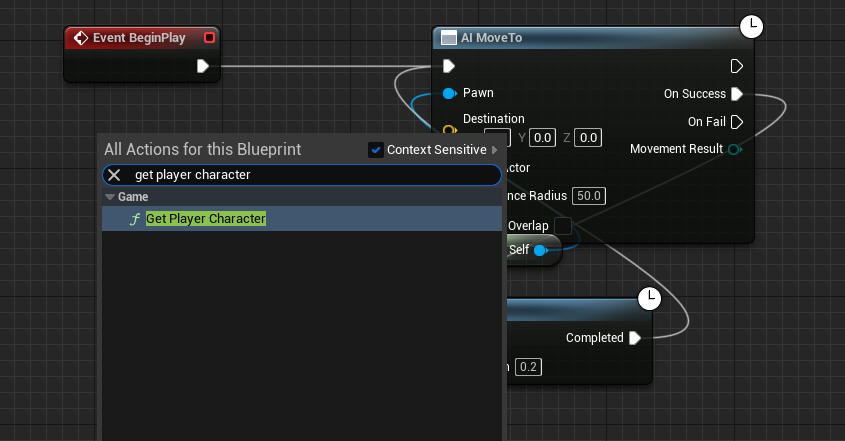
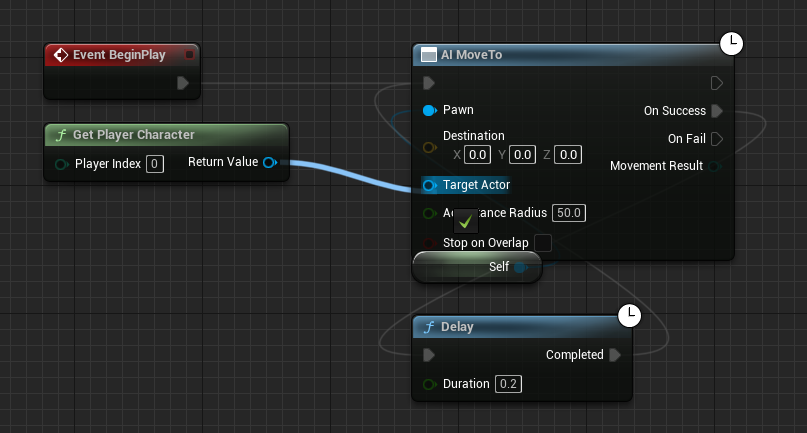
The crucial addition is the "Get Player Character" node. This node provides a direct reference to the player-controlled character in the game world. Its "Return Value" pin, which outputs a reference to the player actor, is then connected to the "Target Actor" pin of the "AI MoveTo" node. The "AI MoveTo" node is the primary component responsible for commanding an AI character to navigate to a specific location or target actor using the underlying NavMesh system. By linking the "Get Player Character" node to "AI MoveTo," the AI is instructed to continuously pathfind and move towards the player’s current position.
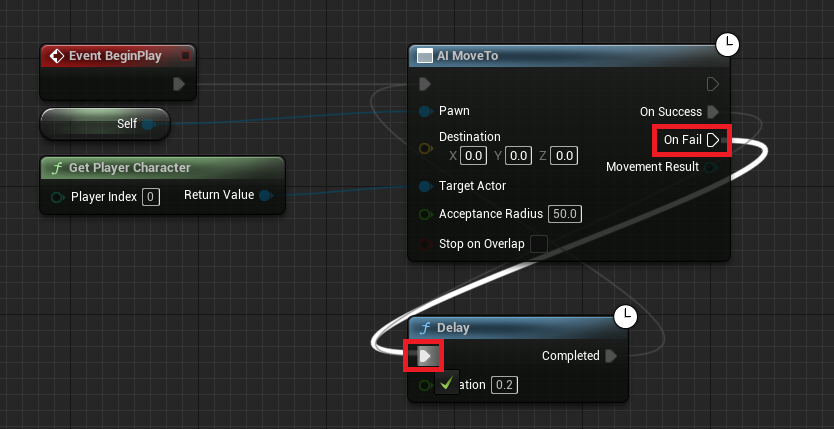
A critical aspect of robust AI design is handling potential failures in movement. In dynamic game environments, players can move into areas temporarily unreachable by the AI (e.g., across a gap the AI cannot jump, or through a door that closes). To ensure the AI’s persistence in chasing the player, the "On Fail" execution pin of the "AI MoveTo" node is connected back to a "Delay" node, which then loops back to re-initiate the "AI MoveTo" command. This creates a resilient system where if the AI momentarily fails to reach the player due to an obstruction or an unnavigable path segment, it doesn’t give up. Instead, after a brief delay, it re-evaluates the player’s position and attempts to pathfind again, ensuring relentless pursuit. This simple yet powerful feedback loop is vital for creating believable and challenging AI encounters.
Finally, ensuring these changes are applied requires the developer to "Compile" and "Save" the Blueprint, a standard procedure in Unreal Engine development. The entire process, from modification to testing, can be completed in minutes, showcasing the efficiency of UE5’s design philosophy.
Implications for Game Development and Industry Trends
This simplification of AI pathfinding has profound implications across the game development industry:
-
Democratization of Development: For independent developers and smaller studios, this ease of implementation means they can now integrate sophisticated AI behaviors into their games without requiring extensive programming expertise or dedicated AI specialists. This levels the playing field, allowing smaller teams to compete with larger studios in terms of gameplay depth and AI complexity. It lowers the barrier to entry, fostering innovation and diversity in game creation.
-
Accelerated Prototyping and Iteration: Even for large AAA studios, the ability to quickly implement and test core AI behaviors using Blueprints significantly accelerates the prototyping phase. Designers can rapidly iterate on enemy behaviors, companion logic, and chase sequences, receiving immediate feedback without waiting for C++ programmers to implement every change. This frees up highly specialized C++ developers to focus on more complex, bespoke AI systems or performance-critical optimizations.
-
Enhanced Player Immersion and Engagement: The direct impact on players is a more dynamic and believable game world. AI characters that consistently and intelligently follow or chase the player contribute significantly to immersion, whether it’s a relentless horror antagonist, a loyal companion, or a persistent enemy. This creates more challenging, unpredictable, and ultimately more engaging gameplay experiences. The feeling of being truly hunted, or having a reliable escort, adds layers of strategic depth and emotional connection.
-
Fueling Creative Design: With the technical hurdle significantly reduced, designers are empowered to experiment more freely with AI behaviors. This could lead to novel gameplay mechanics where AI following is integrated into puzzles, stealth sequences, or even narrative elements in unexpected ways. For example, AI could be programmed to follow the player only under certain conditions, adding layers of psychological tension or strategic considerations.
Epic Games’ strategy with Unreal Engine has consistently been to provide powerful, production-ready tools that are also highly accessible. This philosophy is evident in their ongoing enhancements to the Blueprint system and the integration of complex functionalities into intuitive visual interfaces. This approach aligns with broader industry trends towards democratizing content creation, seen in various fields from video editing to 3D modeling. As the global gaming market continues its rapid expansion, projected to reach hundreds of billions of dollars annually, the demand for high-quality, engaging content is immense. Tools that enable more creators to meet this demand are invaluable.
Statements and Future Outlook
While Epic Games has not issued a specific press release on this particular refinement, their ongoing commitment to developer accessibility speaks volumes. As inferred from their general corporate communications and developer presentations, the emphasis remains on empowering creators: "Epic Games has consistently emphasized its commitment to providing powerful yet accessible tools, enabling creators of all sizes to realize their visions. This latest simplification of AI pathfinding within Unreal Engine 5 is a direct reflection of that philosophy, pushing the boundaries of what’s achievable for developers without requiring extensive programming expertise." This simplification of core AI mechanics is a testament to that vision.
Looking ahead, the foundation laid by these easily implementable AI features opens doors for even more sophisticated behaviors. Future updates to Unreal Engine could build upon this by introducing more advanced decision-making nodes, integrated machine learning capabilities for adaptive AI, or even more nuanced behavioral parameters directly within Blueprint. While the fundamental "chase" mechanic is now simplified, the art of creating truly compelling AI still requires careful design considerations regarding evasion, flanking maneuvers, emotional responses, and complex multi-AI interactions. However, by abstracting away the low-level pathfinding complexities, Unreal Engine 5 allows developers to dedicate more creative energy to these higher-level design challenges.
In conclusion, Unreal Engine 5’s streamlined approach to AI character following represents a significant stride in game development accessibility. By transforming a once technically demanding task into a simple Blueprint configuration, Epic Games has not only empowered a wider range of creators but also set a new benchmark for how game engines facilitate the creation of dynamic, immersive, and believable virtual worlds. This development is poised to foster greater innovation, lead to richer gameplay experiences, and ultimately shape the future of interactive entertainment.
About the Author