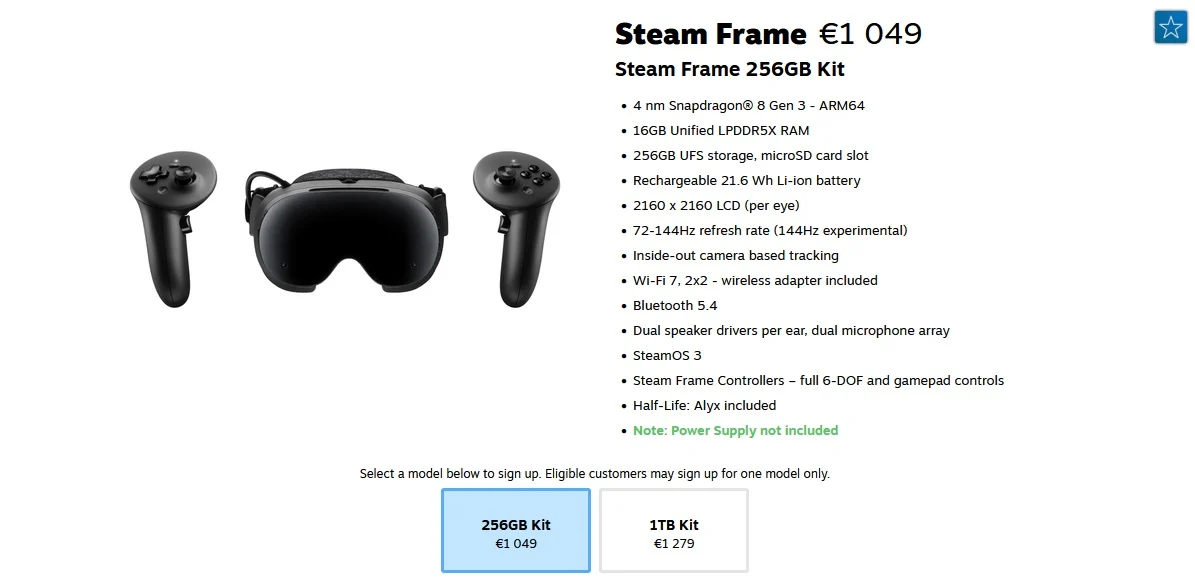
Valve Corporation has officially unveiled its latest entry into the extended reality hardware market, the Steam Frame, a high-end standalone virtual reality (VR) headset designed to bridge the gap between portable convenience and enthusiast-grade performance. The company confirmed that the Steam Frame will be available in two primary configurations: a standard 256GB model priced at $1,059 (€1,049) and a high-capacity 1TB version retailing for $1,299 (€1,279). Despite the difference in internal storage capacity and price, Valve has emphasized that both units share identical internal hardware specifications, ensuring a consistent performance profile across the product line.
The announcement marks a significant pivot for Valve, moving away from the tethered architecture of the 2019 Valve Index toward a self-contained, ARM-based ecosystem. This strategic shift follows the massive commercial and critical success of the Steam Deck, Valve’s handheld gaming computer, which demonstrated the company’s ability to optimize complex gaming experiences for mobile architectures.
Technical Architecture and the Standalone Port of Half-Life: Alyx
A central pillar of the Steam Frame launch is the inclusion of Half-Life: Alyx with every purchase. While the title was originally the flagship exclusive for high-end PCVR systems, Valve has confirmed that the version bundled with the Steam Frame is a native 64-bit ARM build. This version has been specifically re-engineered and optimized to run natively on the headset’s mobile chipset without the need for a wireless link to a secondary PC.
Industry analysts suggest that the porting of Half-Life: Alyx to an ARM architecture represents a major technical milestone for the VR industry. The original game was renowned for its high fidelity, complex physics engine, and detailed environments—features that typically require the graphical processing power of a dedicated desktop GPU. By successfully optimizing this title for a standalone headset, Valve has signaled a new era of graphical capability for mobile VR, potentially narrowing the visual gap between mobile and tethered experiences.

Modular Design and Third-Party Integration
In a departure from the "closed-box" design philosophy seen in many competing standalone headsets, the Steam Frame appears to embrace a modular accessory ecosystem. Valve has released a comprehensive list of first-party and certified third-party accessories intended to expand the headset’s functionality.
Among the most notable additions is a high-performance color passthrough camera module developed by Arcturus Vision. Priced at approximately €157, the module is designed to be "hot-plugged" into the headset, immediately enabling high-fidelity Mixed Reality (MR) capabilities. While the base Steam Frame provides standard tracking and navigation sensors, the Arcturus Vision add-on is marketed toward users interested in professional-grade MR applications and gaming.
Early technical demonstrations of the Arcturus Vision module indicate a significant improvement in visual clarity and latency compared to standard integrated passthrough solutions. Several popular VR titles, including the spatial puzzle game Cubism, the 3D jigsaw experience Puzzling Places, and the productivity tool Table Space, have already been updated to support the new hardware module at launch. This modular approach allows Valve to keep the base weight and cost of the headset lower for traditional VR users while providing a clear upgrade path for those interested in the burgeoning mixed reality sector.
Chronology of Development and Market Context
The road to the Steam Frame has been paved by years of iterative hardware development at Valve’s headquarters in Bellevue, Washington. Following the release of the Valve Index in 2019, rumors began to circulate regarding "Project Deckard," a rumored standalone headset that would utilize the lessons learned from the Steam Deck’s development.
- June 2019: Valve releases the Index, setting a new bar for consumer VR fidelity but remaining tied to high-end PCs via cables.
- February 2022: The launch of the Steam Deck proves Valve can create a robust gaming ecosystem on a portable Linux-based platform (SteamOS).
- 2023–2025: Supply chain leaks and patent filings consistently point toward a standalone VR device utilizing a custom compute unit and advanced lens technology.
- September 14, 2026: Valve officially breaks silence, revealing the Steam Frame, its pricing tiers, and the Arcturus Vision partnership.
The Steam Frame enters a market that has seen significant cooling after the initial "Metaverse" hype of 2021 and 2022. Often referred to by industry insiders as the "VR Winter," this period has been characterized by plateauing hardware sales and a shift in focus toward enterprise applications. Valve’s entry at a premium price point suggests the company is not looking to compete directly with the mass-market pricing of the Meta Quest series, but rather to cater to the "prosumer" and hardcore enthusiast demographic that demands higher build quality and a more open software environment.

Market Positioning and Economic Implications
With a starting price of over $1,000, the Steam Frame is positioned as a premium alternative to the Meta Quest 3 and a more gaming-centric competitor to the Apple Vision Pro. While the Meta Quest 3 targets the $500 entry-level market and the Apple Vision Pro targets the $3,500 spatial computing luxury market, Valve has identified a middle ground for dedicated gamers and VR enthusiasts.
Economically, the pricing strategy reflects the high cost of the components required to run a game of Half-Life: Alyx’s caliber on a mobile chipset. High-density displays, advanced optics (likely pancake lenses), and a sophisticated cooling solution are necessary to maintain performance without the thermal throttling common in smaller mobile devices.
Valve’s decision to offer a 1TB version for a $240 premium further emphasizes the device’s role as a primary gaming machine. As standalone VR titles increase in asset density and file size, onboard storage has become a critical bottleneck for users who wish to maintain a large library of high-fidelity games without constant re-installation.
Industry Outlook and Future Prospects
The launch of the Steam Frame is expected to have a ripple effect across the VR development community. By providing a powerful ARM-based target platform, Valve is encouraging developers to optimize their PCVR titles for mobile architectures, which could lead to a broader library of high-quality standalone games.
Furthermore, the modular nature of the headset—evidenced by the Arcturus Vision camera—suggests that Valve may intend for the Steam Frame to have a longer lifecycle than its competitors. Instead of releasing a new headset every two years, Valve could potentially offer upgraded compute modules or sensor arrays that users can install themselves, mirroring the upgradeability of the traditional PC market.

While the high price tag may limit the Steam Frame’s initial adoption rates compared to more affordable consumer electronics, its arrival is viewed as a "net positive" for the industry. It signals that one of the world’s most influential gaming companies remains committed to the future of virtual reality, providing a much-needed influx of innovation and high-end hardware into an ecosystem that has recently struggled to maintain its early momentum.
As reservations open, the industry will be watching closely to see how quickly the initial stock is depleted. Given Valve’s history of supply constraints with the Index and the Steam Deck, it is anticipated that the Steam Frame will see high initial demand from the "hardcore" segment of the Steam user base, potentially leading to extended wait times for new orders throughout the coming fiscal year.
About the Author