The mobile gaming industry, currently valued at over $90 billion, is undergoing a significant transition as major publishers shift from rapid global releases toward extended soft launch periods and iterative market testing. This strategic pivot comes in response to rising user acquisition costs and the increasing difficulty of sustaining long-term player retention in a saturated marketplace. By examining the current pipeline of titles from industry leaders such as Blizzard, Supercell, Tencent, and Electronic Arts, a clear picture emerges of an industry focused on high-fidelity experiences, intellectual property (IP) expansion, and the integration of emerging technologies like generative artificial intelligence.

The Strategic Importance of Soft Launches and Regional Testing
A soft launch serves as a critical bridge between development and global availability. It allows publishers to collect data on key performance indicators (KPIs) such as Day-1 to Day-30 retention, average revenue per user (ARPU), and server stability. Historically, regions like the Philippines, Malaysia, Indonesia, and the Nordic countries have served as primary testbeds. These markets are favored due to high English proficiency, a sophisticated mobile-first gaming culture, and lower advertising costs compared to Tier-1 markets like the United States or the United Kingdom.
Current data from market intelligence platforms like AppMagic suggests that the average duration of a soft launch has extended from six months to nearly two years for major titles. This "low maintenance" mode, as seen with Supercell’s recent strategy, allows developers to iterate on core loops without the pressure of a full-scale marketing campaign.

Supercell and the Evolution of the Clash Franchise
Supercell, the Finnish developer known for its "kill culture"—where games are canceled if they do not show potential to become top-ten global hits—is currently managing two high-profile projects: Mo.co and Project Rise.
Mo.co, a monster-hunting action RPG, initially entered an invite-only beta in late 2023. Recent reports indicate the game has returned to a soft launch phase following feedback that it lacked the "mass appeal" necessary for a Supercell global launch. Rather than canceling the project, the development team has opted for a "low maintenance" iteration period. This reflects a broader industry trend where even top-tier developers are becoming more cautious about the "fail fast" mantra in favor of deep mechanical overhauls.

Simultaneously, Project Rise, a reimagining of the previously announced Clash Heroes, is entering a new beta phase. Originally revealed in 2021, the title was rebooted in 2024 to better align with modern social gaming trends. Project Rise utilizes the Clash of Clans intellectual property, demonstrating Supercell’s continued reliance on its core universe to mitigate the risks associated with new IP.
Blizzard and Electronic Arts: Leveraging Legacy Brands
The trend of bringing established PC and console franchises to mobile remains a dominant force. Blizzard Entertainment has entered the soft launch phase for Overwatch Rush in Southeast Asia. This "made-for-mobile" hero shooter represents Blizzard’s attempt to recapture the mobile audience following the success of Diablo Immortal. Overwatch Rush is designed with simplified controls and shorter session lengths, tailored specifically for the mobile-first demographic in the Philippines and Indonesia.

Electronic Arts (EA), through its subsidiary PopCap, is nearing a global rollout for Plants vs. Zombies 3: Evolved. The third installment in the storied franchise has faced a complex development cycle, with multiple iterations of its core mechanics. The current version focuses on a merge-based progression system, a genre that has seen explosive growth in recent years. By integrating merge mechanics—popularized by titles like Merge Mansion—with the classic tower defense gameplay of PvZ, EA is attempting to bridge the gap between casual puzzle players and strategy enthusiasts.
The Rise of User-Generated Content and AI in Mobile Gaming
Meta, the parent company of Facebook and Instagram, has quietly entered the gaming space with Pocket, an AI-powered minigame creation and sharing app. Currently in testing in the United States and Brazil, Pocket allows users to build "gizmos"—interactive experiences—using text-to-game AI prompts.

Industry analysts view Pocket as Meta’s response to the success of Roblox and the growing "vibe coding" movement. By removing the barriers to entry for game development, Meta aims to create a TikTok-like feed of interactive content. This move signals a shift where the distinction between a social media platform and a gaming platform continues to blur. The lack of official marketing for Pocket suggests Meta is focusing on organic growth and algorithmic refinement before a broader global push.
Tencent and Level Infinite: Expanding the Honor of Kings Ecosystem
Tencent, the world’s largest gaming company by revenue, is aggressively expanding its Honor of Kings IP. While the core MOBA has finally seen a global release, the company is testing various spin-offs, including Honor of Kings Chess. This auto-chess title follows the trend set by Riot Games’ Teamfight Tactics, aiming to provide a strategic alternative to the high-intensity MOBA experience.

In addition to its internal IP, Tencent’s Level Infinite label is preparing Crownstone Survival for soft launch in several European and Asian markets. Survival games have seen a resurgence on mobile, and Crownstone represents Tencent’s attempt to capture a segment of the market currently dominated by titles like Last Day on Earth.
The Merge and Match-3 Dominance: Playrix and Moon Active
Casual gaming giants Playrix and Moon Active are diversifying their portfolios to combat the volatility of the market. Playrix, the developer of Gardenscapes and Homescapes, is currently testing five distinct titles: Aqua Match, Austin’s Odyssey, Match Around, Questbound, and Roomscapes.

The diversity of these titles is notable. While Roomscapes and Austin’s Odyssey stick to the proven "scapes" formula, Questbound is a fantasy squad battler, representing a significant departure for the company. This suggests that even the most successful casual developers feel the need to move into mid-core genres to find new revenue streams.
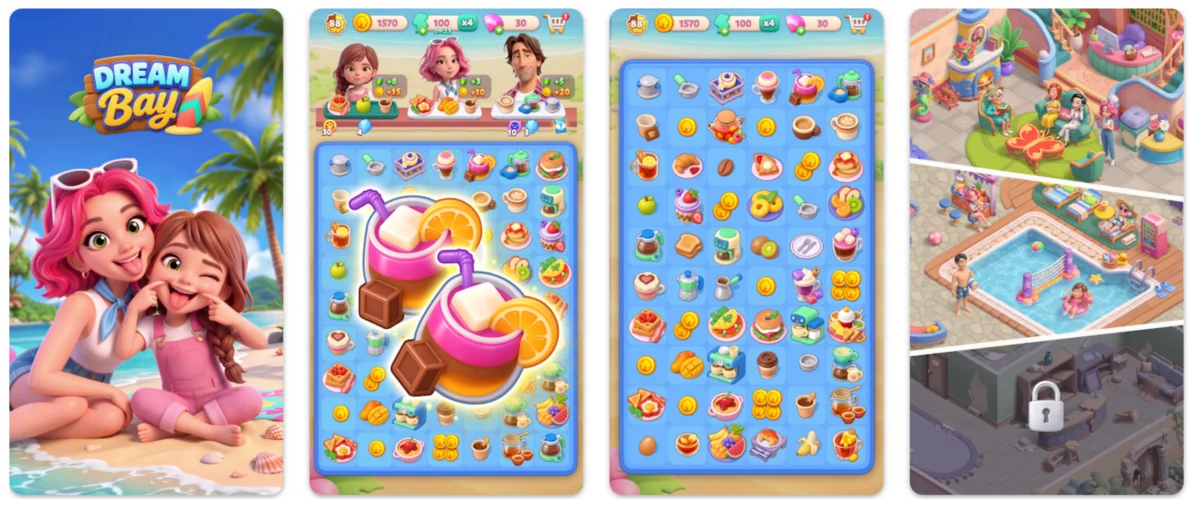
Moon Active, the creator of Coin Master, is following a similar path with Dream Bay and Royal Splash: Tower Blast. Dream Bay incorporates renovation and merge mechanics, while Royal Splash explores physics-based puzzle gameplay. These titles indicate a move toward "hybrid-casual" gaming, where simple mechanics are paired with deep meta-progression systems to improve long-term monetization.

High-Fidelity Racing and Action: Take-Two and Zynga
Following Take-Two Interactive’s acquisition of Zynga, the combined entity has leveraged NaturalMotion—a studio known for its high-end graphics—to develop CSR 3 and a mobile adaptation of Borderlands. CSR 3 is currently being tested in Malaysia and several European markets, focusing on hyper-realistic vehicle rendering and real-time multiplayer.
The Borderlands mobile project, however, highlights the volatility of the testing phase. After a brief appearance on the US App Store, the game was removed from sale. While internal sources suggest the game is still in active development, its removal underscores the rigorous standards major publishers now apply to their mobile ports.

Chronology of Key Industry Moves (2024-2025)
- February 2024: Zynga begins testing CSR 3 in select markets, focusing on high-end mobile hardware.
- May 2024: Ninja Kiwi soft launches Bloons Blitz in the Philippines, adopting the "bullet heaven" mechanics popularized by Vampire Survivors.
- August 2024: Supercell reboots Clash Heroes as Project Rise and opens beta registrations.
- September 2024: FunPlus releases State of Desire, an 18+ prison management game, marking a shift toward more mature themes in mobile strategy.
- October 2024: Blizzard enters the soft launch phase for Overwatch Rush, targeting the Southeast Asian market.
- Winter 2025 (Projected): Hoyoverse scheduled to release Petit Planet, a cutesy life sim aimed at the "cozy gaming" demographic.
Broader Impact and Industry Implications
The current wave of soft launches reveals several key shifts in the mobile gaming ecosystem. First, the "Merge" mechanic has become the new standard for casual progression, replacing or augmenting traditional Match-3 systems. Second, there is a clear move toward "Party" and "Social" gaming, as seen with Miniclip’s Hoverboard Party and Supercell’s Project Rise, likely inspired by the success of Stumble Guys and Eggy Party.
Furthermore, the involvement of companies like PlayStation Mobile (with Ratchet & Clank: Ranger Rumble) and Sega/Rovio (with new Angry Birds iterations) suggests that the "Console-to-Mobile" pipeline is no longer just about ports, but about creating bespoke experiences that utilize established characters in mobile-native genres.

As user acquisition costs continue to climb due to privacy changes on iOS and Android, the industry’s reliance on soft launches will only increase. Publishers are no longer looking for a "hit" at launch; they are looking for a sustainable platform that can be iterated upon for years. The games currently in testing represent the next generation of mobile entertainment, where the boundaries between genres are increasingly fluid, and the quality gap between mobile and console gaming continues to narrow.
About the Author