
The integration of intelligent non-player characters (NPCs) capable of dynamic movement, particularly those designed to chase or follow the player, remains a cornerstone feature in the vast majority of contemporary video games. This fundamental interaction, crucial for creating immersive gameplay, enabling complex narratives, and posing engaging challenges, has become remarkably accessible to developers through powerful visual scripting tools like Unreal Engine 5’s Blueprint system. This guide elucidates the straightforward process of implementing robust AI following mechanics within Unreal Engine 5, demonstrating how a few intuitive Blueprint nodes can establish a sophisticated behavioral foundation for game characters.
The Blueprint Revolution: Accessible AI Development
Unreal Engine 5, Epic Games’ flagship development platform, stands at the forefront of game creation technology, offering a comprehensive suite of tools for artists, designers, and programmers alike. A significant contributor to its widespread adoption, especially among independent developers and those seeking rapid prototyping solutions, is its visual scripting language, Blueprint. Blueprints empower creators to define game logic, character behaviors, and interactive elements without writing a single line of C++ code, thereby democratizing access to advanced game development concepts. The ability to craft complex AI behaviors, such as player following, through an intuitive node-based interface significantly accelerates development cycles and lowers the barrier to entry for aspiring game designers. This ease of implementation ensures that even intricate AI systems can be conceptualized, built, and refined with remarkable efficiency.
Foundation of Movement: Leveraging NavMesh

Before any AI character can effectively navigate a game world, a foundational understanding of its environment is essential. This is where the Navigation Mesh, or NavMesh, plays a critical role. As detailed in the preceding guide, "Setting up a NavMesh in Unreal Engine 5," a NavMesh acts as a navigable surface generated across the game level, outlining areas where AI characters can move. It is an abstract representation of the traversable geometry, allowing AI pathfinding algorithms to quickly calculate efficient routes from one point to another while avoiding obstacles. Without a properly configured NavMesh, AI characters would be unable to intelligently pathfind, often colliding with static geometry or becoming stuck. The NavMesh provides the ‘roadmap’ upon which all subsequent AI movement, including player following, is built, ensuring that AI agents can navigate the dynamic complexities of a game world with calculated precision. The efficiency of the NavMesh system in Unreal Engine 5 allows for real-time path recalculations, which is paramount for responsive AI that can adapt to a player’s unpredictable movements.
Step-by-Step Implementation: Modifying AI Behavior
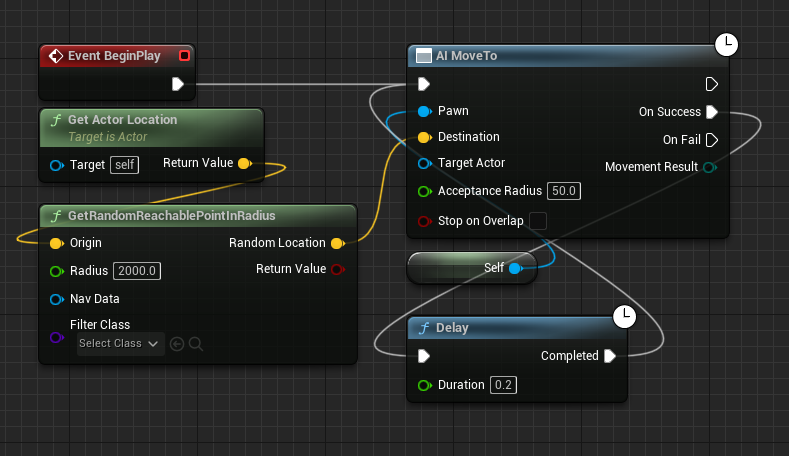
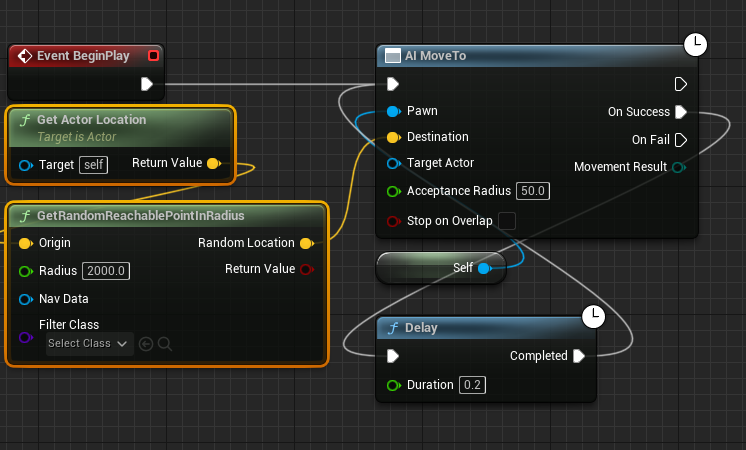
The process of transitioning an AI character from random wandering to actively chasing or following the player involves a precise modification of its existing Blueprint logic. Beginning with the nodes established for general AI movement—typically involving an AI MoveTo node, a Delay node for periodic updates, and logic for determining a target location—developers can swiftly reconfigure the system to prioritize the player’s position. This iterative approach to AI development underscores the flexibility of Unreal Engine 5’s Blueprint system, allowing for incremental enhancements to core functionalities.
-
Refining Target Acquisition: Deleting Redundant Nodes
The initial setup for a wandering AI often includes nodes such asGet Actor LocationandGetRandomReachablePointInRadius. These nodes serve the specific purpose of instructing the AI to find a random, accessible point within a defined radius around itself, thereby simulating aimless movement or patrol behavior. However, for a player-following AI, this logic becomes counterproductive. The objective shifts from seeking random locations to consistently targeting the player’s real-time coordinates. Therefore, the first critical step involves identifying and deleting these two nodes from the Blueprint graph. Their removal clears the way for a direct and explicit targeting mechanism centered on the player character. This targeted deletion simplifies the Blueprint, removing unnecessary computational overhead and focusing the AI’s intent squarely on the player. -
Establishing Player Linkage: Introducing ‘Get Player Character’
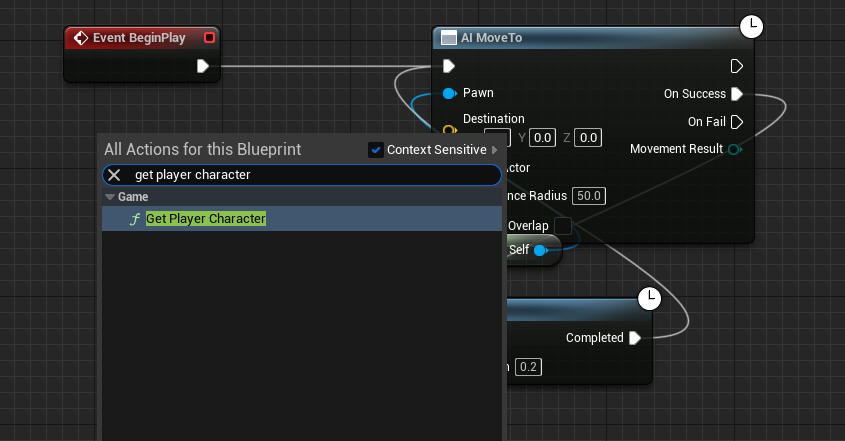
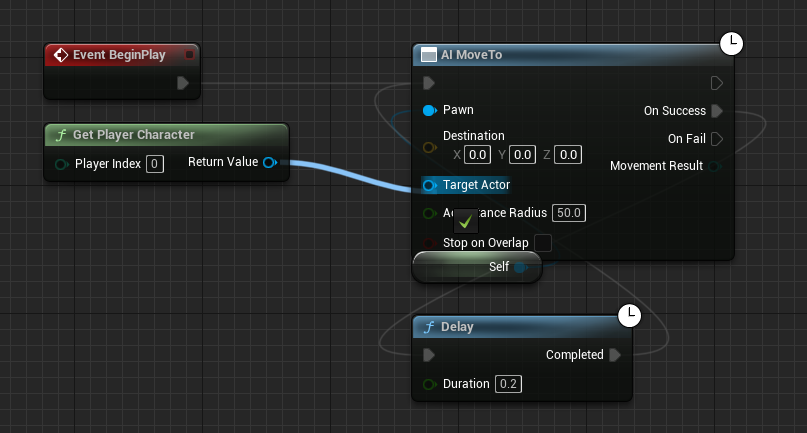
With the random target acquisition nodes removed, the next step is to introduce a direct reference to the player character within the AI’s Blueprint. This is achieved by adding a newGet Player Characternode to the graph. This node, fundamental to any player-centric AI behavior, retrieves a reference to the active player character in the game world. Once added, the blueReturn Valuepin of theGet Player Characternode is connected directly to the blueTarget Actorpin on theAI MoveTonode. This connection is the linchpin of the player-following mechanism, instantly re-directing theAI MoveTonode’s target from an arbitrary location to the player’s current position. Consequently, the AI’s movement instruction now becomes: "move to where the player is." This simple yet powerful modification transforms the AI’s intent, making it a reactive entity that responds directly to the player’s presence and movement within the game environment. -
Ensuring Persistence: The ‘On Fail’ and ‘Delay’ Connection
While establishing a direct target to the player is crucial, robust AI behavior demands resilience and continuous functionality, even in challenging scenarios. There are instances where theAI MoveTooperation might fail: the player could move into an area temporarily inaccessible to the AI (e.g., behind a closed door not yet opened, or an un-NavMeshed area), or the pathfinding calculation itself might encounter a transient error. To prevent the AI from becoming static or "stuck" in such situations, it is imperative to connect theOn Failexecution pin of theAI MoveTonode to theDelaynode. This connection ensures that if the AI’s attempt to move to the player’s location fails for any reason, the system doesn’t simply give up. Instead, it enters a brief delay period (as defined by theDelaynode’s duration) before re-attempting theAI MoveTocommand. This retry mechanism is critical for maintaining persistent AI following, guaranteeing that the AI will continuously attempt to track the player, adapting to environmental changes and overcoming temporary pathfinding obstacles. It creates a loop that ensures the AI remains engaged and reactive, regardless of minor hitches in navigation or player behavior. Finally, to ensure all these changes are integrated into the game, compiling and saving the Blueprint editor is a mandatory step, solidifying the new AI logic for in-game execution.
Beyond Basic Movement: Advanced AI Concepts
While the described Blueprint setup provides a solid foundation for AI following, advanced game development often requires more nuanced and intelligent behaviors. This basic "chase" mechanic can be extended through several sophisticated Unreal Engine features. For instance, AI Perception can be integrated to allow the AI to "see" or "hear" the player, triggering the following behavior only when the player enters its sensory range. This adds a layer of realism and unpredictability, as the AI isn’t simply following an invisible beacon but reacting to perceptible stimuli.
Furthermore, Behavior Trees offer a highly modular and flexible way to design complex AI decision-making processes. Instead of a linear sequence of nodes, a Behavior Tree defines a hierarchy of tasks and conditions, allowing the AI to switch between behaviors (e.g., patrol, chase, attack, flee) based on dynamic game states. A Blackboard, often used in conjunction with Behavior Trees, serves as a central data store for the AI, allowing it to remember critical information such as the player’s last known location, current health, or specific environmental conditions. By leveraging these tools, developers can evolve a simple following AI into an intelligent agent capable of strategic pursuit, tactical retreats, or coordinated attacks, significantly enriching the gameplay experience.
Diverse Applications: The Versatility of AI Following
The foundational AI following mechanism, despite its simplicity in implementation, underpins a vast array of common and complex AI behaviors seen across various game genres. Its applications extend far beyond a basic "enemy chase," providing crucial functionality for character interactions and environmental dynamics.
-
Enemies and Adversaries: This is arguably the most common use case. From relentless zombies in survival horror titles to intelligent predators in open-world games and strategic opponents in action RPGs, AI enemies that track and pursue the player are essential for generating tension, challenge, and emergent gameplay. Different enemy types might employ variations, such as stopping at a certain attack range, attempting to flank the player, or retreating if damaged, all built upon the core following logic.
-
Companions and NPCs: Not all following AI is hostile. Player companions, escort targets, or even friendly animals can utilize this system to maintain proximity to the player. In RPGs, a party member following the player character is a standard feature, contributing to narrative immersion and cooperative gameplay. Escort missions, a staple in many adventure games, rely entirely on an NPC’s ability to navigate the environment while staying near the player, often demanding player protection and strategic movement.
-
Dynamic Environmental Interactions: AI following can also drive environmental puzzles or interactive elements. Imagine a puzzle where a creature must follow the player to a specific trigger point, or a game mechanic where a magical light source trails the player, illuminating the path. These scenarios leverage the AI’s movement capabilities to create unique challenges and enhance environmental storytelling. Furthermore, in sandbox or simulation games, AI characters might follow predefined routes or other NPCs, contributing to the illusion of a living, breathing world.
Performance and Optimization Considerations
While the Blueprint approach to AI following is straightforward, developers must remain mindful of performance, especially when scaling up the number of AI agents in a scene. Each AI character running pathfinding calculations and updating its target position introduces computational overhead. For games featuring dozens or hundreds of AI characters, optimizing these processes becomes crucial. Techniques include:
- LOD (Level of Detail) for AI: Reducing the complexity of AI behavior or even suspending updates for AIs that are far from the player or out of sight.
- Batching AI Updates: Staggering the updates of multiple AI characters over several frames rather than all at once.
- Optimizing NavMesh: Ensuring the NavMesh is efficient and covers only necessary areas, avoiding overly complex or redundant geometry.
- Pathfinding Simplification: For distant AIs, using less precise pathfinding algorithms that consume fewer resources.
- Using Behavior Trees/Blackboards: These systems can make AI more efficient by preventing unnecessary calculations and allowing AIs to "think" only when necessary.
Impact on Game Development: Democratizing AI
The accessibility of implementing core AI functionalities like player following through visual scripting tools like Unreal Engine 5’s Blueprints represents a significant milestone in game development. It empowers a broader range of creators, including designers and artists, to directly contribute to and iterate on AI behaviors without requiring specialized programming knowledge. This democratization of AI development accelerates prototyping, allows for more iterative design, and ultimately leads to richer, more dynamic gameplay experiences. Indie studios, in particular, benefit immensely, as they can achieve sophisticated AI interactions with limited resources, fostering innovation across the industry. The ease of setting up such fundamental AI not only provides a quick win for developers but also serves as a gateway to exploring more advanced AI paradigms, setting the stage for truly intelligent and adaptive virtual characters.
In conclusion, implementing AI following the player in Unreal Engine 5 is a testament to the engine’s powerful yet user-friendly design. By making a few targeted modifications to existing Blueprint nodes, developers can rapidly establish a robust and persistent AI following system. This fundamental mechanic not only forms the basis for a multitude of character interactions, from formidable enemies to loyal companions, but also serves as a crucial stepping stone towards crafting more complex and intelligent AI behaviors. The integration of this functionality is not merely a technical exercise but a key enabler for creating immersive, challenging, and engaging interactive experiences that resonate with players across diverse game genres.
About the Author