The landscape of modern video games is increasingly defined by sophisticated artificial intelligence (AI) that brings virtual worlds to life, challenging players, assisting them, and populating immersive environments. Among the most fundamental yet impactful AI behaviors is the ability for non-player characters (NPCs) or enemies to accurately chase or follow the player character. What was once a complex programming feat requiring extensive coding knowledge is now remarkably streamlined within contemporary game engines, particularly Unreal Engine 5 (UE5). The implementation of this core AI functionality, crucial for everything from relentless antagonists to loyal companions, has been distilled into an accessible process requiring only a handful of visual scripting nodes within UE5’s powerful Blueprint system.
This accessibility represents a significant evolution in game development, democratizing the creation of dynamic and interactive experiences. Developers leveraging Unreal Engine 5 can integrate sophisticated player-following AI with surprising ease, laying the groundwork for complex gameplay mechanics and richer narratives. The underlying principles involve robust navigation systems and intuitive visual scripting tools, which together empower creators to imbue their digital characters with purposeful movement.
The Evolution of AI Navigation in Game Development
For decades, crafting believable AI movement has been a cornerstone and often a significant challenge in game development. Early games relied on rudimentary pathfinding algorithms, often pre-defined paths or simple line-of-sight checks, leading to predictable and sometimes unconvincing AI behavior. The introduction of navigation meshes, or NavMeshes, marked a pivotal advancement. A NavMesh is a data structure that defines walkable surfaces within a game world, allowing AI agents to efficiently calculate paths from one point to another while avoiding obstacles. This foundational technology is indispensable for any AI that needs to move intelligently through a complex environment.
Unreal Engine has been at the forefront of providing robust NavMesh solutions, evolving through several iterations to offer increasingly optimized and user-friendly tools. With UE5, the NavMesh system is highly integrated and largely automated, allowing developers to quickly generate navigable areas for their AI with minimal manual intervention. This prerequisite for intelligent movement—the establishment of a functional NavMesh—is the initial step before any AI can begin to understand and traverse its environment. Once a NavMesh is properly configured, the path is clear for implementing more advanced behaviors like player pursuit.
Unreal Engine 5’s Blueprint System: Empowering Developers
The cornerstone of Unreal Engine 5’s acclaimed accessibility is its Blueprint visual scripting system. Blueprints allow developers to create game logic, define behaviors, and manage game assets without writing a single line of code. Instead, functionality is constructed by connecting nodes in a graph-based interface, each node representing a specific action, event, or data manipulation. This visual approach significantly lowers the barrier to entry for aspiring game designers and accelerates prototyping for experienced developers.
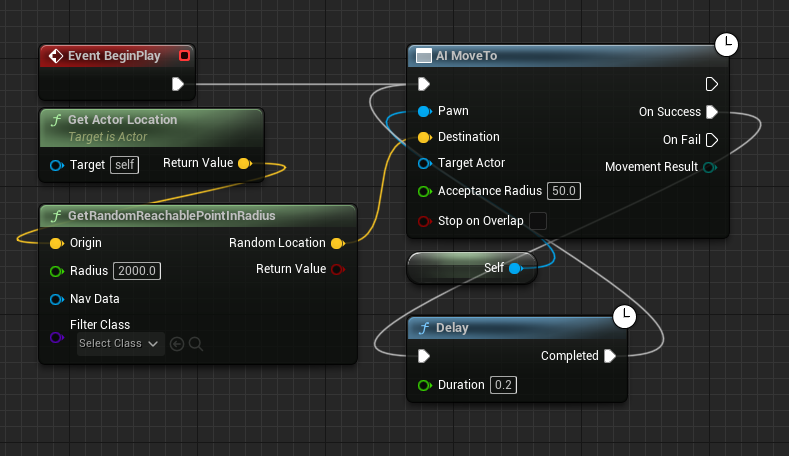
For AI behaviors, Blueprints provide a highly intuitive environment. The AI MoveTo node, for instance, encapsulates complex pathfinding and movement logic into a single, easy-to-use component. This node, when supplied with an AI controller, a target location or actor, and a navigation radius, automatically handles the intricate calculations required to guide an AI agent along the NavMesh to its destination. This abstraction shields developers from the complexities of underlying algorithms, allowing them to focus on designing engaging AI interactions.
Implementing Player-Following AI: A Streamlined Process
The core process of enabling an AI character to follow a player in Unreal Engine 5, building upon an existing NavMesh and basic AI movement setup, involves a series of logical modifications within the AI’s Blueprint graph. Initially, AI might be programmed to patrol randomly or move between pre-defined points using nodes like Get Actor Location and GetRandomReachablePointInRadius. The transition to player-following behavior necessitates replacing these random targeting mechanisms with a direct reference to the player character’s position.
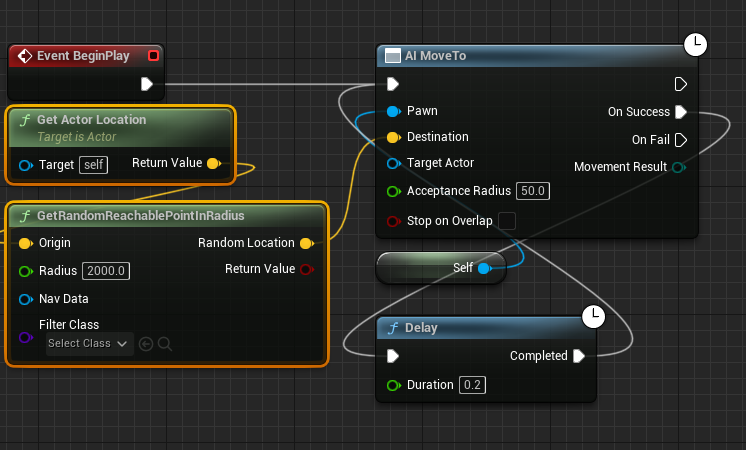
The first step in this transformation involves removing the existing nodes responsible for generating random destinations. Specifically, the Get Actor Location node, which retrieves the AI’s current position, and the GetRandomReachablePointInRadius node, which calculates a random point on the NavMesh around a given origin, are no longer needed. Their purpose was to define a patrol route; for player pursuit, a dynamic target is required. By deleting these nodes, the AI’s movement logic is freed from its previous directive, ready to receive a new, player-centric objective.
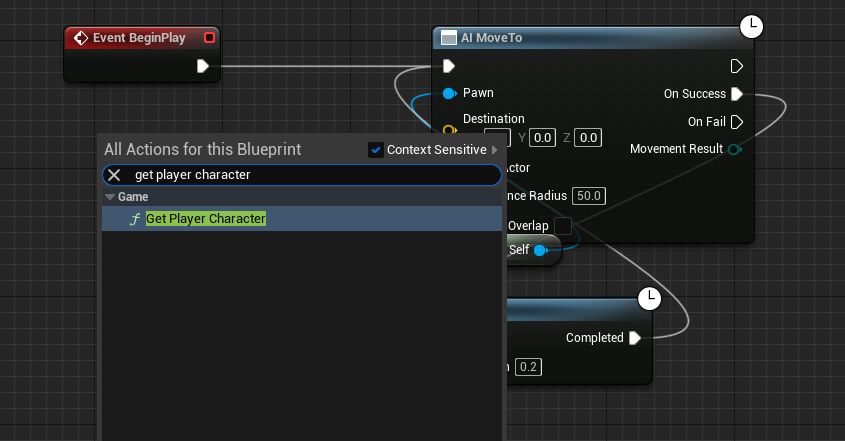
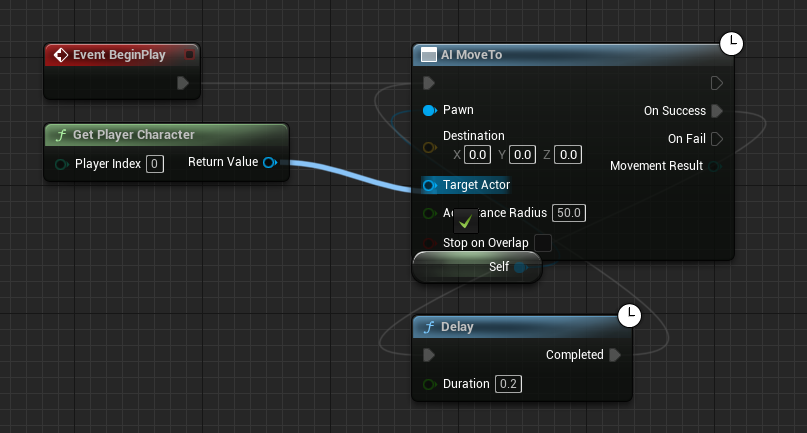
The next critical addition is the Get Player Character node. This fundamental Blueprint node provides a direct reference to the player-controlled character in the game world. Its Return Value output pin, typically blue to denote an Object Reference, carries the identity of the player actor. This reference is then seamlessly connected to the Target Actor input pin of the AI MoveTo node. This single connection redefines the AI’s objective: instead of seeking a random point, it now actively seeks out the player character’s location in real-time. The AI MoveTo node, receiving the player as its target, will continuously calculate and update the optimal path along the NavMesh to reach the player, driving the AI character in pursuit.
Ensuring Robust AI Behavior: Handling Failure States
A crucial aspect of developing reliable AI is accounting for potential failures in movement. In dynamic game environments, situations can arise where the player might move to an unreachable location, or the NavMesh itself might present temporary obstacles that prevent the AI from successfully completing its MoveTo command. Without proper error handling, the AI could simply stop moving, leading to a broken or immersion-breaking experience. Unreal Engine 5’s AI MoveTo node addresses this with dedicated output pins for On Success and On Fail.
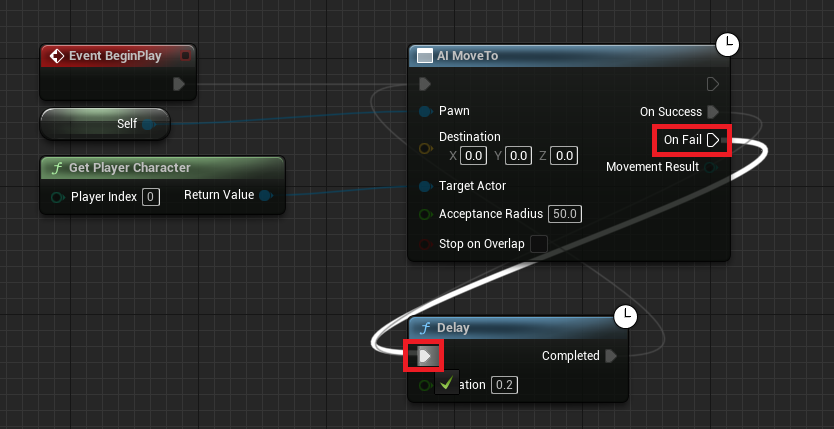
To ensure persistent pursuit, the On Fail execution pin of the AI MoveTo node is connected back to a Delay node, which then loops back to re-initiate the AI MoveTo command. This creates a robust retry mechanism. If, for any reason—be it an obstructed path, the player entering an area outside the NavMesh, or a temporary glitch—the AI MoveTo operation fails, the AI doesn’t simply give up. Instead, it waits for a brief, configurable delay (e.g., a fraction of a second) and then attempts to move to the player’s current location again. This continuous retrying ensures that the AI remains engaged in chasing the player, providing a consistent and challenging experience, regardless of the player’s movements or environmental complexities.
Once these Blueprint modifications are complete, the final essential step is to compile and save the AI’s Blueprint asset. This action processes the visual script into executable code, applying all the changes made to the AI’s behavior. Without compiling, the new logic will not be active in the game editor or a packaged build, ensuring that the development environment accurately reflects the intended AI behavior during testing and play.
Broad Implications and Diverse Use Cases
The ability to implement player-following AI with such straightforwardness unlocks a vast array of possibilities for game designers. This foundational mechanic, though simple in its core implementation, forms the backbone of numerous complex gameplay scenarios:
- Antagonists and Enemies: From relentless zombies in survival horror to cunning adversaries in action games, player-following AI is essential for creating compelling combat and chase sequences. The ability to pursue the player creates pressure, requiring strategic movement and decision-making.
- Companions and Allies: In role-playing games or cooperative adventures, AI companions that follow the player are critical for team cohesion and narrative immersion. These allies might provide support in combat, carry items, or simply enhance the feeling of companionship in a vast world.
- Dynamic NPCs and Quest Givers: NPCs that follow players to a destination, guide them through a level, or react to their presence by initiating dialogue add depth and dynamism to quests and world interactions. This enables more organic storytelling and mission design.
- Escort Missions and Environmental Interaction: The pursuit logic can be inverted or adapted for escort missions, where the player must protect a vulnerable AI character. It also allows for environmental puzzles where AI reactions to player position are key to progression.
- Emergent Gameplay: By combining simple following behavior with other AI systems (like perception, combat routines, or decision-making trees), developers can create emergent gameplay scenarios where AI agents react dynamically to player actions and environmental changes, leading to unpredictable and engaging experiences. For instance, an enemy might follow until line of sight is broken, then switch to patrolling, or a companion might follow until the player engages in combat, then switch to a combat support routine.
Supporting Data and Industry Impact
The accessibility offered by engines like Unreal Engine 5, particularly concerning core AI functionalities, has had a profound impact on the game development industry. According to various industry reports, the global video game market continues its robust growth, projected to exceed $300 billion in revenue by the mid-2020s. A significant driver of this growth is the increasing number of independent developers and small studios capable of producing high-quality games, thanks to powerful and accessible tools. Epic Games, the creator of Unreal Engine, has consistently emphasized empowering creators of all scales. Their decision to make Unreal Engine free to use, coupled with a generous royalty model, aligns with this philosophy, making advanced features like sophisticated AI movement available to everyone.
Industry analysts frequently highlight how visual scripting environments, exemplified by Blueprints, have lowered the technical barrier to entry for game development. This allows more creative minds to translate their visions into interactive experiences without needing extensive computer science backgrounds. This democratization fuels innovation, leading to a wider variety of game concepts and mechanics reaching the market. Developers often praise Unreal Engine for its ability to rapidly prototype and iterate on game ideas, with AI behavior being a prime example of where this efficiency shines. The ability to quickly implement and test core AI functions means more time can be dedicated to refining gameplay, narrative, and overall polish.
A Look Ahead: The Future of Accessible AI in Gaming
While the current implementation of player-following AI is remarkably efficient, the trajectory of AI in game development points towards even greater sophistication and accessibility. Future iterations of game engines will likely integrate more advanced machine learning techniques for AI behavior, potentially allowing AI characters to learn and adapt to player strategies dynamically. However, foundational mechanics like intelligent pathfinding and targeted pursuit will remain crucial. The ease with which these basics can be established in Unreal Engine 5 provides a strong foundation for future innovations.
The simplification of complex tasks like AI movement in Unreal Engine 5 underscores a broader trend in software development: providing powerful abstractions that allow creators to focus on higher-level design challenges. For game developers, this means less time wrestling with low-level code and more time crafting compelling characters, engaging challenges, and immersive worlds. The seamless integration of robust navigation, visual scripting, and efficient error handling ensures that AI characters in Unreal Engine 5 can consistently deliver dynamic and believable interactions, enriching the player experience across all genres.
In conclusion, the capacity for AI characters to follow or chase the player is not just a common game feature; it is a fundamental element that drives player engagement and narrative progression. Unreal Engine 5’s Blueprint system, combined with its advanced navigation mesh capabilities, transforms what was once a daunting programming task into an incredibly straightforward process. By merely manipulating a few visual nodes, developers can imbue their AI agents with intelligent, persistent pursuit behavior, opening doors to limitless creative possibilities. This accessibility not only speeds up development but also empowers a new generation of creators to bring their imaginative worlds to life, solidifying Unreal Engine 5’s position as a pivotal tool in the ongoing evolution of interactive entertainment.
About the Author