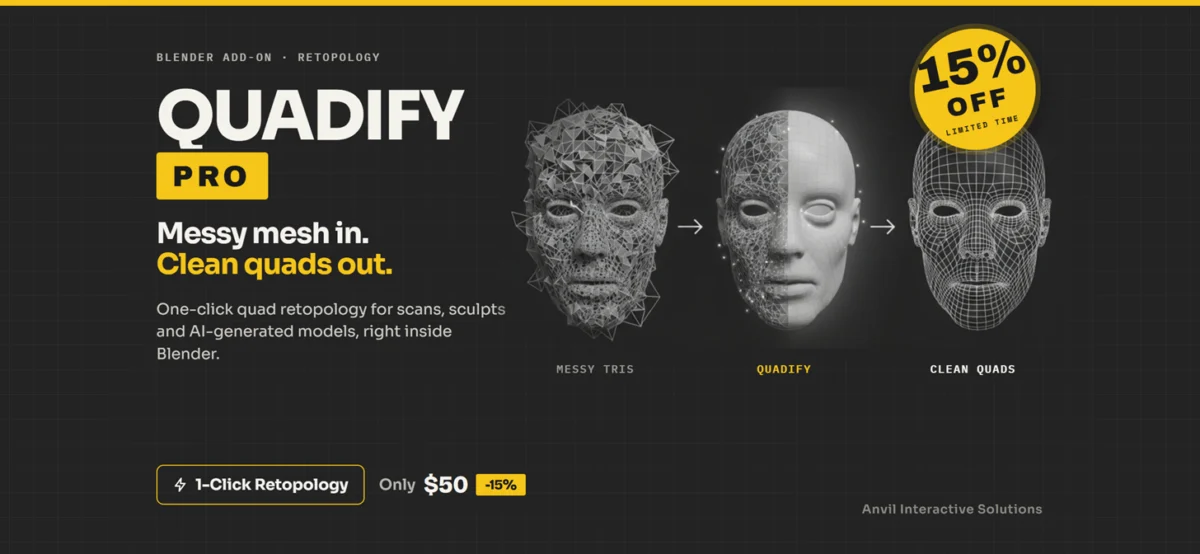
A significant advancement in 3D asset creation has been unveiled with the latest iteration of Quadify Pro, a suite of Blender add-ons designed to address a pervasive challenge in digital modeling: the conversion of complex, triangulated meshes into clean, animation-ready quad topology. This development promises to dramatically reduce the time and effort required for retopology, a critical but often laborious stage in the 3D production pipeline, particularly for assets generated by AI, imported from 3D scans, or created through CAD software and extensive boolean operations.
The core problem, as identified by the developers, lies in the inherent nature of many modern 3D asset generation methods. Artificial intelligence models, designed for rapid content creation, often output meshes composed entirely of triangles. Similarly, 3D scanning technologies capture surface data as a dense collection of triangles, and CAD software, built for precision engineering, frequently relies on triangulated representations for complex geometries. Even extensive use of boolean operations in traditional 3D modeling can result in messy, triangulated topology. This omnipresent "triangle soup" presents substantial hurdles for subsequent stages of 3D production.
"Meshes from AI generators, 3D scans, CAD imports and heavy booleans all share the same problem: triangles everywhere, no edge flow, and topology that falls apart the moment you deform, UV or sculpt it," states the official announcement, underscoring the fundamental limitations of such meshes for practical application in animation, game development, or high-fidelity rendering. The lack of clean edge flow—the organized arrangement of polygons that dictates how a surface deforms—renders these models unsuitable for rigging and animation, where smooth, predictable deformation is paramount. Furthermore, attempting to UV unwrap or sculpt on such a base mesh often leads to distorted textures and unpredictable sculpting results, necessitating a time-consuming manual retopology process.
The Genesis and Evolution of Quadify
Quadify Pro 3.0 is the latest evolution of a family of Blender add-ons developed by a team dedicated to streamlining the 3D workflow. The project was born out of a recognized need within the 3D community for automated solutions to the manual retopology bottleneck. Traditional retopology involves painstakingly drawing new polygons over an existing high-polygon mesh to create a cleaner, lower-polygon version with optimized edge flow. This process, while essential for producing high-quality assets, can consume a significant portion of a project’s timeline, especially for complex models.
The development of Quadify represents a significant investment in algorithmic research and software engineering, aiming to automate this intricate process. The add-on family has undergone several iterations, with each version building upon the previous one to enhance accuracy, speed, and the quality of the resulting quad topology. Quadify Pro 3.0, the most recent release, is presented as the culmination of this effort, offering refined algorithms and expanded capabilities.
Addressing the Triangle Problem: A Technical Overview
The technical challenge in converting a triangulated mesh to a quad-based mesh lies in intelligently identifying and connecting adjacent triangles to form quads (four-sided polygons) while preserving the overall shape and detail of the original model. This requires sophisticated algorithms that can analyze the curvature, edges, and overall structure of the input mesh. Key aspects of this process include:
- Edge Flow Analysis: The add-on must be able to discern natural edge loops that follow the contours of the model, which are crucial for deformation.
- Triangle Merging: Algorithms need to efficiently group pairs or sets of triangles that can form coherent quads without introducing unwanted distortions.
- Detail Preservation: While simplifying the topology, the system must ensure that important surface details are not lost. This can involve strategies for adaptive tessellation or the preservation of sharp edges.
- Quad Dominance: The ultimate goal is to achieve a mesh that is predominantly composed of quads, minimizing the presence of triangles, n-gons (polygons with more than four sides), and poles (vertices where more or fewer than four edges meet), which can cause issues in rendering and animation.
The success of Quadify Pro 3.0 hinges on its ability to perform these complex operations automatically and with high fidelity, thereby saving artists from the manual drudgery.
Product Tiers and Target Audiences
The Quadify family of add-ons is offered in distinct versions, catering to different user needs and budget considerations. This tiered approach acknowledges the diverse requirements within the 3D industry, from hobbyists to professional studios.
- Quadify Lite: This version likely represents a more accessible entry point, perhaps offering core retopology functionality for simpler models or for users who do not require the most advanced features. It would be ideal for individuals or small teams looking for a cost-effective solution to improve basic mesh quality.
- Quadify Pro: Positioned as the flagship product, Quadify Pro is expected to include the most comprehensive set of features and the highest level of automation and accuracy. This version is geared towards professional artists and studios requiring robust performance for complex projects, including character animation, game development, and visual effects.
- Quadify Studio: This premium offering may include additional features such as network rendering support, batch processing capabilities, custom script integration, or dedicated support, making it suitable for larger studios with demanding production pipelines and a need for scalable solutions.
The developers have emphasized that all versions are available as one-time purchases with instant download, a common and attractive model for software add-ons that avoids recurring subscription fees.
Promotional Launch and Reader Discount
To mark the launch and encourage adoption, a special promotional offer has been extended to readers of BlenderNation, a prominent online resource for the Blender 3D software community. For a limited period of 30 days, users can avail themselves of a 15% discount by using the promotional code BLENDERNATION15. This initiative highlights the strong connection between the developers and the Blender ecosystem, aiming to foster a collaborative environment where innovative tools are made accessible to the community that relies on them.
The announcement directs interested parties to "See all Quadify versions here" via a provided link, which leads to The Anvil Store. This online marketplace, developed by Anvil Interactive Solutions, serves as a hub for production tools relevant to Blender, Unreal Engine, and Unity, further indicating the broad applicability of Quadify Pro across various digital content creation platforms.
The Anvil Store: A Platform for Production Tools
The Anvil Store’s existence signifies a growing trend of specialized marketplaces catering to the needs of digital content creators. By aggregating tools designed for specific engines and workflows, it simplifies the discovery and acquisition of essential software. The store’s focus on Blender, Unreal, and Unity suggests a strategic intent to support the full spectrum of modern game development and real-time rendering pipelines, where efficient asset creation and optimization are paramount. Anvil Interactive Solutions, as the proprietor, positions itself as a provider of solutions that enhance productivity and quality within these demanding industries.
Broader Implications for the 3D Industry
The widespread availability of advanced retopology tools like Quadify Pro has several significant implications for the 3D industry:
- Accelerated Production Cycles: By drastically reducing the time spent on manual retopology, Quadify can significantly shorten project timelines. This is particularly beneficial in industries with tight deadlines, such as game development and advertising.
- Democratization of High-Quality Assets: Tools that automate complex tasks can lower the barrier to entry for creating high-quality 3D assets. This empowers smaller studios and independent artists to compete with larger, more resource-intensive organizations.
- Increased Focus on Creative Tasks: With retopology automated, artists can dedicate more time and energy to creative aspects of 3D production, such as sculpting, texturing, lighting, and animation.
- Improved Workflow for Emerging Technologies: As AI continues to generate increasingly sophisticated 3D models, tools that can efficiently process and optimize these outputs will become indispensable. Similarly, the demand for clean topology in virtual and augmented reality environments, where real-time performance is critical, will drive the adoption of such solutions.
- Standardization of Mesh Quality: The availability of reliable automated retopology tools could lead to a more standardized approach to mesh quality across different projects and pipelines, ensuring better interoperability and performance.
The development and release of Quadify Pro 3.0 represent a noteworthy step forward in the ongoing effort to make 3D content creation more efficient, accessible, and powerful. As the digital landscape continues to evolve with new generative technologies and demanding real-time applications, the role of intelligent automation in the asset creation pipeline will only become more critical.
About the Author