The landscape of digital content creation is undergoing a profound transformation, driven by the rapid advancements and increasing accessibility of Artificial Intelligence (AI). As businesses and individuals grapple with the perpetual demand for engaging, relevant, and high-quality content, AI-powered writing tools are emerging not as a novelty, but as essential components of a modern content strategy. These sophisticated platforms are capable of assisting with everything from brainstorming and drafting to refining and optimizing, offering unprecedented efficiency and scalability. This article delves into the top 10 AI content generator tools that are making significant waves in 2022, exploring their capabilities, unique selling propositions, and the implications for content creators across various sectors.
The genesis of AI in content generation can be traced back to early natural language processing (NLP) research, with significant leaps occurring in the last decade. The development of large language models (LLMs) like GPT-3 and its successors has been a pivotal moment, enabling AI to understand context, generate coherent text, and even mimic human writing styles with remarkable accuracy. This technological evolution has moved AI content generation from theoretical possibility to practical application, empowering marketers, bloggers, businesses, and even students to overcome the inherent challenges of content production. The sheer volume of digital information consumed daily necessitates a constant influx of new material, placing a considerable burden on human creators. AI tools offer a solution by augmenting human capabilities, allowing for faster turnaround times, greater output, and the exploration of diverse content formats.
The adoption of AI in content creation is not merely about speed; it’s also about democratizing access to powerful writing assistance. Historically, professional copywriting and content strategy required specialized skills and significant investment. Today, AI tools are making these capabilities accessible to a broader audience, enabling small businesses, startups, and independent creators to compete with larger organizations that have extensive marketing budgets. This shift has the potential to level the playing field, fostering a more diverse and dynamic online ecosystem.
Understanding the AI Content Generation Spectrum
AI content generators operate on a spectrum of complexity and specialization. Some tools are designed for broad-stroke content creation, capable of producing entire blog posts or articles from a single prompt. Others focus on specific tasks, such as generating social media captions, product descriptions, email subject lines, or even rewriting existing content for better clarity or SEO. The effectiveness of these tools often lies in their ability to understand user intent and provide tailored outputs that align with specific marketing objectives or communication goals.
The underlying technology for these tools typically involves machine learning algorithms trained on vast datasets of text and code. This training allows them to identify patterns, understand grammatical structures, and learn various writing styles. When a user provides a prompt, the AI analyzes this input and generates text that is statistically probable to follow, based on its training data. The quality of the output is highly dependent on the sophistication of the model, the quality of the training data, and the user’s ability to craft effective prompts.

Top 10 AI Content Generator Tools for 2022
As the demand for efficient content creation solutions grows, several AI tools have distinguished themselves through their features, performance, and user experience. Here are ten of the most prominent AI content generator tools that are shaping the industry in 2022:
1. Jasper AI (Formerly Jarvis)
Jasper AI has rapidly ascended to become a leading name in AI-powered content generation. Originally known as Jarvis, the platform has evolved to offer a comprehensive suite of tools designed to assist writers, marketers, and entrepreneurs. Its core strength lies in its ability to understand nuanced instructions and generate high-quality, engaging content across a wide array of formats. Jasper AI leverages advanced AI models to identify optimal word choices and sentence structures, facilitating the creation of content that is both efficient and accessible.
Key Features:
- Boss Mode: This advanced feature allows users to command Jasper with natural language, directing it to write specific types of content, expand on ideas, or rephrase existing text.
- Templates: Jasper offers over 50 pre-built templates for various content needs, including blog post outlines, ad copy, email subject lines, video scripts, and more.
- Content Improver: This tool can take existing content and rewrite it to be more engaging, clear, or persuasive.
- Plagiarism Checker: Integrated checks help ensure that the generated content is original.
- Brand Voice: Users can train Jasper to adopt a specific brand voice, ensuring consistency across all generated content.
Pros:
- Exceptional quality of generated content, often requiring minimal editing.
- User-friendly interface with a robust Boss Mode for advanced control.
- Extensive template library catering to diverse content needs.
- Strong community support and educational resources.
Cons:
- Can be one of the more expensive options, particularly for heavy users.
- Occasional need for prompt engineering to achieve desired results.
Pricing:
Jasper AI offers several pricing tiers, with its most popular "Boss Mode" starting at $99 per month. For users seeking to explore its capabilities, a special offer provides 10,000 free credits upon signing up via a specific link.
2. Copy.ai
Copy.ai is another prominent player in the AI content generation space, known for its user-friendly interface and extensive range of templates. The platform is designed to help users create marketing copy, social media posts, blog content, and much more, by utilizing over 90 distinct templates. Its utility extends to short-form and long-form content needs, including product descriptions, website copy, and sales reports.
Key Features:
- Over 90 Templates: Covering a broad spectrum of marketing and content creation needs, from ad copy to email newsletters.
- Freestyle Tool: Allows users to input their own ideas and have Copy.ai generate content based on them.
- Blog Post Wizard: A step-by-step tool to help create complete blog posts.
- Tone Adjustment: Ability to specify the desired tone for the generated content (e.g., professional, witty, friendly).
Pros:
- Highly intuitive and easy to navigate, making it accessible for beginners.
- Generous free trial and competitive pricing for paid plans.
- Wide variety of templates for diverse marketing applications.
- Excellent for generating short-form copy and brainstorming ideas.
Cons:
- Long-form content generation might require more user input and refinement compared to some competitors.
- The sheer number of templates can sometimes be overwhelming.
Pricing:
Copy.ai offers a free trial for 7 days, providing 100 runs per day. The Pro Plan is priced at $49 per month, or $420 annually ($35 per month). A special offer grants users 7,000 free words and a 40% discount on paid plans if upgraded within four days of signing up.
3. Frase.io
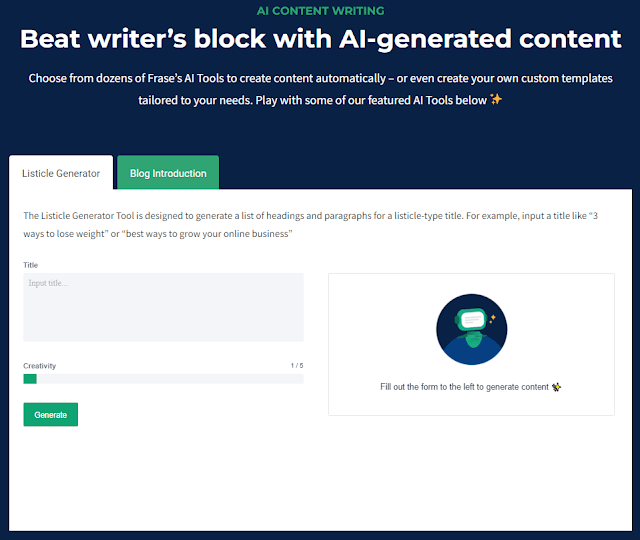
Frase.io distinguishes itself by integrating AI content generation with powerful SEO optimization tools. It assists users in researching, creating, and optimizing content to ensure it ranks well in search engine results. Frase analyzes top-ranking content for a given keyword and provides actionable insights to help users create comprehensive and SEO-friendly articles.

Key Features:
- Content Briefs: Automatically generated briefs based on top search results, outlining key topics, questions, and statistics to include.
- AI Content Generation: Integrated AI writer to help draft content based on research and briefs.
- SEO Optimization: Real-time feedback on content optimization for target keywords.
- Competitor Analysis: Tools to analyze the content strategies of competitors.
Pros:
- Excellent for SEO-focused content creation, providing data-driven recommendations.
- Streamlines the research and writing process into a single platform.
- Helps create content that is both informative and search-engine friendly.
Cons:
- The AI writing capabilities might not be as advanced as dedicated AI writing tools for creative prose.
- Can have a steeper learning curve for users new to SEO principles.
Pricing:
Frase.io offers several plans:
- Solo Plan: $14.99/month ($12/month if billed yearly) for 4 document credits and 1 user seat.
- Basic Plan: $44.99/month ($39.99/month if billed yearly) for 30 document credits and 1 user seat.
- Team Plan: $114.99/month ($99.99/month if billed yearly) for unlimited document credits and 3 user seats.
SEO Add-ons and other premium features are available for an additional $35 per month.
4. Article Forge
Article Forge operates on a different principle, requiring only a keyword to generate a complete article. This approach emphasizes speed and efficiency, making it a popular choice for users who need to produce a high volume of content quickly. The platform guarantees that all generated content passes Copyscape, addressing a common concern about AI-generated text originality.
Key Features:
- Keyword-Based Generation: Generates full articles based on a single keyword input.
- Copyscape Guarantee: All content produced is guaranteed to be plagiarism-free.
- Bulk Article Creation: Ability to generate multiple articles simultaneously.
- Automatic Posting: Option to automatically post generated articles to WordPress sites.
Pros:
- Extremely fast content generation for a large volume of articles.
- Simple to use, requiring minimal input.
- Cost-effective for generating basic informational content.
Cons:
- Content quality can be variable and may require significant editing for nuance and style.
- Less flexibility in terms of creative control compared to other tools.
- Not ideal for highly specialized or opinion-based content.
Pricing:
Article Forge offers a 30-day money-back guarantee.
- Basic Plan: $27/month, allowing up to 25,000 words per month.
- Standard Plan: $57/month for unlimited words.
- Unlimited Plan: $117/month for unlimited words and advanced features.
A free trial is available, but there is no free plan.
5. Rytr.me
Rytr.me positions itself as a superb AI content writing assistant, particularly suited for small businesses, bloggers, and students. It offers a free plan with limited features, making it an accessible entry point for those new to AI content generation. The software is designed for ease of use and can generate SEO-friendly blog posts, articles, and academic papers within minutes.
Key Features:
- Versatile Use Cases: Supports over 40 use cases, including blog posts, emails, social media ads, and more.
- Multiple Tones: Offers various tones to match the desired output.
- Built-in Plagiarism Checker: Helps ensure content originality.
- User-Friendly Interface: Simple and intuitive design for quick content creation.
Pros:

- Generous free plan, ideal for testing and limited usage.
- Affordable pricing for paid plans.
- Easy to use and understand, even for non-technical users.
- Supports multiple languages.
Cons:
- The free plan has character limits, and advanced features are locked behind paid tiers.
- Content quality can vary, and extensive editing may be necessary for complex topics.
Pricing:
Rytr offers a free plan that generates up to 5,000 characters per month.
- Saver Plan: $9/month ($90/year) for 50,000 characters per month.
- Unlimited Plan: $29/month ($290/year) for unlimited characters per month and all features.
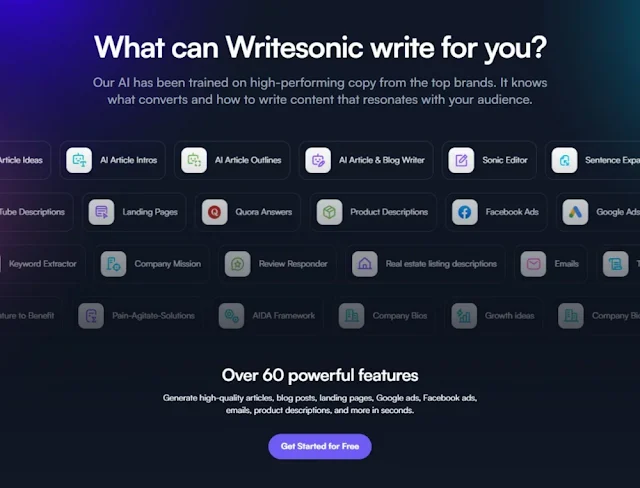
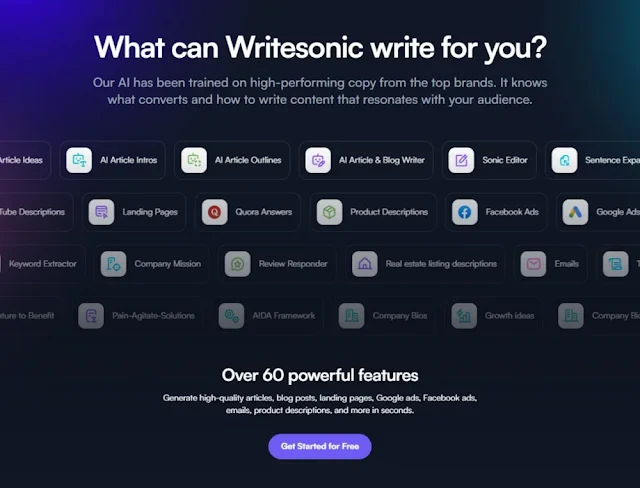
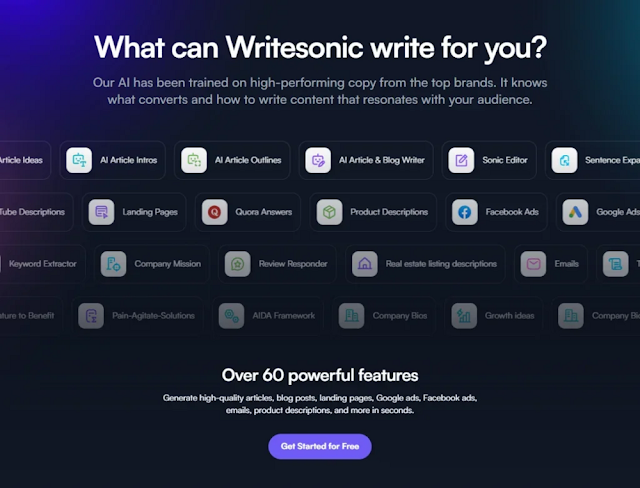
6. Writesonic
Writesonic is a free, easy-to-use AI content generator designed to help users create marketing copy, website content, and blog posts efficiently. It’s particularly beneficial for small businesses and solopreneurs who need to produce content on a budget. The platform also includes grammar and plagiarism checkers, adding to its value proposition.
Key Features:
- Wide Range of Templates: Covers various content types, including landing pages, product descriptions, and ad copy.
- AI Article Writer: Capable of generating full blog posts and articles.
- Grammar and Plagiarism Checkers: Integrated tools to ensure quality and originality.
- Multiple Languages: Supports content generation in various languages.
Pros:
- Free plan offers a decent starting point for users.
- User-friendly interface, making it easy to get started.
- Good for generating marketing-focused copy and short-form content.
Cons:

- The free plan has limited credits, acting more like a trial.
- Long-form content generation may require significant user guidance and editing.
Pricing:
Writesonic offers a free plan with 10 credits. Paid plans include:
- Short-form: Starting at $15/month, offering a set number of words.
- Long-Form: Starting at $19/month, with higher word limits for longer content.
7. CopySmith
CopySmith is an AI content generator designed to produce quality content rapidly, suitable for both personal and professional documents, blogs, and presentations. It offers a broad spectrum of features, including the ability to easily create documents and presentations, along with a library of templates to expedite the creation process.
Key Features:
- Multiple Content Types: Generates blog posts, product descriptions, ad copy, and more.
- Template Library: Provides pre-designed templates for quick content generation.
- Bulk Content Creation: Ability to generate multiple pieces of content at once.
- Customizable Workflows: Designed for teams and agencies.
Pros:
- Fast content generation, saving significant time.
- User-friendly interface with helpful templates.
- Suitable for generating content for e-commerce and marketing purposes.
Cons:
- The quality of generated content can vary, and editing is often required.
- May lack the creative depth of some higher-end AI writers for certain types of content.
Pricing:
CopySmith offers a free trial with no credit card required. Paid plans include:
- Starter Plan: $19/month.
- Professional Plan: $59/month.
- Enterprise: Custom pricing available by contacting the sales team.
8. Hypotenuse.ai
Hypotenuse.ai is recognized for its strength in AI writing software, particularly for e-commerce and product descriptions. It offers a user-friendly online tool that simplifies the creation of AI content, making it accessible even for beginners. The software allows users to create videos, articles, and infographics with ease, featuring a simple interface that is perfect for those new to AI content generation.
Key Features:
- E-commerce Focus: Specialized tools for generating product descriptions and e-commerce copy.
- Article Generation: Capable of producing blog posts and articles.
- Video Script Generation: Assists in creating scripts for video content.
- Infographic Content: Tools to help generate text for infographics.
Pros:
- Excellent for generating persuasive product descriptions and e-commerce content.
- User-friendly interface, making it accessible for beginners.
- Offers a good balance of features for various content needs.
Cons:
- Does not offer a free plan, only a free trial.
- The AI writing for longer-form content may require more refinement.
Pricing:
Hypotenuse.ai offers a free trial. Paid options include:
- Starter Plan: $29/month.
- Growth Plan: $59/month.
- Enterprise: Custom pricing available.
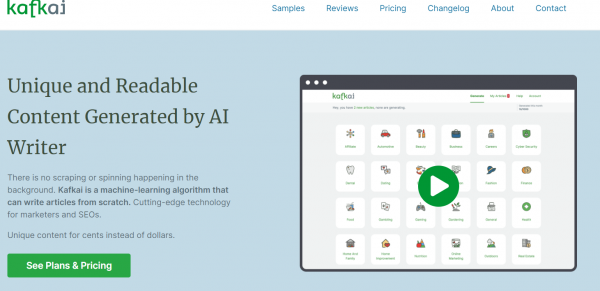
9. Kafkai
Kafkai is positioned as a leading AI writing tool for SEOs and marketers, focusing on producing niche-specific content across a wide array of topics. It boasts a user-friendly interface and offers a high degree of personalization, allowing users to tailor the generated content to their specific needs.

Key Features:
- Niche-Specific Content: Trained on vast datasets to generate content relevant to various niches.
- User-Friendly Interface: Designed for ease of use and quick content creation.
- Personalization Options: Allows users to customize the output to match their brand voice and style.
- Bulk Article Generation: Efficiently produces multiple articles for SEO purposes.
Pros:
- Effective for generating SEO-optimized content for niche websites.
- Offers competitive pricing for high-volume content creation.
- Good for users who need to quickly populate websites with relevant articles.
Cons:
- The creative writing quality may not be as refined as some premium tools.
- Requires some understanding of SEO principles to maximize its effectiveness.
Pricing:
Kafkai offers a free trial. Paid plans include:
- Writer Plan: $29/month for 100 articles.
- Newsroom Plan: $49/month for 250 articles.
- Printing Press Plan: $129/month for 1000 articles.
- Industrial Printer Plan: $199/month for 2500 articles.
10. Peppertype.ai
Peppertype.ai is an online AI content generator that is easy to use and particularly well-suited for small business owners seeking a powerful copy and content writing tool. It helps craft and generate various types of content for numerous purposes, making it a versatile solution for marketing and communication needs.
Key Features:

- Versatile Content Creation: Generates content for blogs, social media, ads, and more.
- Ease of Use: Designed with a simple interface for quick adoption.
- Targeted for Small Businesses: Offers features and pricing suitable for smaller operations.
- Brand Messaging: Helps in crafting consistent brand messaging across different platforms.
Pros:
- User-friendly and intuitive for generating various content formats.
- Good for brainstorming and generating initial drafts.
- Offers competitive pricing for individuals and teams.
Cons:
- Does not offer a free plan, only a free trial.
- The quality of generated content may require editing and refinement.
Pricing:
Peppertype.ai offers a free trial. Paid plans include:
- Personal Plan: $35/Month.
- Team Plan: $199/month.
- Enterprise: Custom pricing available.
The Broader Impact and Implications of AI Content Generation
The widespread adoption of AI content generators has significant implications across industries. For content marketers, these tools offer the potential to increase output, improve efficiency, and personalize campaigns at scale. Businesses can leverage AI to generate product descriptions, marketing emails, and social media posts, freeing up human resources for more strategic tasks. For bloggers and publishers, AI can help overcome writer’s block and accelerate the publication of timely content.
However, the rise of AI content generation also raises important questions about originality, ethics, and the future of human creativity. While AI can produce grammatically correct and contextually relevant text, it currently lacks the human touch, emotional intelligence, and lived experiences that often define truly exceptional content. Therefore, the most effective approach to AI content generation appears to be a collaborative one, where AI serves as an assistant rather than a replacement for human creators.
The ability of AI to generate content at an unprecedented scale also presents challenges related to information overload and the potential for misinformation. As AI tools become more sophisticated, the line between human-generated and AI-generated content may blur, necessitating robust verification and ethical guidelines. Regulators and platform providers are already beginning to address these issues, exploring ways to ensure transparency and accountability in AI-generated content.
In conclusion, the advent of AI content generators marks a pivotal moment in digital communication. Tools like Jasper AI, Copy.ai, Frase.io, and others are empowering individuals and organizations to create content more efficiently and effectively than ever before. While these technologies offer immense potential, their responsible and ethical integration into existing workflows will be crucial for harnessing their full benefits while mitigating potential risks. As AI continues to evolve, the relationship between human creativity and artificial intelligence in content creation will undoubtedly remain a dynamic and fascinating area to observe.
About the Author