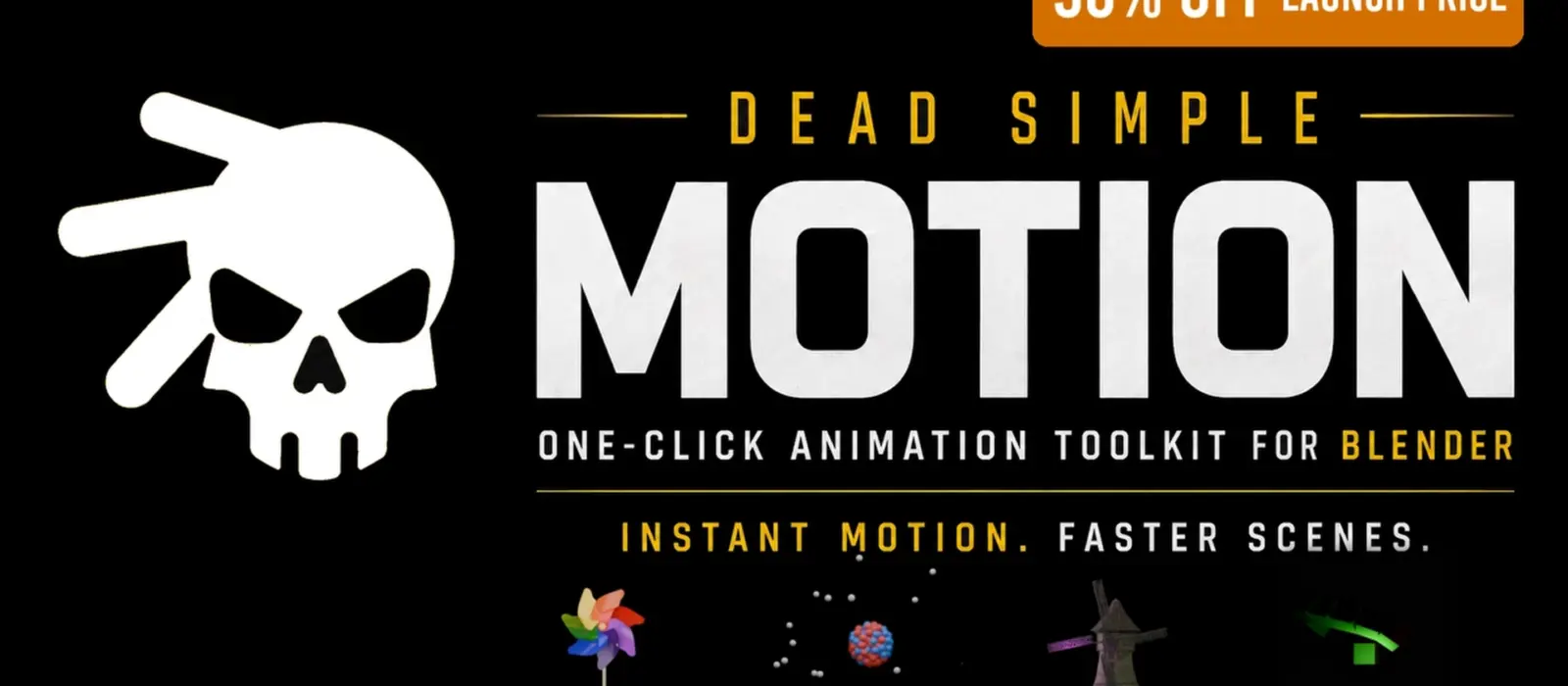
A new Blender add-on, aptly named "Dead Simple Motion," is poised to revolutionize the workflow for 3D animators by introducing live procedural motion tools for objects, cameras, and bones. This innovative solution aims to eliminate the tedious and repetitive task of rebuilding common animation constraints, drivers, and looping keyframes, promising a significant boost in efficiency for both individual artists and larger production studios. Developed by vfxblender, the add-on focuses on streamlining the animation of frequently encountered elements in virtually any 3D scene, from subtle environmental details to dynamic character interactions.
The core premise of Dead Simple Motion, as articulated by its creator, is a philosophy of "Select. Click. Animate." This succinct motto encapsulates the add-on’s design intention: to make complex or repetitive animation tasks accessible and intuitive. The developer highlights a broad spectrum of use cases that the add-on is designed to address, including the animation of common environmental elements such as ceiling fans, background cars in a scene, or the orbital motion of a moon. Beyond static environmental details, the tool also targets dynamic camera movements and character actions like picking up, dropping, or throwing objects, as well as the intricate process of following a character. Furthermore, it extends to animating reactions to music, effectively serving as a "one-stop shop for animating the boring stuff in a scene." This suggests a deliberate effort to identify and automate the animation of elements that, while crucial for a believable and engaging scene, often consume a disproportionate amount of an animator’s time without offering significant creative challenges.
Background and Development Context
The introduction of Dead Simple Motion arrives at a time when the demand for high-quality 3D animation continues to surge across various industries, including film, television, video games, and architectural visualization. The open-source nature of Blender has fostered a vibrant ecosystem of developers creating add-ons that enhance its already robust feature set. These add-ons often address specific pain points or introduce novel workflows, empowering the Blender community to compete with proprietary software.
The developer’s motivation for creating Dead Simple Motion appears to stem from personal experience within the animation pipeline. The phrase "environmental animation you encounter in any scenario over and over again" suggests a developer who has grappled with the repetitive nature of certain animation tasks and sought a more elegant and efficient solution. The "boring stuff" often refers to foundational animations that are necessary for realism and immersion but do not necessarily push creative boundaries. By automating these, animators are freed to focus on more artistically demanding aspects of their work.
The development of such an add-on typically involves a deep understanding of Blender’s Python API, its animation system, and the underlying principles of motion graphics and animation. The ability to create "live procedural motion" implies that the animations are not baked into keyframes that are then manually adjusted. Instead, they are driven by parameters and logic that can be modified in real-time, allowing for dynamic adjustments and iterations without the need to constantly re-keyframe. This approach aligns with modern animation workflows that prioritize flexibility and non-destructive editing.
Key Features and Functionality
While the provided text is concise, the description of "live procedural motion tools for objects, cameras and bones without rebuilding the same constraints, drivers and looping keyframes" points to several key functional areas:
- Procedural Animation: The add-on likely utilizes algorithms and mathematical functions to generate motion, rather than relying solely on manual keyframing. This allows for complex and repeatable animation patterns to be created with minimal input.
- Live Manipulation: The "live" aspect suggests that changes made to parameters or controls within the add-on are immediately reflected in the animation, facilitating an iterative and responsive workflow.
- Constraint and Driver Automation: A significant pain point in 3D animation is setting up and managing constraints (e.g., follow path, inverse kinematics) and drivers (e.g., using one object’s property to control another). Dead Simple Motion appears to abstract these processes, providing pre-built solutions for common scenarios.
- Looping Animation: The ability to create seamless looping animations is crucial for many applications, from character cycles to animated textures. The add-on promises to simplify this process, eliminating the need for complex offset calculations or manual frame matching.
- Object, Camera, and Bone Support: The broad applicability across different types of scene elements – static objects, dynamic cameras, and articulated character rigs (bones) – indicates a versatile tool.
The mention of "ceiling fans," "cars moving down the road," and "orbiting moon" suggests that the add-on might include pre-configured motion presets or intuitive interfaces for generating specific types of movement. For instance, animating a ceiling fan could involve setting rotation speed and direction, while animating a car might involve defining a path and speed. An orbiting moon could be achieved with precise rotational and positional controls relative to a parent object.
Potential Impact on Animation Workflows
The implications of Dead Simple Motion for animation workflows are potentially far-reaching. By automating repetitive tasks, the add-on can:
- Reduce Production Time: Animators can significantly cut down on the time spent on mundane animation setups. This allows for faster turnaround on projects and the ability to take on more complex scenes within the same timeframe.
- Lower the Barrier to Entry: For aspiring animators or those less experienced with the intricacies of Blender’s animation system, Dead Simple Motion could provide a more accessible entry point. The "Select. Click. Animate." philosophy suggests a user-friendly interface that abstracts away some of the underlying technical complexity.
- Enhance Creative Exploration: By freeing up time and mental bandwidth, animators can dedicate more resources to creative problem-solving, character performance, and artistic direction. The ability to quickly iterate on different animation ideas becomes more feasible.
- Improve Consistency and Accuracy: Procedural methods, when implemented correctly, can ensure a high degree of consistency and accuracy in animations. This is particularly beneficial for technical animations or when replicating specific motion patterns.
- Facilitate Large-Scale Projects: For studios working on projects with numerous background elements or complex environmental animations, an add-on like Dead Simple Motion could be instrumental in managing the workload efficiently.
The efficiency gains are particularly relevant in the context of current industry demands. With the increasing complexity of visual effects and the growing expectation for detailed and dynamic environments, tools that streamline the creation of such elements are highly valued. The ability to quickly generate believable background motion, for example, can elevate the overall quality of a scene without requiring extensive manual animation effort for every element.
Community and Future Development
The release of Dead Simple Motion within the Blender community is likely to be met with significant interest. Blender’s open-source nature fosters a collaborative environment where developers often release their tools freely or at a nominal cost, with the expectation that the community will provide feedback, suggest improvements, and contribute to further development.
While the initial description focuses on the core functionality, it is plausible that future iterations of Dead Simple Motion could incorporate:
- More Advanced Procedural Generators: Expanding the library of procedural motion types to cover even more niche or complex animation scenarios.
- Integration with Physics Systems: Combining procedural motion with Blender’s physics simulations for more dynamic and reactive animations.
- Customizable Presets and User-Defined Libraries: Allowing users to save their own custom procedural setups for future use.
- Scripting and API Access: Providing deeper control for advanced users who wish to integrate the add-on’s functionality into custom scripts or pipelines.
The success of such an add-on often hinges on its ease of use, reliability, and the responsiveness of its developer to community feedback. The YouTube video accompanying the announcement serves as a crucial demonstration of the add-on’s capabilities, offering potential users a visual preview of its performance and workflow. Observing the reactions and usage patterns within the Blender community will be key to understanding the long-term impact of Dead Simple Motion.
Conclusion
Dead Simple Motion represents a significant advancement in Blender’s animation toolkit. By addressing the often-overlooked but time-consuming aspects of procedural motion for common scene elements, it empowers animators to work more efficiently, creatively, and effectively. The "Select. Click. Animate." philosophy underscores a commitment to user-friendliness and accessibility, suggesting that this add-on has the potential to become an indispensable tool for a wide range of 3D artists. As the demand for high-quality animated content continues to grow, solutions that streamline production and enhance creative output will undoubtedly play a pivotal role in shaping the future of the industry. The development of Dead Simple Motion is a testament to the innovative spirit within the Blender community and its ongoing contribution to democratizing and advancing the field of 3D animation.
About the Author