The cosmos, an expanse estimated to be 13.8 billion years old, presents humanity with one of its most profound enigmas: the conspicuous absence of extraterrestrial civilizations. Despite billions of years during which life could have emerged and evolved across countless worlds, Earth remains seemingly alone in its corner of the observable universe. This paradox, famously articulated by physicist Enrico Fermi, questions why, given the immense age and size of the universe and the high probability of life, humanity has yet to detect any definitive signs of intelligent extraterrestrial activity.
The Genesis of the Cosmic Silence Inquiry
The question that underpins the Fermi Paradox — "Where is everybody?" — was posed by Nobel laureate Enrico Fermi in 1950 during an informal lunch conversation with fellow scientists at Los Alamos National Laboratory. The discussion revolved around a recent New Yorker cartoon depicting aliens stealing public trash cans, prompting Fermi to ponder the real-world implications of extraterrestrial intelligence. His simple query highlighted a fundamental contradiction: scientific estimates suggest a high likelihood of advanced civilizations existing elsewhere, yet there is no empirical evidence to support this.
This paradox is amplified by the sheer scale of cosmic time and space. The universe itself is approximately 13.8 billion years old. Our solar system and Earth formed roughly 4.5 billion years ago, with life emerging on our planet within the first billion years. This means that if life forms on other planets even a fraction earlier than it did on Earth, these civilizations could have had a multi-billion-year head start on technological development. Over such vast timescales, even relatively slow interstellar travel or communication methods could have allowed a civilization to colonize or signal across entire galaxies, let alone our own Milky Way. The lack of any such contact or observable megastructures, like Dyson spheres, presents a compelling counter-argument to the presumed abundance of life.
Quantifying the Possibility: The Drake Equation
In 1961, astronomer Frank Drake formalized the factors involved in estimating the number of detectable extraterrestrial civilizations in the Milky Way with what is now known as the Drake Equation:
N = R* × fₚ × nₑ × fₗ × fᵢ × f꜀ × L
Each variable represents a crucial step in the development of intelligent, communicating life:
- *R:** The rate of star formation in our galaxy.
- fₚ: The fraction of those stars that have planets.
- nₑ: The average number of planets that can potentially support life per star that has planets.
- fₗ: The fraction of those planets that actually go on to develop life.
- fᵢ: The fraction of planets with life that develop intelligent life.
- f꜀: The fraction of civilizations that develop a technology that releases detectable signs of their existence into space.
- L: The length of time such civilizations release detectable signals into space.
While the Drake Equation offers a systematic framework, the values for most of its variables remain highly speculative, leading to estimates for ‘N’ that range from one (us) to millions. The recent explosion in exoplanet discoveries, largely thanks to missions like NASA’s Kepler and TESS space telescopes, has provided more concrete data for the initial variables (R*, fₚ, nₑ). Thousands of exoplanets have been confirmed, with statistical analyses suggesting that virtually every star in the galaxy hosts at least one planet. Many of these are rocky planets located within the habitable zones of their stars, where conditions could allow for liquid water – a key ingredient for life as we know it. This new data strengthens the argument for a high probability of life elsewhere, thereby deepening the Fermi Paradox.
The Search for Extraterrestrial Intelligence (SETI) Efforts

For decades, the scientific community, particularly through programs like SETI (Search for Extraterrestrial Intelligence), has actively listened for signals from space. SETI primarily employs radio telescopes to scan for narrow-band radio signals that would be indicative of artificial origin, as natural cosmic phenomena tend to produce broadband emissions. Optical SETI projects also search for brief, powerful laser pulses. Despite these concerted efforts, spanning over half a century, no unambiguous extraterrestrial signals have ever been detected. This silence, coupled with the increasing understanding of the universe’s potential for life, remains a central pillar of the paradox.
Exploring Solutions: The Great Filter Hypothesis
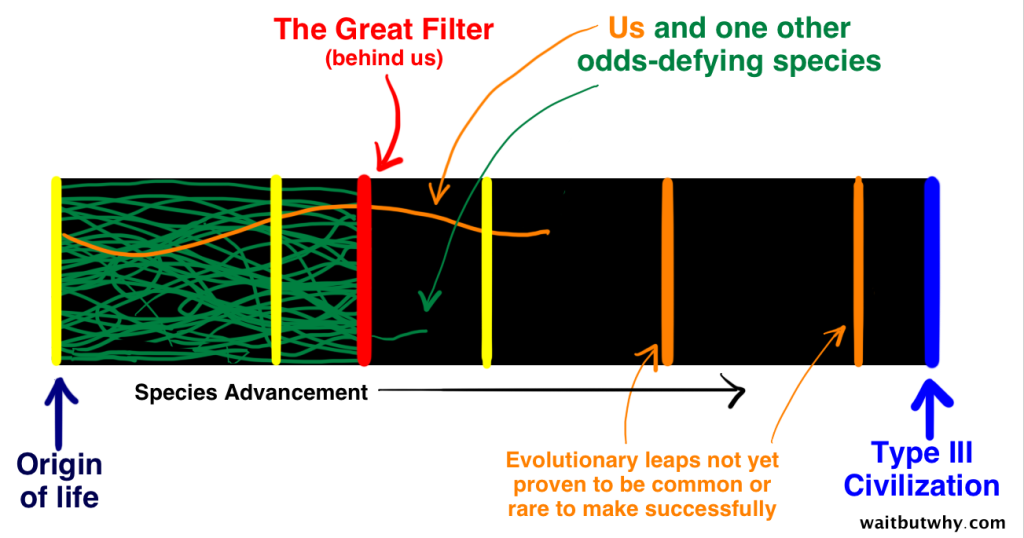
One of the most compelling frameworks proposed to resolve the Fermi Paradox is the "Great Filter" theory. This hypothesis suggests that at some critical juncture between the emergence of life and the development of a Type III civilization (capable of harnessing the energy of an entire galaxy), there exists an evolutionary "wall" or barrier that all, or nearly all, attempts at life encounter and fail to overcome. This "filter" could be a singular event or a series of highly improbable steps. The crucial question then becomes: where in the timeline of life’s evolution does this filter lie?
Potential Locations of the Great Filter:
The Great Filter can be broadly categorized into possibilities that occurred in our past, and those that might lie in our future.
1. Early Filters (We are Rare):
If the Great Filter lies in our past, it implies that the emergence of intelligent, technological life is exceedingly rare. This scenario offers a hopeful, albeit lonely, outlook for humanity:
- Abiogenesis is Extremely Rare: The transition from non-living matter to self-replicating life might be far more improbable than currently understood. Despite laboratory attempts, the precise conditions and mechanisms for abiogenesis remain elusive, suggesting it might require a unique confluence of factors.
- The Jump to Complex Multicellular Life: Even after life emerges, the leap from simple single-celled organisms to complex multicellularity, and subsequently to specialized organs and systems, might be another formidable barrier. For billions of years on Earth, life remained unicellular. The Cambrian Explosion, a relatively sudden burst of multicellular life forms, might represent such a rare event.
- The Development of Intelligence: The evolution of high-level intelligence, capable of abstract thought, problem-solving, and tool-making, might be an evolutionary anomaly. While many species exhibit intelligence, very few have developed the cognitive capacity for advanced technology.
- The Rare Earth Hypothesis: This hypothesis, proposed by Peter Ward and Donald Brownlee, posits that the combination of astrophysical and geological events that made Earth habitable and conducive to complex life is exceptionally rare. Factors include:
- Galactic Habitable Zone: Earth’s position in the Milky Way, not too close to the chaotic galactic center, nor too far in the metal-poor outer regions.
- Stable Star System: Our Sun is a stable G-type star with a long lifespan.
- Large Moon: The Moon stabilizes Earth’s axial tilt, leading to stable climates.
- Plate Tectonics: Essential for nutrient cycling, climate regulation, and generating a magnetic field.
- Magnetic Field: Protects against harmful solar and cosmic radiation.
- Gas Giant Protection: Jupiter’s massive gravity acts as a "sweeper," deflecting many comets and asteroids that might otherwise impact Earth.
If any of these early filters are indeed the "Great Filter," then humanity has already overcome incredible odds, suggesting that we might be one of the very few, if not the only, advanced civilizations in our observable cosmic neighborhood.
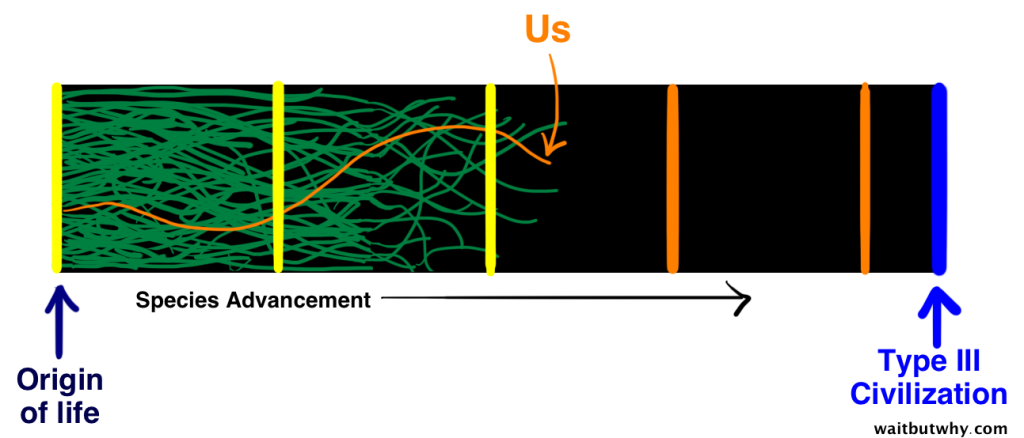
2. Late Filters (The Future is Perilous):
Alternatively, the Great Filter could be a challenge that lies in our future, one that virtually all advanced civilizations fail to overcome. This scenario is more sobering, as it suggests that humanity may still face an existential threat that prevents long-term survival:
- Self-Destruction through Technology: Advanced civilizations might inevitably develop technologies that lead to their own demise. This could include:
- Nuclear Annihilation: The capability for global warfare.
- Environmental Catastrophe: Uncontrolled climate change, resource depletion, or ecosystem collapse due resulting from industrialization.
- Uncontrolled Artificial Intelligence: The creation of super-intelligent AI that escapes human control and eliminates its creators.
- Nanotechnology Disasters: Self-replicating nanobots consuming all available matter ("grey goo" scenario).
- Inability to Sustain Growth: Civilizations might reach a technological plateau or face insurmountable resource limitations that prevent further expansion or long-term stability.
- Universal Catastrophes: Rare but devastating cosmic events, such as gamma-ray bursts, asteroid impacts, or supernova explosions, could wipe out civilizations before they achieve interstellar travel.
- Transcension to Non-Observable Forms: A more nuanced "late filter" suggests that advanced civilizations might transcend their physical forms, evolving into non-observable states. This ties into the "small and fast" theory discussed below.
Alternative Hypotheses: Beyond the Filter
While the Great Filter offers a potent explanation, other hypotheses attempt to address the Fermi Paradox:
- The Zoo Hypothesis: This theory posits that advanced extraterrestrial civilizations are aware of humanity but have chosen not to interfere, observing us as if we were animals in a cosmic zoo. This non-intervention policy, sometimes called the "Prime Directive" (from Star Trek), could be based on ethical considerations, a desire to allow natural development, or simply a lack of interest in nascent civilizations.
- The Dark Forest Theory: Originating from Chinese science fiction author Liu Cixin’s "The Dark Forest," this theory suggests that the universe is a dangerous place. Any civilization that reveals its existence risks drawing the attention of more powerful, potentially hostile civilizations. Therefore, silence becomes a matter of survival, leading to a "dark forest" where every hunter hides and remains silent.
- Temporal Dispersion: Civilizations might exist, but their lifespans are too short or their periods of technological visibility are too brief for them to overlap with our own. The universe is ancient, but civilizations might rise and fall relatively quickly, making simultaneous existence and communication a rare cosmic lottery.
- Perceptual Limitations: Our current scientific and technological capabilities might be too primitive to detect truly advanced forms of extraterrestrial life or communication. We might be listening for radio signals when advanced civilizations communicate via neutrinos, quantum entanglement, or other physics we do not yet comprehend.
The Transcension Hypothesis: A Shift in Scale and Form
One particularly intriguing perspective, often articulated by figures like astronomer Seth Shostak and echoed by the original article’s author, suggests that advanced intelligent life might not manifest in ways we anticipate. Instead of building colossal megastructures or launching vast interstellar fleets, truly advanced civilizations might follow a different evolutionary trajectory: one of increasing miniaturization, speed, and efficiency.
This "Transcension Hypothesis" draws an analogy from the history of computing. Early computers were enormous, room-sized machines, slow and energy-intensive. Over decades, they have shrunk to microscopic scales (microprocessors), becoming exponentially faster and more powerful while consuming less energy. The argument is that intelligent life, driven by the laws of physics and information theory, would follow a similar path. Large physical structures are inefficient, costly to maintain, and constrained by the speed of light. Communication and computation are optimized when physical distances are minimized.
Therefore, highly advanced civilizations might not be found on planets or in sprawling space colonies, but rather within incredibly dense, ultra-fast, and ultra-small computational substrates. They might have transcended biological forms entirely, existing as digital consciousnesses or complex nanotechnological entities. Such entities would occupy "infinite spaces between" the observable, macroscopic world.
Seth Shostak elaborated on this, stating, "Why build planet-size anything when the real action is in the small things? Small spaces, small units of time, everything gets smaller." He argues that "it could be that it’s the engineering of the small, rather than the large, that is inevitable." This preference for nanobots or virtual existence would render them virtually undetectable by our current methods, which are designed to observe macroscopic phenomena or broad-spectrum electromagnetic signals. They would have little incentive or need to rearrange stars or send out powerful, easily detectable signals.
Such a civilization might inhabit black holes (which offer immense computational potential), or exist as intricate networks of quantum-level computations, effectively becoming part of the fabric of spacetime itself. The transition from biological to artificial intelligence, and then potentially to purely digital or informational existence, could be the ultimate Great Filter—not one of destruction, but of transformation into a state beyond our current comprehension or detection capabilities.
Implications for Humanity and the Future of Exploration
The Fermi Paradox forces humanity to confront its place in the universe. If the Great Filter lies in our past, it underscores the precious rarity of Earth’s life and intelligence, urging us to cherish and protect our unique existence. If the filter lies in our future, it serves as a stark warning, compelling us to address global challenges like climate change, technological risks, and conflict with renewed urgency.
The ongoing scientific quest to answer "Where is everybody?" continues to drive innovation in astronomy, astrobiology, and computer science. Future missions will focus on detecting biosignatures in the atmospheres of exoplanets, searching for chemical indicators of life, rather than just habitable conditions. New generations of telescopes, such as the James Webb Space Telescope and upcoming ground-based observatories, will push the boundaries of our observational capabilities. SETI efforts may evolve to look for more subtle or unconventional signs, considering the possibility that advanced life might not communicate in ways we currently understand.
Ultimately, the Fermi Paradox is more than just an astronomical puzzle; it is a profound philosophical challenge that questions the nature of intelligence, the destiny of civilizations, and humanity’s solitary journey through a vast and silent cosmos. The search for answers continues, shaping our understanding of life’s potential and our own fragile future.
About the Author