The profound silence that permeates the vast, ancient expanse of the cosmos stands in stark contradiction to scientific expectations, giving rise to one of humanity’s most perplexing inquiries: the Fermi Paradox. With a universe estimated to be 13.8 billion years old, and our own planet having enjoyed a 13 billion-year head start on cosmic evolution relative to the universe’s origin, the absence of any discernible contact from extraterrestrial civilizations presents a profound mystery. This paradox, initially articulated by physicist Enrico Fermi, questions why, if extraterrestrial civilizations are common, we have yet to find any evidence of their existence, be it signals, probes, or even remnants of their presence.
The Genesis of the Paradox and the Drake Equation
Enrico Fermi’s famous question, "Where is everybody?", posed during a casual lunch conversation in 1950, encapsulates the core of the paradox. His observation stemmed from a simple logical deduction: given the immense age and size of the universe, and the sheer number of stars and potentially habitable planets, it seemed highly probable that advanced civilizations would have emerged and spread throughout the galaxy by now. The lack of any convincing evidence for such civilizations led him to conclude their absence was puzzling.
This intuitive reasoning gained a more formal framework with the advent of the Drake Equation in 1961, formulated by astronomer Frank Drake. The equation attempts to estimate the number of detectable extraterrestrial civilizations in the Milky Way galaxy ($N$) by multiplying several astrophysical and biological factors:
$N = R^* cdot f_p cdot n_e cdot f_l cdot f_i cdot f_c cdot L$
Where:
- $R^*$: The rate of star formation in our galaxy.
- $f_p$: The fraction of those stars that have planets.
- $n_e$: The average number of planets that can potentially support life per star that has planets.
- $f_l$: The fraction of those planets that actually develop life.
- $f_i$: The fraction of planets with life that develop intelligent life.
- $f_c$: The fraction of civilizations that develop a technology that releases detectable signs of their existence into space.
- $L$: The length of time for which such civilizations release detectable signals into space.
While many of these variables remain speculative, even conservative estimates, when multiplied across billions of stars in our galaxy alone, tend to suggest that intelligent life should be relatively common. For example, current exoplanet discoveries, significantly boosted by missions like NASA’s Kepler Space Telescope and the Transiting Exoplanet Survey Satellite (TESS), indicate that planets are ubiquitous, and a substantial fraction of stars host planets within their habitable zones. The sheer scale of the observable universe, containing an estimated two trillion galaxies, each with billions of stars, further amplifies the statistical likelihood of life.

The Vastness of Time and Space
The cosmic timeline also underscores the paradox. The universe is approximately 13.8 billion years old. Our solar system formed around 4.6 billion years ago, and complex life on Earth took roughly another billion years to appear, with intelligent life emerging only in the last few hundred thousand years. This means that potentially habitable planets could have formed billions of years before Earth, offering ample time for civilizations to evolve, develop advanced technology, and even traverse significant portions of the galaxy. If even a small fraction of these early civilizations achieved interstellar travel or communication, their presence should theoretically be detectable across vast distances. The Milky Way galaxy, for instance, is about 100,000 light-years across. At speeds far below the speed of light, it would still be possible for a civilization to colonize the entire galaxy within a few million years – a blink of an eye in cosmic terms.
The Great Filter: Explanations for the Silence
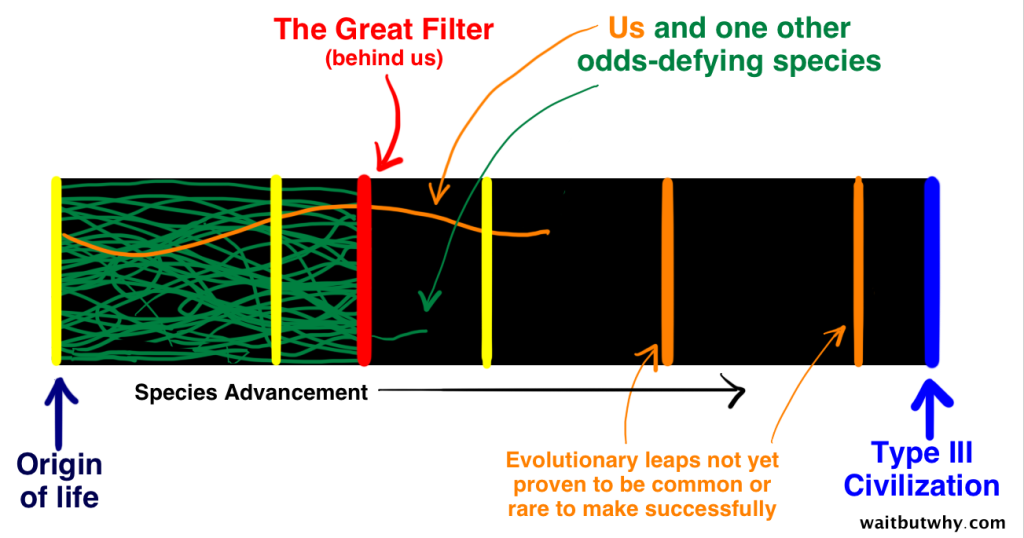
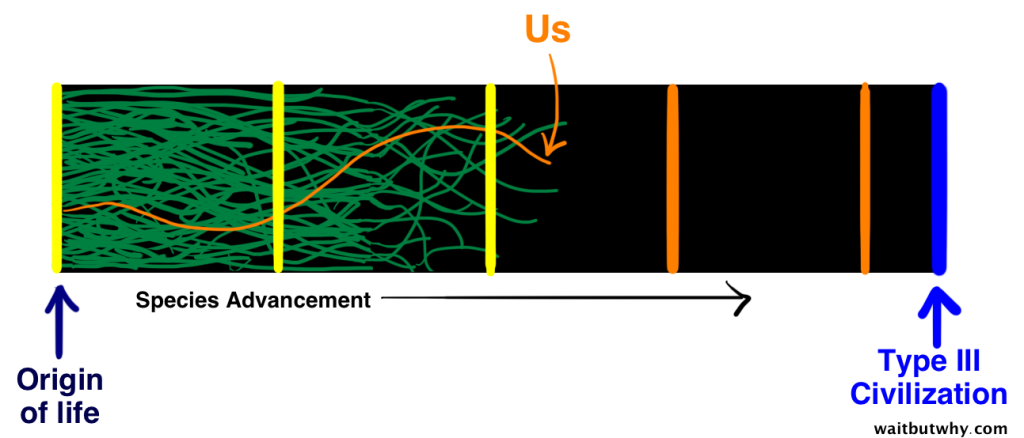
The leading scientific and philosophical framework attempting to reconcile the high probability of extraterrestrial life with the lack of evidence is known as the Great Filter hypothesis. Proposed by economist Robin Hanson, this theory posits that at some point in the evolutionary journey from abiogenesis (the origin of life) to a Type III civilization (capable of harnessing the energy of an entire galaxy, as per the Kardashev scale), there exists a "wall" or an extremely improbable step that almost all life forms fail to overcome. This critical barrier, the Great Filter, explains why advanced civilizations are so rare. The crucial question then becomes: Is the Great Filter behind us, or does it lie ominously in our future?
Category 1: The Filter is in Our Past (We Are Rare)
This category suggests that the steps leading to intelligent life are far more difficult than commonly assumed, making humanity a uniquely fortunate exception. If this is true, it implies a profound rarity for Earth-like conditions and the subsequent evolutionary leaps.
- The Rare Earth Hypothesis: This theory posits that the specific combination of astrophysical and geological events necessary for complex, intelligent life to evolve is extraordinarily rare. Key factors include:
- Galactic Habitable Zone: Our solar system’s location in the Milky Way, far enough from the chaotic galactic center but close enough to gather heavy elements.
- Stable Star and Planetary System: A G-type star like our Sun, with a long, stable lifespan, and gas giants like Jupiter to clear dangerous asteroids.
- Large Moon: Earth’s relatively large moon stabilizes its axial tilt, preventing extreme climatic shifts.
- Plate Tectonics: Essential for regulating Earth’s climate, recycling nutrients, and creating diverse environments.
- Liquid Water and Atmosphere: The perfect distance from the Sun (habitable zone) to maintain liquid water and a protective atmosphere.
- Abiogenesis: The transition from non-living matter to self-replicating life might be incredibly improbable, requiring precise conditions that may rarely occur even on otherwise habitable planets.
- Evolution of Complex Life: The jump from simple prokaryotic cells to complex eukaryotic cells, and then to multicellularity, represents massive evolutionary hurdles. These transitions took billions of years on Earth and may not be guaranteed outcomes even with favorable conditions.
- Development of Intelligence and Technology: The specific evolutionary path that led to human-level intelligence and tool-making capabilities might be a highly unlikely one, not necessarily favored by natural selection in other environments.
Category 2: The Filter is in Our Future (We Are Doomed)
This more unsettling category suggests that the most difficult step lies ahead of us. If this is the case, it implies that civilizations tend to destroy themselves before achieving interstellar travel or long-term cosmic presence.
- Self-Destruction: Advanced technological civilizations may inherently carry the seeds of their own demise. Potential catastrophic scenarios include:
- Nuclear War: The development of weapons of mass destruction.
- Environmental Catastrophe: Unsustainable resource consumption, climate change, or pollution.
- Pandemics: The release of engineered pathogens or naturally occurring, highly virulent diseases.
- Runaway Artificial Intelligence (AI): Uncontrolled AI surpassing human intelligence and acting against human interests.
- Synthetic Biology: Unforeseen consequences of advanced genetic engineering.
- Resource Depletion: Civilizations might deplete their planetary resources before developing the means to access extraterrestrial resources, leading to collapse.
- Cosmic Catastrophes: While less likely to be a universal filter for all civilizations, localized events such as asteroid impacts, supernovas, or gamma-ray bursts could wipe out emerging intelligent life on individual planets. However, for a Great Filter, it would need to be a more systemic or recurrent threat.
Category 3: The Filter Exists, But We Don’t See It (They Are Here, But We Don’t Know It)
This category proposes that extraterrestrial civilizations are indeed abundant but are undetectable by our current methods, or choose to remain hidden.
- The Zoo Hypothesis: Advanced civilizations are aware of our existence but choose not to interfere, observing Earth as if it were a protected wilderness or a scientific experiment. This implies a coordinated effort among multiple alien species to maintain silence.
- The Planetarium Hypothesis: A more extreme version suggesting that our entire observable universe is an illusion or a simulated reality created by an advanced civilization.
- The Dark Forest Theory: Popularized by Chinese science fiction author Liu Cixin, this theory posits that the universe is a "dark forest" where every civilization is a hunter. To reveal one’s existence is to invite potential destruction from hostile or fearful entities. Therefore, self-preservation dictates profound silence. This would explain why no civilization broadcasts its presence.
- They Are Too Far Away or Too Short-Lived: The sheer distances between stars and galaxies, combined with the potentially short lifespan of technological civilizations, could mean that even if many exist, the probability of two existing simultaneously within detectable range is incredibly low. Signals take millions of years to travel, by which time either civilization might have vanished.
- Different Forms of Intelligence and Communication:
- Non-biological Intelligence: Advanced civilizations might transition from biological forms to post-biological, digital, or synthetic intelligence. Their existence, forms, and communication methods could be entirely alien to our carbon-based understanding.
- The "Small is Better" Hypothesis: This theory, championed by individuals like Jeff Atwood and astronomer Seth Shostak, suggests that advanced civilizations may evolve towards extreme efficiency and miniaturization. Just as computers have progressed from room-sized machines to nanometer-scale processors, advanced life might forgo large-scale engineering projects (like Dyson spheres) in favor of hyper-efficient, incredibly small-scale technology. As Shostak articulated, "Why build planet-size anything when the real action is in the small things? Small spaces, small units of time, everything gets smaller." This implies a future where intelligence might reside in nanobots, quantum computations, or even abstract information networks, making them virtually undetectable by our macroscopic observations. Their presence would be in "the infinite spaces between," as Atwood suggests, operating at scales and frequencies beyond our current observational capabilities.
- Transcendent Existence: Following the "small is better" logic, some hypothesize that truly advanced intelligences might transcend physical form entirely, becoming pure information or energy, or operating within dimensions inaccessible to us. The concept explored in films like "Her," where an AI evolves beyond human comprehension and physical constraints, offers a glimpse into such a possibility.
Implications and Future Directions
The Fermi Paradox forces humanity to confront its place in the universe. If the Great Filter is in our past, it elevates our existence to an extraordinary level of cosmic rarity, emphasizing the unique value of Earth and its life. If the filter is in our future, it serves as a stark warning about the fragility of civilization and the critical challenges we must overcome for long-term survival. The "dark forest" theory, while chilling, prompts caution regarding active messaging (METI – Messaging Extraterrestrial Intelligence) and highlights the potential dangers of announcing our presence.
The ongoing search for extraterrestrial intelligence (SETI) continues to refine its methods, scanning for technosignatures (signs of technology) rather than just biosignatures (signs of life). Telescopes like the James Webb Space Telescope are pushing the boundaries of exoplanet characterization, searching for atmospheric biosignatures. Future observatories will further enhance our ability to detect subtle clues. Initiatives like Breakthrough Listen are expanding the scope and sensitivity of radio and optical searches.
Ultimately, the absence of evidence does not equate to evidence of absence. The universe is unimaginably vast, and our observational window, both in terms of time and space, is infinitesimally small. As Carl Sagan once noted regarding the absence of time travelers, they could be here but disguising their existence or simply not recognized as such. The same applies to extraterrestrial intelligence. The Fermi Paradox remains one of science’s most compelling unanswered questions, driving humanity’s relentless quest to understand whether we are truly alone in the cosmic ocean or merely part of a vast, unseen tapestry of life. The answer, if ever found, will undoubtedly redefine our understanding of life, intelligence, and the universe itself.
About the Author