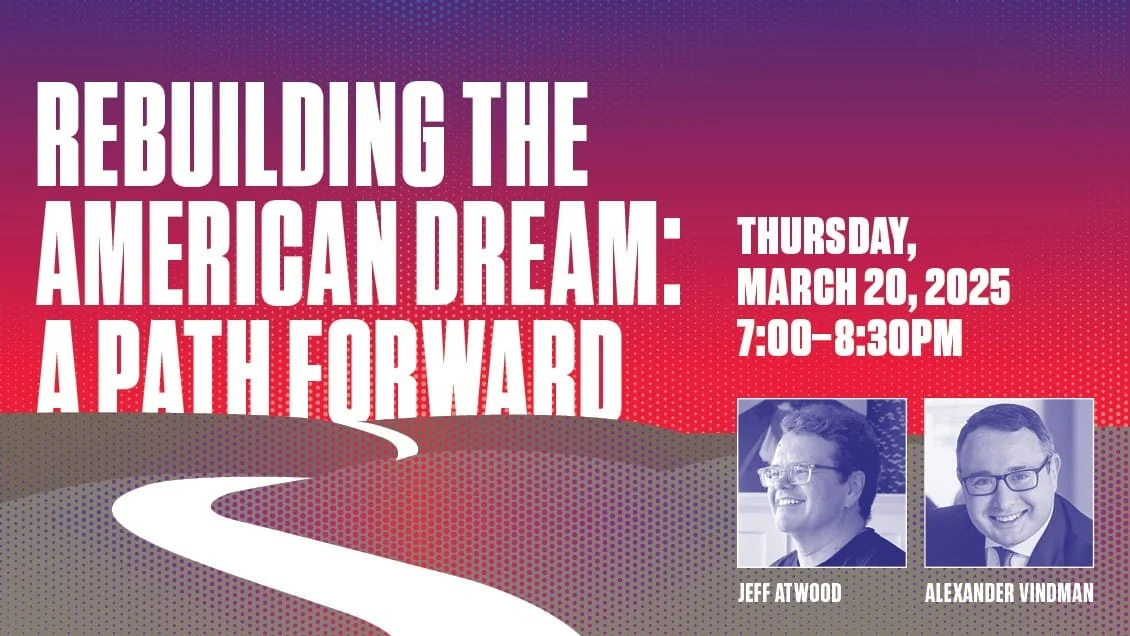
In a pivotal gathering that underscored the urgency of addressing contemporary societal challenges, tech entrepreneur and community builder Jeff Atwood joined forces with decorated military veteran and national security expert Lt. Col. Alexander Vindman (Ret.) for a landmark discussion at the historic Cooper Union Great Hall in early February 2025. The event, titled "Rebuilding The American Dream: A Path Forward," brought together two disparate but profoundly aligned voices to dissect the intricate layers of democracy, community, and economic mobility in pursuit of a more equitable future for all Americans. The conversation, streamed live and now available on the Cooper Union Great Hall YouTube channel, aimed to move beyond individual acts of generosity towards structural changes that foster security, dignity, and possibility on a national scale.
The Convergence of Minds: Tech and Civic Duty
The event marked a significant moment in public discourse, pairing Jeff Atwood, a figure renowned for co-founding influential online platforms like Stack Overflow and Discourse, with Alexander Vindman, whose unwavering commitment to democratic principles during a period of intense national scrutiny captivated global attention. Atwood, through his popular blog "Coding Horror," had previously articulated the concept of "staying gold"—a proactive endeavor to preserve the best aspects of oneself, one’s community, and the foundational promise of the American Dream. This philosophy, he explained, necessitates difficult conversations and decisive action to confront past realities, assess current standings, and define future aspirations. His collaboration with Vindman, a man he deeply admires for "putting everything on the line to defend the ideals of democracy," represented a tangible step in this ongoing commitment.
Colonel Vindman’s presence brought the gravitas of a life dedicated to service and principle. Born in the Soviet Union and immigrating to the United States as a child, his journey from Brooklyn to a distinguished 21-year career in the U.S. Army, including earning a Purple Heart in Iraq and serving as Director for European Affairs on the National Security Council, embodies a profound understanding of civic duty. His highly publicized decision to prioritize truth and national values over personal career advancement during a critical juncture in American politics cemented his reputation as a defender of democratic institutions. Atwood openly acknowledged his intent to learn from Vindman’s embodiment of civic duty, recognizing the parallels between upholding constitutional values and maintaining the integrity of large-scale digital communities.
A Historic Venue for Critical Dialogue
The choice of the Cooper Union Great Hall as the venue for this crucial dialogue was itself symbolic. Nestled in New York City, the Great Hall has a storied history as a cradle of transformative ideas and pivotal speeches that have shaped the American narrative. From Abraham Lincoln’s anti-slavery address in 1860, which significantly boosted his presidential campaign, to speeches by U.S. Presidents Ulysses S. Grant, Theodore Roosevelt, and Bill Clinton, and civil rights leaders like Frederick Douglass and Susan B. Anthony, the hall has consistently served as a platform for challenging the status quo and envisioning progress. Its walls have borne witness to the birth of the NAACP, the American Red Cross, and the women’s suffrage movement, imbuing the recent event with a legacy of activism and profound societal change. This historical resonance underscored the gravity of the discussion, signaling that the issues at hand—the health of American democracy, the strength of its communities, and the accessibility of its economic opportunities—are as fundamental today as they were in previous eras of national introspection.
Deconstructing the American Dream in 2025
The central theme of the discussion revolved around the enduring yet increasingly questioned concept of the American Dream. Traditionally defined as the promise that hard work, fairness, and opportunity can lead to a better life, the speakers posited that by 2025, this promise felt more like a profound question: "How can we build on our dream so that it works for everyone?" The joint talk delved into this query through the interconnected lenses of democracy, community, and economic mobility. Despite their vastly different professional backgrounds—one a builder of digital worlds, the other a guardian of geopolitical stability—Atwood and Vindman shared an unwavering conviction that "everyone’s American Dream is worth fighting for."
Their approach acknowledged the inherent complexities of achieving long-term structural change. Atwood, drawing from his experience in designing self-governing digital spaces, emphasized that whether one is "running a country or running a forum, the same rules seem to apply: people need clear expectations, fair systems, strong boundaries, and a shared sense of purpose." This analogy served as a bridge between the often-abstract challenges of national governance and the concrete mechanisms of community management, suggesting that lessons from effective online interaction could inform broader societal reforms.
The Erosion and Resilience of Democratic Ideals
The discussion on democracy touched upon the challenges facing modern republics, including political polarization, the spread of misinformation, and declining public trust in institutions. Colonel Vindman, speaking from his direct experience within the national security apparatus, offered critical insights into the fragility and resilience of democratic norms. His perspective highlighted the constant vigilance required to safeguard the rule of law and the principles of accountability. The discourse acknowledged that while the U.S. boasts a robust constitutional framework, its effective functioning relies heavily on the commitment of its citizens and leaders to uphold its foundational values.
Data from recent surveys underscore these concerns. A 2024 Pew Research Center study, for instance, revealed that only 20% of Americans trust the government "always or most of the time," a stark contrast to the 77% recorded in 1964. Furthermore, perceptions of democratic health vary significantly across political lines, contributing to a fractured national consensus on fundamental issues. Vindman’s personal narrative served as a powerful reminder that democracy is not a passive inheritance but an active responsibility, requiring individuals to make difficult choices in defense of collective good. His advocacy for transparency and integrity resonates deeply in an era where trust in democratic processes is frequently tested.
Fostering Digital and Civic Communities
Atwood’s contribution heavily focused on the architecture of community, both online and offline. His work with Stack Overflow, a knowledge-sharing platform for programmers, and Discourse, an open-source forum software, provided him with unique insights into how people interact, cooperate, and conflict within structured environments. He emphasized the importance of designing "digital spaces that encourage fairness, participation, and constructive discourse," leading to "artifacts for the common good." He drew a parallel between these digital commons and physical spaces like local parks, where everyone can benefit.
The challenge, as Atwood articulated, lies in translating these principles of digital governance to broader civic engagement. In an increasingly digital world, the lines between online and offline communities blur, and the dynamics observed in virtual spaces—such as the rapid dissemination of information, the formation of echo chambers, and the challenges of moderation—have profound implications for democratic deliberation. According to a 2023 report by the Knight Foundation, digital literacy and media consumption habits significantly influence civic participation and the quality of public discourse. Atwood’s vision suggests that by applying lessons learned from building scalable, self-governing online platforms, society can cultivate more inclusive, fair, and purposeful physical communities, thereby strengthening the fabric of democracy itself.
Navigating the Labyrinth of Economic Mobility
The economic dimension of the American Dream formed a critical third pillar of the discussion. The speakers confronted the stark reality that for many Americans, particularly younger generations and marginalized communities, the promise of upward mobility feels increasingly out of reach. The narrative explored issues such as stagnant wages, rising costs of living, escalating student debt, and persistent wealth inequality.
Supporting data paints a sobering picture: a 2024 analysis by the Economic Policy Institute indicated that while productivity has grown significantly over the past few decades, real wages for the majority of workers have largely stagnated. Concurrently, the top 1% of earners continue to capture a disproportionate share of national income. A recent Federal Reserve report highlighted the widening wealth gap, with the median net worth of the wealthiest 10% of families being 14 times higher than that of the bottom 50%. These trends challenge the core tenet of the American Dream, suggesting that hard work alone may no longer guarantee a better future without systemic support. The conversation aimed to identify concrete strategies to foster economic systems that genuinely create security, dignity, and possibility for all, moving beyond individual philanthropy to structural solutions that address root causes of inequality.
The "Stay Gold" Ethos: A Call to Action
The event served as a practical extension of Atwood’s "Stay Gold" philosophy, moving from theoretical ideals to actionable strategies. He openly admitted that the missing piece of his earlier reflections was "how to make long-term structural change that creates opportunity for everyone." This collaborative effort with Vindman was designed to bridge that gap. The speakers acknowledged the immense complexity of the problem but expressed optimism that focused efforts in specific areas could catalyze foundational shifts in the country’s trajectory.
Their vision articulated a shift "beyond individual generosity and toward systems that create security, dignity, and possibility for all." This call for systemic reform resonated with growing demands for policies that address housing affordability, universal access to quality education and healthcare, and robust social safety nets. The implication is that while individual effort is vital, it must be complemented by governmental and societal structures that provide a fair playing field and genuine opportunities for advancement, irrespective of one’s starting point.
Reactions and Broader Implications
The joint talk garnered significant attention, both from those engaged in tech and civic reform. Representatives from Cooper Union expressed pride in hosting a dialogue that continued its tradition of fostering crucial national conversations. Dr. Laura Miller, a political science professor specializing in civic engagement, noted, "This pairing is ingenious. Atwood brings a practical, scalable approach from the digital world, while Vindman offers a profound moral compass from the realm of public service. Together, they represent a powerful synthesis for tackling 21st-century challenges to the American Dream." Online, the live stream and subsequent video garnered thousands of views, sparking lively discussions across social media platforms and forums, indicating a widespread appetite for substantive conversations on these critical issues.
The broader implications of this collaboration are manifold. It signaled a growing recognition that solutions to national problems require interdisciplinary approaches, bridging sectors that have historically operated in silos. Atwood’s foray into civic architecture from digital architecture suggests a potential new model for public intellectuals: leveraging expertise gained in one domain to inform and improve another. Vindman’s continued advocacy post-military service highlights the ongoing role that individuals can play in shaping public discourse and upholding democratic values.
Looking Forward: A Blueprint for Collective Action
While acknowledging that easy answers are elusive, Atwood and Vindman promised an "honest, unfiltered conversation about how we move forward, with specifics." Colonel Vindman’s perspective, rooted in embodying American ideals under duress, offered a moral anchor, while Atwood’s experience in building scalable, self-governing digital communities provided a practical framework for structural change. The synergy of these experiences, they argued, was "far more relevant to the future of democracy than I ever would have dreamed possible."
The closing message of the event was a powerful call for collective action: "Imagine what we can do if Alex and I work together. Imagine what we could do if we all worked together." This statement encapsulated the hope that by fostering collaboration across diverse backgrounds and expertise, society can move towards building a more inclusive, resilient, and truly democratic American Dream for future generations. The event at Cooper Union Great Hall was not merely a discussion; it was a blueprint for a path forward, emphasizing that the revitalization of the American Dream rests on shared purpose, robust systems, and the unwavering commitment of its people.
About the Author