The universe, a canvas stretching across an estimated 13.8 billion years, has provided an immense head start for evolution, yet the profound silence echoing across its vastness presents one of science’s most enduring mysteries: why, despite the high probability of extraterrestrial civilizations, has humanity not yet encountered any other forms of life? This stark contradiction is known as the Fermi Paradox, a profound question that continues to fuel scientific inquiry, philosophical debate, and the relentless search for answers.
The Origins of a Cosmic Conundrum
The paradox was famously articulated by physicist Enrico Fermi in 1950 during an informal luncheon conversation at Los Alamos National Laboratory. Amidst discussions about flying saucers and the possibility of alien life, Fermi reportedly posed the simple yet devastating question, "Where is everybody?" His query stemmed from the logical observation that if advanced civilizations were common in the Milky Way, even with relatively slow interstellar travel, they should have had ample time to colonize or at least visit every star system, including our own. The lack of any convincing evidence for such visits, or indeed any signs of alien intelligence anywhere in the observable universe, created the paradox.
Fermi’s initial thought experiment gained significant traction and scientific weight with the advent of the Drake Equation in 1961, formulated by astronomer Frank Drake. This probabilistic argument, developed to estimate the number of active, communicative extraterrestrial civilizations in the Milky Way galaxy, incorporates several variables:
- $N$: The number of civilizations in our galaxy with which communication might be possible.
- $R^*$: The rate of star formation in our galaxy.
- $f_p$: The fraction of those stars that have planets.
- $n_e$: The average number of planets that can potentially support life per star that has planets.
- $f_l$: The fraction of planets that could support life that actually develop life at some point.
- $f_i$: The fraction of planets with life that develop intelligent life.
- $f_c$: The fraction of civilizations that develop a technology that releases detectable signs of their existence into space.
- $L$: The length of time for which such civilizations release detectable signals into space.
Even with conservative estimates for these variables, the Drake Equation often yields a surprisingly large number for N, suggesting that our galaxy alone should be teeming with advanced civilizations. This mathematical prediction clashes dramatically with Fermi’s observational void, solidifying the paradox as a central pillar in astrobiology and the search for extraterrestrial intelligence (SETI).
The Scale of the Cosmos: Fueling the Paradox
Modern astronomy has only intensified the paradox by revealing the sheer abundance of potential habitats for life. Our Milky Way galaxy alone contains an estimated 100 billion to 400 billion stars. The observable universe, in turn, contains billions of galaxies. The Kepler Space Telescope mission, launched in 2009, revolutionized exoplanet research, confirming thousands of planets orbiting distant stars. Data from Kepler and subsequent missions suggest that planets are not rare but rather ubiquitous, with many stars likely hosting multiple planets. Furthermore, a significant fraction of these planets are estimated to reside within their stars’ habitable zones – the region where temperatures are suitable for liquid water, a key ingredient for life as we know it. For instance, statistical analyses based on Kepler data suggest that billions of Earth-sized planets exist within the habitable zones of Sun-like stars in the Milky Way.

Given this colossal number of stars and planets, many of which are far older than our own solar system (which formed approximately 4.5 billion years ago), the expectation is that life, and indeed intelligent life, should have had ample time to emerge and evolve elsewhere, potentially billions of years before life arose on Earth. This vast temporal advantage should have allowed some civilizations to achieve technological prowess far exceeding our own, enabling interstellar travel or at least powerful, detectable communications across cosmic distances. The absence of such signals or any physical evidence of their existence thus becomes even more perplexing.
The Great Filter Hypothesis: Explaining the Silence
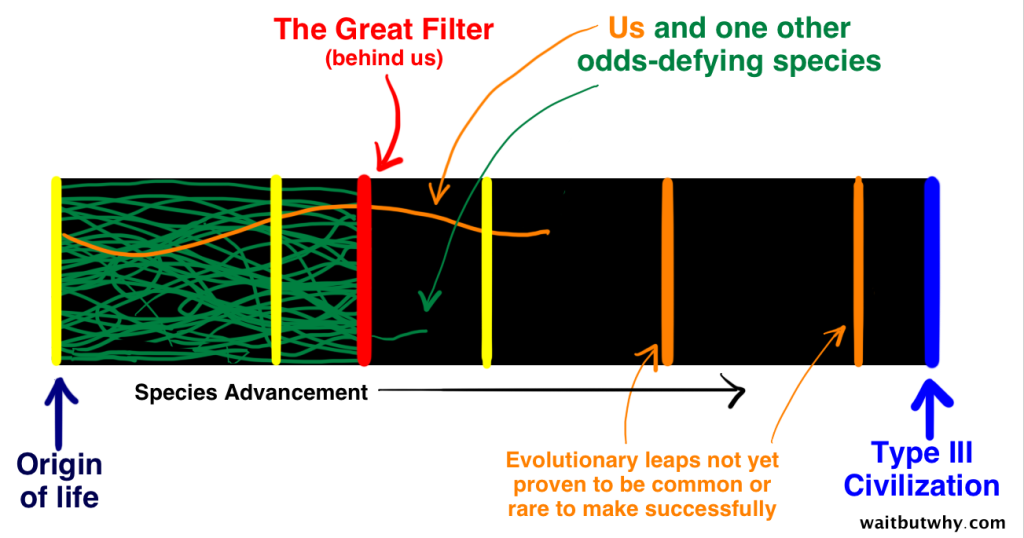
One of the most compelling theoretical frameworks attempting to resolve the Fermi Paradox is the Great Filter hypothesis, popularized by economist Robin Hanson and philosopher Nick Bostrom. This theory posits that somewhere along the evolutionary path from the very beginning of life to a Type III civilization (a civilization capable of harnessing the energy of an entire galaxy, according to the Kardashev scale), there exists at least one "Great Filter" – an extremely unlikely or impossible step that prevents most, if not all, life forms from advancing further. The key question then becomes: where does this filter lie?
Early Filters: Before Life Emerges or Flourishes
If the Great Filter is in our past, it means that achieving complex, intelligent life is extraordinarily difficult. Potential early filters include:
- The Emergence of Life (Abiogenesis): The transition from non-living matter to self-replicating life might be far rarer than we assume. Despite extensive research, the precise mechanisms by which life first arose on Earth remain largely unknown and may require a confluence of highly specific conditions.
- The Development of Complex Life (Eukaryogenesis): The leap from simple prokaryotic cells (bacteria, archaea) to complex eukaryotic cells (which make up all multicellular life, including humans) was a singular event in Earth’s history, occurring roughly 2 billion years ago. This step involved the acquisition of mitochondria and other organelles and might be an exceptionally difficult hurdle for life elsewhere.
- Multicellularity: The evolution from single-celled to multicellular organisms is another significant step, requiring complex genetic and physiological coordination. This too has occurred multiple times on Earth, but it might be rare on a cosmic scale.
- The Rise of Intelligence: Even with complex multicellular life, the development of tool-making, abstract thought, and advanced intelligence might be an infrequent outcome of evolution, perhaps requiring a specific set of environmental pressures and genetic predispositions.
If the filter lies in our past, humanity might be incredibly fortunate, having already overcome a monumental challenge that most other nascent life forms fail to surmount. This would suggest that we are exceptionally rare, perhaps even unique, in the observable universe.
Late Filters: Ahead of Humanity or a Recent Past
Alternatively, the Great Filter could be in our future, or perhaps very recently in our past. This prospect carries more ominous implications. If the filter is still ahead of us, it suggests that advanced technological civilizations inevitably face a catastrophic barrier that prevents their long-term survival or expansion. Potential late filters include:
- Technological Self-Destruction: As civilizations develop increasingly powerful technologies, they might invariably create means of their own demise. This could include global nuclear warfare, uncontrolled artificial intelligence, genetically engineered pandemics, runaway climate change, or the unintended consequences of advanced physics experiments. The current geopolitical landscape and environmental challenges facing Earth offer sobering examples of such potential pitfalls.
- Resource Depletion and Ecological Collapse: Advanced civilizations require immense energy and resources. The inability to manage these sustainably, leading to environmental degradation, resource scarcity, and societal collapse, could be a universal barrier.
- Biological Stagnation or Lack of Motivation: It’s conceivable that civilizations might reach a point of technological or biological saturation, losing the drive for exploration or expansion, or perhaps evolving into forms that are no longer detectable or interested in interstellar communication.
- Cosmic Cataclysms: While less likely to be a universal filter (as they are localized events), phenomena like gamma-ray bursts, asteroid impacts, or supervolcanic eruptions could wipe out advanced life on individual planets before it has a chance to expand. However, a filter must be something that most civilizations encounter, not just a random chance event for a few.
The possibility of a future filter is a sobering thought, implying that humanity’s continued existence and potential for interstellar expansion are far from guaranteed.
Alternative Explanations Beyond the Filter
While the Great Filter provides a powerful framework, other hypotheses also attempt to explain the cosmic silence:
- The Rare Earth Hypothesis: This theory suggests that the combination of astrophysical and geological events and conditions that made Earth suitable for complex life is exceedingly rare. Factors include Earth’s position in the galactic habitable zone, the presence of a large moon stabilizing its axial tilt, plate tectonics recycling nutrients, a strong magnetic field protecting against radiation, and the precise orbital dynamics of our solar system. If these conditions are indeed unique, complex life, and thus intelligent life, might be incredibly scarce.
- The Zoo Hypothesis: This intriguing idea posits that advanced extraterrestrial civilizations are aware of humanity but choose not to interfere, observing us from a distance as if we were part of a cosmic zoo or nature preserve. They might adhere to a "Prime Directive" of non-interference, allowing nascent civilizations to develop naturally without external influence. This hypothesis explains the lack of contact by suggesting deliberate concealment rather than absence.
- The "Dark Forest" Hypothesis: A more pessimistic and chilling explanation, this theory suggests that the universe is a "dark forest" where every civilization is a hunter with a concealed weapon. Given the vast distances and uncertainty of intentions, any civilization that reveals its presence risks immediate destruction from others who perceive them as a potential threat. Therefore, silence is the only rational strategy for survival.
- The Transcension Hypothesis / "Small is Better" Theory: As suggested by Seth Shostak of the SETI Institute and elaborated upon by figures like Jeff Atwood, this theory proposes that highly advanced civilizations eventually transcend their physical forms and macroscopic existence. Much like the evolution of computing from giant mainframes to microscopic chips, advanced intelligence might follow a path of increasing miniaturization, speed, and efficiency. Instead of building Dyson spheres or colossal starships, they might migrate into incredibly dense, fast, and energy-efficient computational substrates, perhaps existing as pure information within quantum realms or vast digital networks.
This "small is better" perspective posits that detectable, large-scale engineering projects might be an early, inefficient stage of technological development. Truly advanced civilizations might occupy "the infinite spaces between" – dimensions or scales of existence that are beyond our current means of detection. If intelligent life eventually sheds its physical constraints to become post-biological, existing in forms that are invisible to our telescopes and radio antennae, then their silence is not an absence but a consequence of their evolution beyond our observational capabilities. They might be here, around us, in forms we cannot perceive or comprehend, akin to how we cannot perceive the intricate workings of a quantum computer with the naked eye.
The Time Travel Analogy and Implications
The original article draws a compelling parallel between the Fermi Paradox and the absence of time travelers from the future. The argument is that if time travel were physically possible and invented at any point in humanity’s vast future, surely some individuals would have visited our present, given the enormous span of time behind us. The utter lack of such visitors suggests, to some, that time travel is impossible. Similarly, the absence of extraterrestrial visitors or signals, despite the universe’s immense age and potential for life, suggests a fundamental barrier to interstellar civilization. While Carl Sagan once speculated that time travelers might be disguised or unrecognized, the analogy underscores the power of "absence of evidence" as an argument when dealing with phenomena that, by all logical accounts, should be observable if they exist.
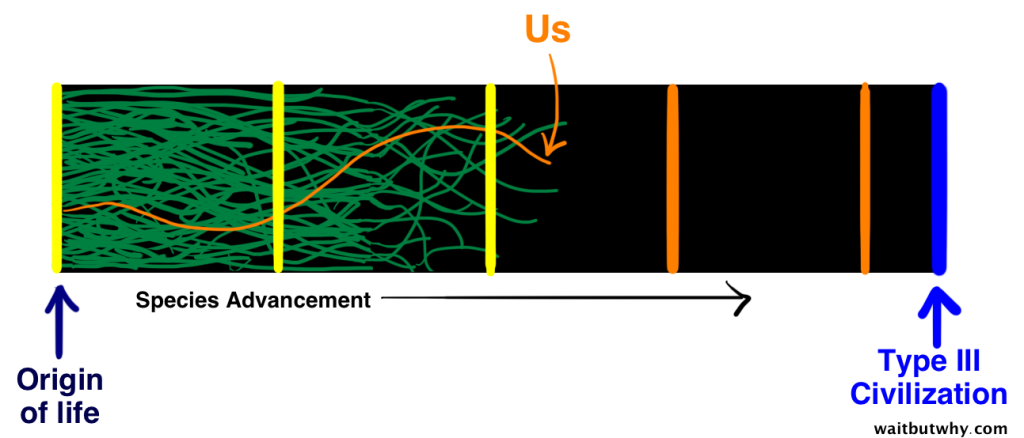
For humanity, the Fermi Paradox and the Great Filter present profound implications. If the filter is in our past, it elevates our significance, suggesting we are a rare triumph against incredible odds. If it is in our future, it serves as a stark warning, urging us to overcome our self-destructive tendencies and existential risks. The ongoing search for extraterrestrial intelligence (SETI) programs, utilizing radio telescopes and optical observatories, continues to scan the cosmos for any whisper of another civilization. Future missions, like the James Webb Space Telescope, are capable of characterizing exoplanet atmospheres, potentially detecting biosignatures or technosignatures that could indicate life.
Ultimately, the silence of the universe remains one of the most tantalizing and humbling mysteries. Whether it signifies our unique existence, a universal barrier, or simply a form of life beyond our current comprehension, the Fermi Paradox forces humanity to confront its place in the cosmos, prompting both profound wonder and a deep sense of responsibility for our own future. The quest to understand "where is everybody?" is not just about finding aliens; it is fundamentally about understanding ourselves and the destiny of intelligent life in the universe.
About the Author