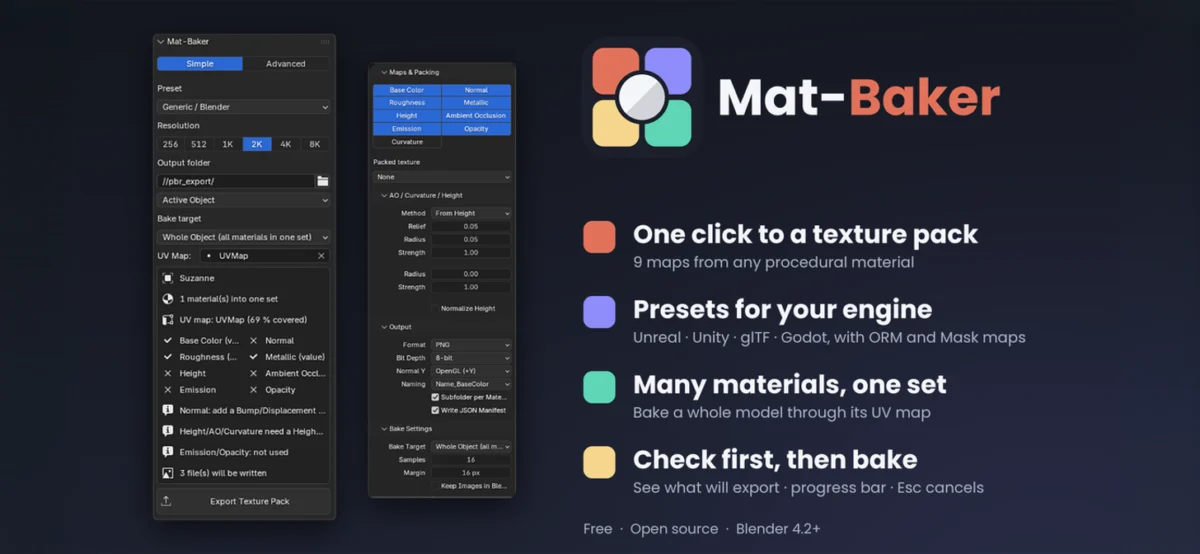
A new, free add-on for the popular 3D creation suite Blender, dubbed Mat-Baker, is poised to significantly streamline the often time-consuming process of converting complex procedural materials into usable Physically Based Rendering (PBR) texture packs. Developed with both novice and experienced users in mind, Mat-Baker aims to automate key aspects of this workflow, empowering artists to generate high-quality textures with greater efficiency and less manual intervention. This innovation arrives at a critical juncture for the 3D art community, where the demand for realistic and versatile assets continues to surge across industries like game development, architectural visualization, and visual effects.
The Challenge of Procedural to PBR Conversion
Procedural materials, generated through node-based systems within 3D software like Blender, offer immense flexibility and scalability. They allow artists to create intricate patterns, textures, and surface details that can be infinitely adjusted without degradation in quality. However, when it comes to real-time rendering engines or workflows that require discrete texture maps (such as Albedo, Normal, Roughness, Metallic, and Ambient Occlusion), these procedural setups often need to be "baked." This baking process involves rendering the procedural material onto a 2D image, effectively capturing its appearance as a set of texture maps.
Historically, this conversion has been a manual and often tedious undertaking. Artists would need to meticulously configure each texture map, ensuring correct settings for resolution, anti-aliasing, and output format. This often involved repetitive tasks, especially when dealing with multiple materials or complex node setups, leading to significant time investment and potential for user error. The introduction of PBR workflows, which simulate how light interacts with surfaces in the real world, further amplified the need for accurate and well-defined texture maps, making the baking process more crucial than ever.
Mat-Baker’s Automated Approach
Mat-Baker directly addresses these challenges by introducing an intelligent automation layer to the baking process. At its core, the add-on is designed to analyze a material’s node setup and automatically identify which standard PBR texture maps can be generated. This means users no longer need to manually set up individual bake nodes for each desired map. Instead, Mat-Baker can infer the necessary connections and settings, significantly reducing the initial configuration time.
The primary advantage lies in its "auto-detect" functionality. When a user selects a material that Mat-Baker can process, the add-on scans the node tree for common inputs and outputs associated with PBR workflows. It then presents a simplified interface where users can initiate the baking process, with the add-on handling the underlying technicalities of generating the Albedo, Normal, Roughness, Metallic, and other relevant maps. This feature is particularly beneficial for artists who prioritize speed and efficiency, allowing them to quickly generate PBR texture packs for their procedural materials without getting bogged down in the minutiae of baking node configurations.
Catering to Diverse User Needs: Simple and Advanced Modes
Recognizing that not all users have the same requirements, Mat-Baker offers two distinct modes: Simple Mode and Advanced Mode.
Simple Mode is designed for users who want a straightforward, no-fuss experience. In this mode, Mat-Baker’s automated detection takes center stage. Users can select their material, choose a target resolution, and initiate the bake. The add-on handles the rest, generating a standard set of PBR maps. This mode is ideal for quick iterations, generating assets for less demanding projects, or for those who are new to baking textures and want to avoid overwhelming complexity.
For artists who require a greater degree of control over the baking process, Advanced Mode provides a more granular set of options. This mode allows users to manually select which specific texture maps they wish to bake, overriding the automatic detection if necessary. It also exposes additional settings related to baking resolution, anti-aliasing, sample counts, and output file formats. This level of customization ensures that experienced users can fine-tune the baking process to meet the precise requirements of their projects, whether it’s achieving ultra-high-fidelity textures for cinematic rendering or optimizing texture sizes for performance-critical game environments. The ability to manually select maps also empowers users to bake custom maps or masks that might be specific to their unique node setups, further expanding the add-on’s versatility.
Key Features Highlighted
While the provided content did not explicitly list the key features in a bulleted format, based on the description, the core functionalities can be inferred and elaborated upon:
- Automated Texture Map Detection: Mat-Baker intelligently analyzes material node setups to identify the potential for generating standard PBR texture maps, eliminating the need for manual node configuration for each map type.
- Simplified Baking Workflow: Users can initiate the baking process with minimal setup, especially in Simple Mode, allowing for rapid generation of texture packs.
- Dual Mode Functionality: Offers both a user-friendly Simple Mode for quick results and an Advanced Mode for granular control over baking settings.
- Comprehensive PBR Map Generation: Designed to produce essential PBR maps such as Albedo, Normal, Roughness, Metallic, and Ambient Occlusion, facilitating compatibility with most modern rendering engines.
- Customization Options (Advanced Mode): Users can manually select specific maps to bake, adjust resolutions, anti-aliasing, and other baking parameters for tailored results.
- Free and Open-Source: Mat-Baker is provided completely free of charge, democratizing access to advanced texture creation tools for all artists.
- Offline Operation: The add-on functions entirely offline, ensuring user privacy and independence from internet connectivity.
- GPL-3.0-or-Later License: Released under a permissive open-source license, allowing for free use, modification, and distribution.
Accessibility and Community Impact
The decision to release Mat-Baker as a completely free, offline, and open-source add-on under the GPL-3.0-or-later license is a significant boon for the 3D art community. This approach fosters inclusivity, providing powerful tools to students, hobbyists, and independent developers who may not have the budget for commercial add-ons. The open-source nature also encourages community involvement, allowing other developers to contribute to its development, report bugs, and suggest new features. This collaborative model has historically driven innovation and improvement in many open-source software projects, and Mat-Baker stands to benefit from this ecosystem.
The GPL-3.0-or-later license ensures that users are free to use, modify, and distribute the software, with the caveat that any derivative works must also be released under the same or a compatible license. This promotes the continued accessibility and evolution of the tool for the benefit of the entire community.
Timeline and Release Context
While a specific release date was not provided, the availability of Mat-Baker as a free add-on suggests a recent development or an ongoing project. The increasing complexity and importance of PBR workflows across various 3D industries have created a persistent demand for tools that simplify and accelerate the creation of high-quality texture assets. This need has likely been a driving force behind the development of Mat-Baker, aiming to fill a gap in the existing Blender ecosystem. The add-on’s presence on platforms like Blender’s extension repository indicates its official integration and availability to users.
Analysis of Implications
The implications of Mat-Baker are far-reaching for 3D artists and studios alike.
- Increased Productivity: By automating and simplifying the baking process, Mat-Baker can significantly reduce the time artists spend on texture creation. This allows them to focus more on the creative aspects of their work, such as modeling, texturing artistry, and scene composition.
- Lower Barrier to Entry for PBR: The ease of use, particularly in Simple Mode, makes it more accessible for newer artists to adopt PBR workflows. This can lead to a higher overall quality of assets being produced by a wider range of creators.
- Cost-Effectiveness: As a free add-on, Mat-Baker offers a substantial cost saving compared to commercial solutions that might provide similar functionality. This is especially impactful for individuals and small studios operating on tight budgets.
- Community Empowerment: The open-source nature fosters a collaborative environment, potentially leading to rapid feature development and bug fixes driven by user feedback and contributions. This can result in a more robust and feature-rich tool over time.
- Standardization and Interoperability: By facilitating the creation of standard PBR texture maps, Mat-Baker promotes greater interoperability between different 3D software and game engines. This ensures that assets created by Blender artists can be seamlessly integrated into a wider range of pipelines.
The video demonstration, indicated by the <video> tag, likely showcases the add-on in action, illustrating its user interface and the results of the baking process. Such visual aids are invaluable for potential users in understanding the add-on’s capabilities and ease of use. The inclusion of a video further suggests that the development team is committed to providing clear documentation and support for their creation.
In conclusion, Mat-Baker represents a significant step forward in simplifying the conversion of procedural materials to PBR texture packs within Blender. Its intelligent automation, dual-mode functionality, and commitment to being free and open-source position it as an indispensable tool for 3D artists looking to enhance their workflow efficiency and elevate the quality of their digital creations. As the demand for realistic and performant 3D assets continues to grow, innovations like Mat-Baker will play a crucial role in democratizing advanced 3D content creation.
About the Author