The contemporary digital landscape is characterized by an incessant pace, where users operate with a sense of urgency, constantly seeking efficiency and instant gratification across all platforms. This pervasive demand extends even to intricate digital manipulations such as face swapping, catalyzing a significant shift in the development paradigm for such tools. Historically confined to desktop software requiring cumbersome installations and significant device resources, face swap capabilities are now predominantly migrating to lightweight, browser-based online applications. This strategic evolution by developers addresses critical user pain points: the desire to avoid software downloads, mitigate device clutter, and access advanced functionalities seamlessly from any internet-connected device. The proliferation of these online face swap apps signifies a new era of accessibility, enabling users to achieve impressive, realistic results with just a few clicks, without the traditional barriers of entry.
This transition reflects broader trends in the software industry, particularly the increasing dominance of Software-as-a-Service (SaaS) models. As internet speeds improve and cloud computing becomes more robust, the necessity for local installations diminishes. Users, ranging from casual social media enthusiasts to professional digital artists, are increasingly prioritizing convenience and flexibility. This demand has spurred intense innovation among developers, leading to a sophisticated array of online tools that leverage advanced artificial intelligence (AI) and machine learning algorithms to perform complex facial recognition, tracking, and blending with remarkable accuracy and speed. The move to browser-based solutions also inherently addresses the challenge of keeping software updated, as these platforms can be automatically refreshed by developers, ensuring users always have access to the latest features and security enhancements without manual intervention.
The Genesis of Face Swapping Technology and its Digital Evolution
The concept of manipulating faces in images predates modern AI, tracing back to early photo editing techniques and even artistic endeavors. However, the digital revolution significantly accelerated this capability. Initial attempts at digital face swapping were often rudimentary, involving manual cutting and pasting in image editing software, yielding results that were visibly artificial. The true breakthrough came with the advent of sophisticated computer vision and machine learning algorithms in the early 21st century. Early dedicated face swap applications, such as FaceApp and Snapchat filters, popularized the technology on mobile devices, demonstrating its viral potential. These early iterations, however, typically required application downloads and often had limitations in realism or flexibility.
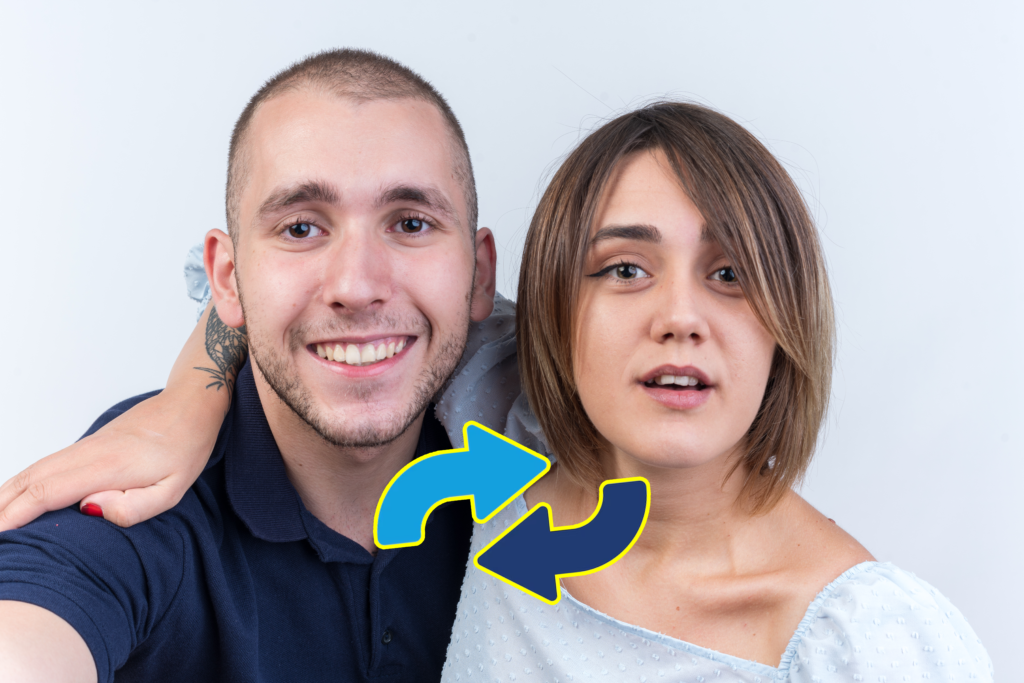
The current wave of online face swap tools represents the third major phase of this evolution, moving from desktop to mobile, and now to entirely web-based platforms. This progression is underpinned by advancements in deep learning, particularly Generative Adversarial Networks (GANs) and neural style transfer techniques. These AI models are adept at analyzing facial features, expressions, lighting, and skin tones, enabling them to seamlessly integrate a source face onto a target image or video while maintaining naturalistic continuity. The ability to perform these complex computations on cloud servers, rather than local devices, is what makes the browser-based model so effective and appealing. This technological leap allows for faster processing, higher quality outputs, and broader accessibility, democratizing a technology once reserved for specialized software and skilled professionals.
Market Dynamics and User Demand Driving Online Innovation
The global market for AI in media and entertainment, which includes advanced image and video manipulation tools like face swap applications, is experiencing exponential growth. Reports indicate that the broader AI market is projected to reach hundreds of billions of dollars in the coming years, with significant contributions from creative AI applications. User behavior data underscores the preference for instant, frictionless experiences. A substantial percentage of internet users access digital content and services primarily through web browsers, highlighting the strategic advantage of browser-based tools. Furthermore, with the average smartphone user having numerous apps installed, concerns about device storage and performance are paramount. Online tools eliminate these concerns, offering a ‘use-and-discard’ or ‘use-as-needed’ model that resonates deeply with contemporary digital consumption habits.
Developers are keenly aware of these market dynamics. Their shift towards online platforms is a direct response to user feedback emphasizing ease of access, minimal resource consumption, and cross-device compatibility. Industry analysis suggests that platforms offering intuitive user interfaces combined with powerful backend AI processing will capture significant market share. The convenience of not needing to update software manually, coupled with the ability to access projects from any device with an internet connection, positions online face swap apps as a highly attractive solution for a diverse user base, from casual hobbyists creating memes to marketing professionals generating engaging content.
Leading Online Face Swap Applications: A Curated Review
As the online face swap market matures, several platforms have distinguished themselves through their technological prowess, user experience, and commitment to quality. Here is a curated list of top online face swap applications that operate entirely within a web browser, eliminating the need for any downloads:
1. Simfa
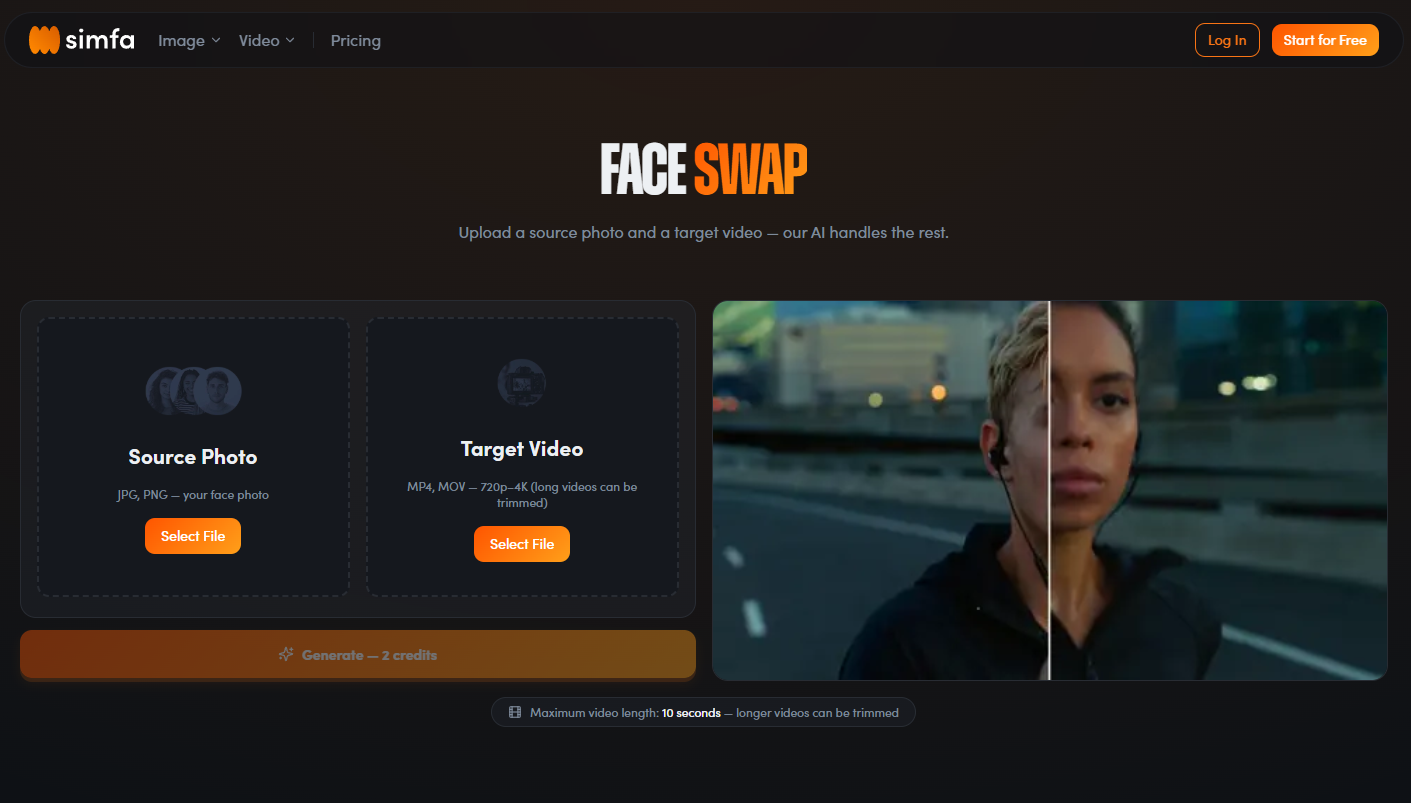
Simfa has emerged as a frontrunner in the online face swap arena, lauded for its sophisticated approach to image and video manipulation. Unlike many superficial face placers, Simfa employs a robust two-step processing pipeline designed to achieve unparalleled quality and realism. This process begins with meticulous calibration, where the AI analyzes critical facial key points, expressions, and movements within the source material. Subsequently, this intricate facial data is seamlessly transferred onto video frames or target images, ensuring that not only the face but also its nuanced expressions and movements are preserved and realistically integrated. The platform prides itself on delivering speedy results, allowing users to download their creations immediately, free from watermarks, processing queues, or any additional software installations. This emphasis on quality, efficiency, and user-centric design positions Simfa as a premium choice for creators seeking professional-grade face swaps.
Why it stands out:
- Advanced Two-Step AI Pipeline: Ensures high-fidelity face transfers that retain original expressions and movements, far exceeding simple overlays.
- Real-time Processing and Instant Download: Eliminates waiting times, providing immediate access to completed projects without delays.
- Watermark-Free Output: Professional results without branding, suitable for diverse applications.
- No Software Installation or Queue System: Offers a truly frictionless user experience, emphasizing convenience and accessibility.
- Cross-Platform Browser Compatibility: Works seamlessly across various web browsers and operating systems, enhancing user flexibility.
2. ImagineArt
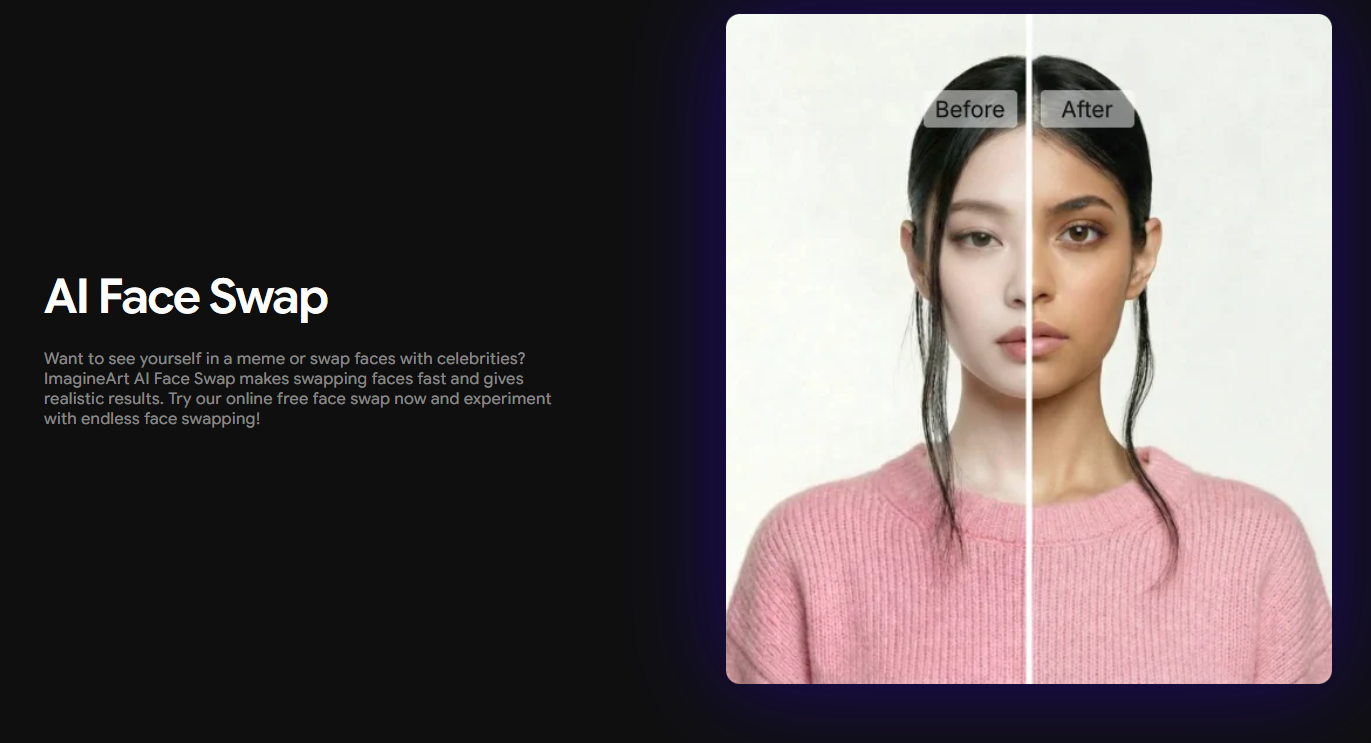
ImagineArt distinguishes itself with a remarkably clean and intuitive online interface, meticulously designed to facilitate simple yet highly effective face-swapping. Leveraging advanced AI, the platform enables users to generate multiple versions of face swaps within minutes, catering to both quick edits and more experimental creative endeavors. ImagineArt’s core strength lies in its ability to produce realistic and natural-looking results, making it accessible for anyone to swap faces with convincing authenticity. The platform’s commitment to user-friendliness ensures that even novices can achieve sophisticated outcomes without a steep learning curve, making complex AI-driven image manipulation widely available.
Why it stands out:
- User-Friendly Interface: A streamlined design that simplifies the face swap process for all skill levels.
- AI-Powered Realism: Generates highly natural and believable face swaps by intelligently blending facial features and lighting.
- Multiple Version Generation: Allows for rapid iteration and experimentation, providing diverse creative options from a single input.
- Quick Processing Times: Delivers results efficiently, aligning with the modern demand for instant digital content.
- Curated Template Library: Offers a selection of pre-designed scenarios and styles to inspire and guide users.
3. Playform
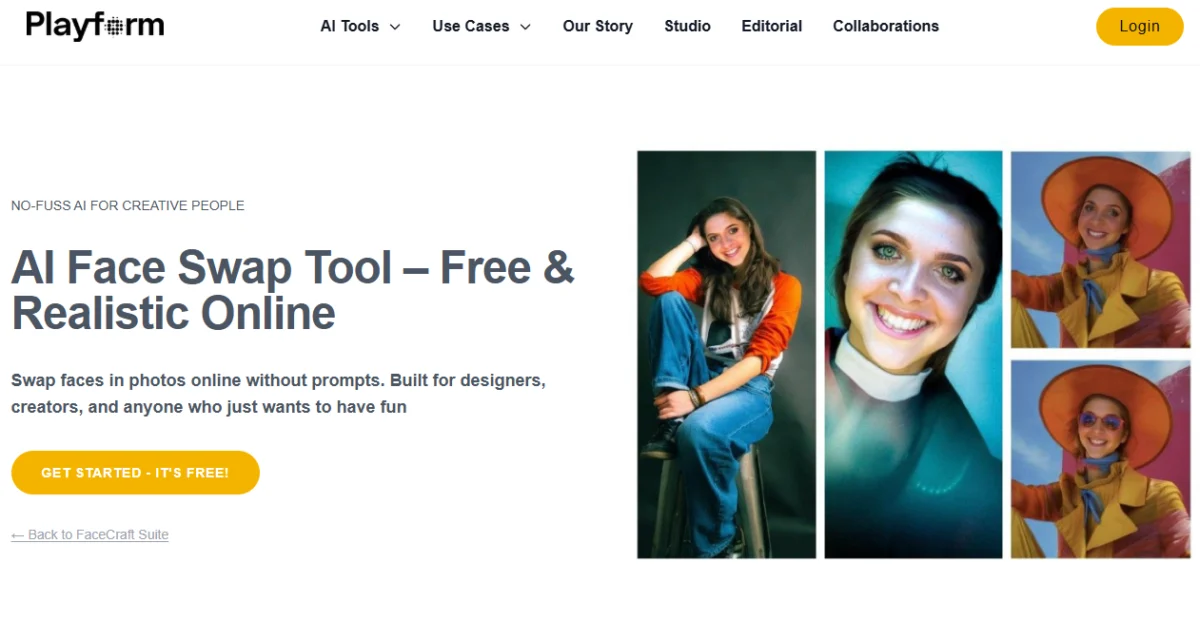
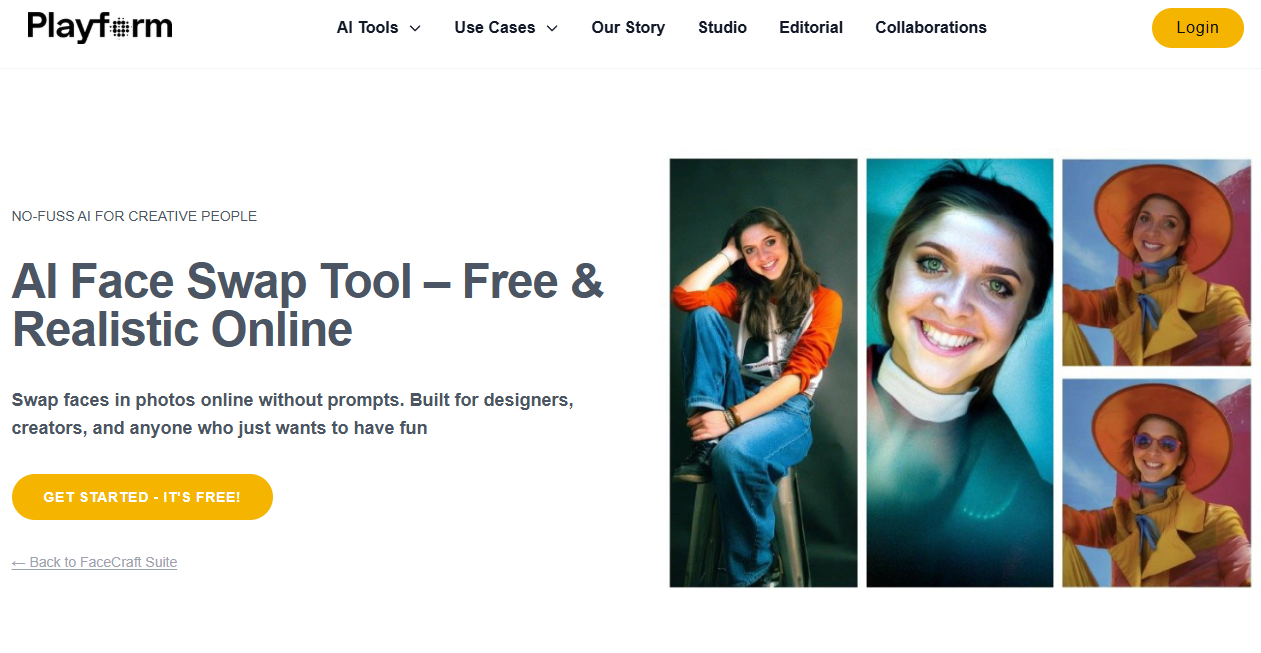
Playform sets itself apart by offering a straightforward, prompt-free face-swapping experience, streamlining the creative process into an easy three-step workflow. This approach caters specifically to users who prioritize efficiency and direct results over complex parameters. Playform excels in generating high-resolution outputs, making it an ideal tool for a variety of professional and personal projects. Whether for editorial compositions requiring pristine imagery, marketing mockups demanding visual precision, or purely for personal creative exploration and fun experiments, Playform consistently delivers superior image quality. Its focus on resolution and simplicity makes it a valuable asset for those requiring clean, crisp face swap integrations.
Why it stands out:
- Prompt-Free Operation: Simplifies the user experience by removing the need for text prompts, focusing on visual input.
- Easy Three-Step Process: Ensures a quick and intuitive workflow, making face swapping accessible to a broad audience.
- High-Resolution Output: Produces images suitable for professional applications, including print and detailed digital media.
- Versatile Use Cases: Caters to editorial, mockup, and personal projects, demonstrating broad applicability.
- Batch Processing Capability: Allows users to process multiple images simultaneously, enhancing productivity for larger projects.
4. SeaArt AI
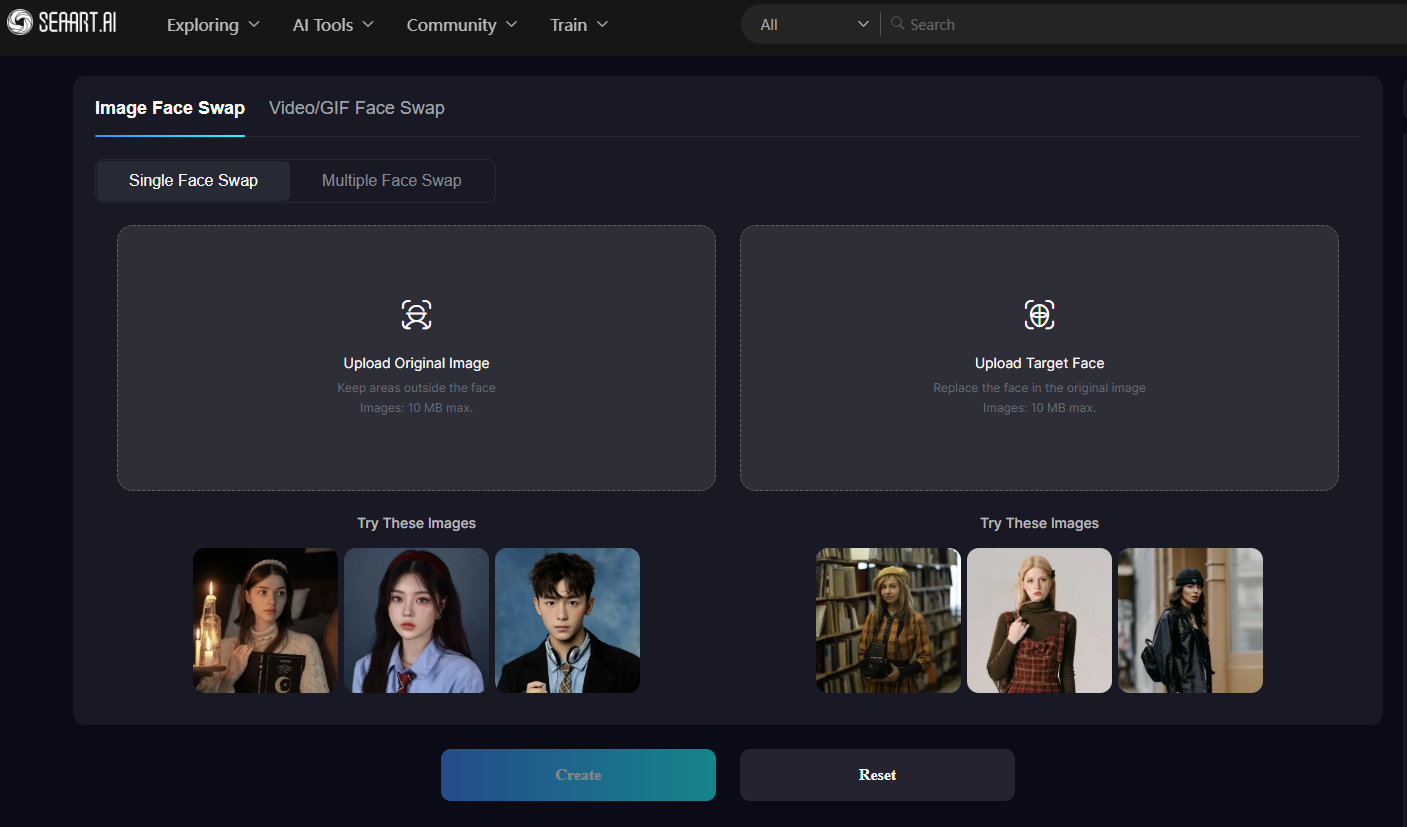
SeaArt AI stands out for its comprehensive suite of features and its robust integration of smart technology algorithms, designed to perform accurate and instant face swaps across various media types. This versatile platform supports a wide array of functionalities, including traditional image face swaps, dynamic GIF and video face swaps, celebrity face swaps, meme-oriented swaps, and even gender transformations. SeaArt AI guarantees quick results that maintain a natural and realistic appearance, minimizing the need for manual adjustments post-processing. Its expansive capabilities and commitment to seamless, high-quality output make it a highly adaptable tool for diverse creative needs, from casual entertainment to more specific content creation.
Why it stands out:
- Multi-Modal Face Swapping: Supports images, GIFs, and videos, offering extensive creative possibilities.
- Specialized Swaps: Includes features for celebrity, meme, and gender swaps, catering to popular trends and specific demands.
- Smart Technology Algorithms: Utilizes advanced AI for accurate facial detection, tracking, and seamless integration.
- Natural and Realistic Results: Achieves convincing outputs without requiring extensive manual fine-tuning.
- Extensive Template and Source Library: Provides users with a rich collection of resources for creative inspiration and application.
5. MockoFUN
MockoFUN leverages groundbreaking AI technology to facilitate rapid and efficient face changes within images. This platform is particularly appealing due to its free account offering, which grants users access to previous edits and the ability to export files without intrusive watermarks, a significant advantage in the free-tier landscape. Beyond standard face swapping, MockoFUN champions a native AI human generator, providing users with the unique capability to create customized human images for their face swap projects. This feature enhances creative control, allowing for highly personalized and unique digital compositions, making MockoFUN a powerful tool for those seeking both flexibility and advanced customization in their face swap endeavors.
Why it stands out:
- Groundbreaking AI Technology: Ensures quick and effective face alterations with high precision.
- Free Account Benefits: Offers access to edit history and watermark-free exports, providing significant value.
- Native AI Human Generator: Enables the creation of custom human images, enhancing creative control and uniqueness.
- Integrated Design Tools: Combines face swapping with other graphic design functionalities, offering a comprehensive creative suite.
- Cloud Storage for Projects: Allows users to save and access their work from anywhere, promoting flexibility and collaboration.
The Indisputable Advantages of Online Face Swap Apps
The shift towards face swap applications that function entirely online offers a compelling array of advantages over their installed software counterparts. Fundamentally, these web-based tools resolve persistent storage concerns, a critical issue in an era of ever-expanding digital content and device limitations. By processing data in the cloud, users’ devices remain uncluttered and unburdened by heavy application files.
Furthermore, web-based tools inherently benefit from automatic updates. Developers can push new features, performance enhancements, and security patches instantaneously, ensuring users always have access to the latest and most secure version of the software without any manual intervention. This contrasts sharply with installed software, which often requires users to download and install updates, sometimes disrupting workflow.
Perhaps one of the most significant benefits is device accessibility and flexibility. An online face swap app can be accessed from virtually any internet-enabled device—a desktop computer, a laptop, a tablet, or even a smartphone—regardless of its operating system. This universal access liberates users from device dependency, allowing for seamless creative work and sharing on the go, making creative expression truly portable. This flexibility is particularly valuable for individuals who work across multiple devices or who need to collaborate on projects remotely.
Navigating the Ethical Landscape: Responsible Use of Face Swap Technology
While face swapping offers immense creative potential and entertainment value, the rapid advancement and widespread accessibility of this technology necessitate a strong emphasis on ethical considerations. The ease with which realistic facial manipulations can be created carries inherent risks, particularly concerning privacy, consent, and potential misuse.
Responsible use of face swap apps mandates unwavering respect for the privacy and explicit consent of individuals whose images are utilized. Users must refrain from employing this technology to create content that could cause harm, propagate misinformation, or engage in deceptive manipulations. The creation of "deepfakes"—hyper-realistic manipulated videos or images—without consent, especially those used for malicious purposes such as defamation, harassment, or fraudulent activities, poses significant societal challenges. Such misuse can erode trust, compromise personal reputations, and even interfere with democratic processes.
Developers of these technologies also bear a significant responsibility. Implementing robust safeguards, transparent usage policies, and clear guidelines for ethical conduct are paramount. Some platforms are exploring features like watermarking manipulated content or integrating detection mechanisms to identify AI-generated media, although these solutions are still evolving. The broader industry and regulatory bodies are increasingly engaging in discussions about governing AI-generated content to mitigate potential harms while fostering innovation. Education plays a crucial role as well, ensuring users are aware of the ethical implications and legal ramifications of misusing face swap technology. Promoting digital literacy and encouraging a culture of responsibility are essential for harnessing the positive aspects of this technology while safeguarding against its darker potential.
The Future Horizon: Accessibility, Innovation, and Ethical AI
As online face swap applications continue to dominate the digital creative space, their trajectory points towards even greater accessibility, enhanced capabilities, and a heightened focus on ethical AI development. The continuous refinement of AI algorithms promises even more seamless and indistinguishable face swaps, blurring the lines between reality and digital fabrication. Future iterations may integrate more sophisticated features such as emotion transfer, age progression/regression, and even the ability to swap entire body poses, pushing the boundaries of digital identity manipulation.
The convenience offered by these browser-only solutions is undeniably a game-changer for both casual users seeking entertainment and seasoned digital artists exploring new creative frontiers. The ability to engage in complex image and video manipulation without the wait for downloads or the burden on device resources has democratized a powerful technology. This shift towards online platforms exemplifies the broader trend of cloud-centric computing, where resources are shared, access is universal, and innovation is agile.
Within this dynamic landscape, platforms like Simfa exemplify the pinnacle of current online face swap technology. By blending unparalleled convenience with sophisticated AI processing that prioritizes quality, speed, and user-friendly features, Simfa stands out as a leading solution for this fast-paced generation. Its commitment to delivering high-fidelity results without the typical constraints of traditional software makes it a compelling choice for creators who demand both efficiency and excellence. As the technology evolves, the imperative remains for both developers and users to champion responsible innovation, ensuring that the power of face swapping is wielded ethically to enrich the digital experience for all.
About the Author