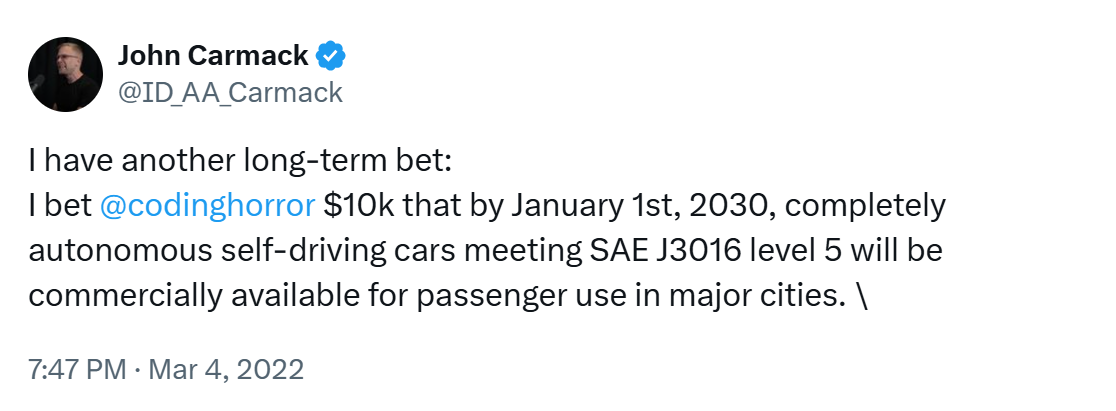
In a move that has captured the attention of the technology and automotive worlds, prominent software developer and "Coding Horror" blogger Jeff Atwood has announced a friendly but significant wager with legendary programmer and game developer John Carmack. The bet, set at $10,000 (with potential inflation adjustments), centers on a pivotal technological prediction: whether completely autonomous, SAE J3016 Level 5 self-driving cars will be commercially available for passenger use in major U.S. cities by January 1st, 2030. Atwood, known for his pragmatic and often skeptical views on emerging tech, is betting against this achievement, while Carmack, a celebrated innovator and optimist, is betting for it. The stakes, beyond bragging rights, involve a donation to the winner’s chosen 501(c)(3) charity, adding a philanthropic dimension to this high-tech prognostication.
The Specifics of the Groundbreaking Wager
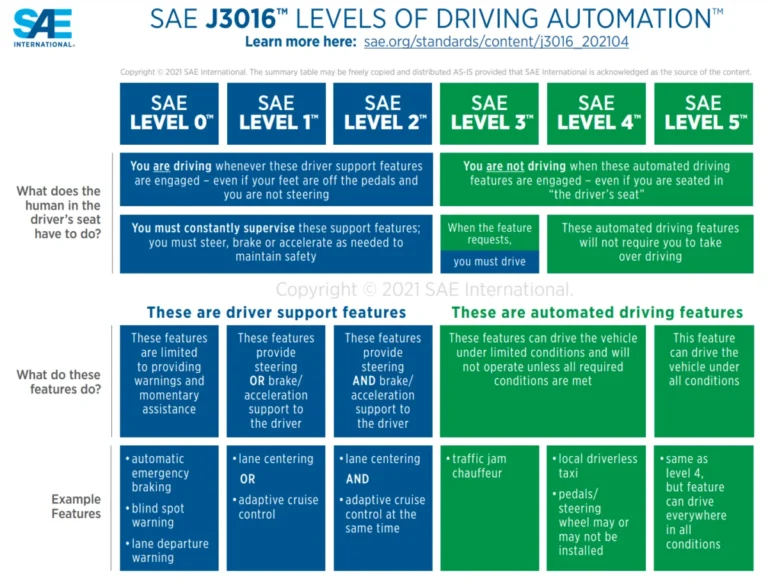
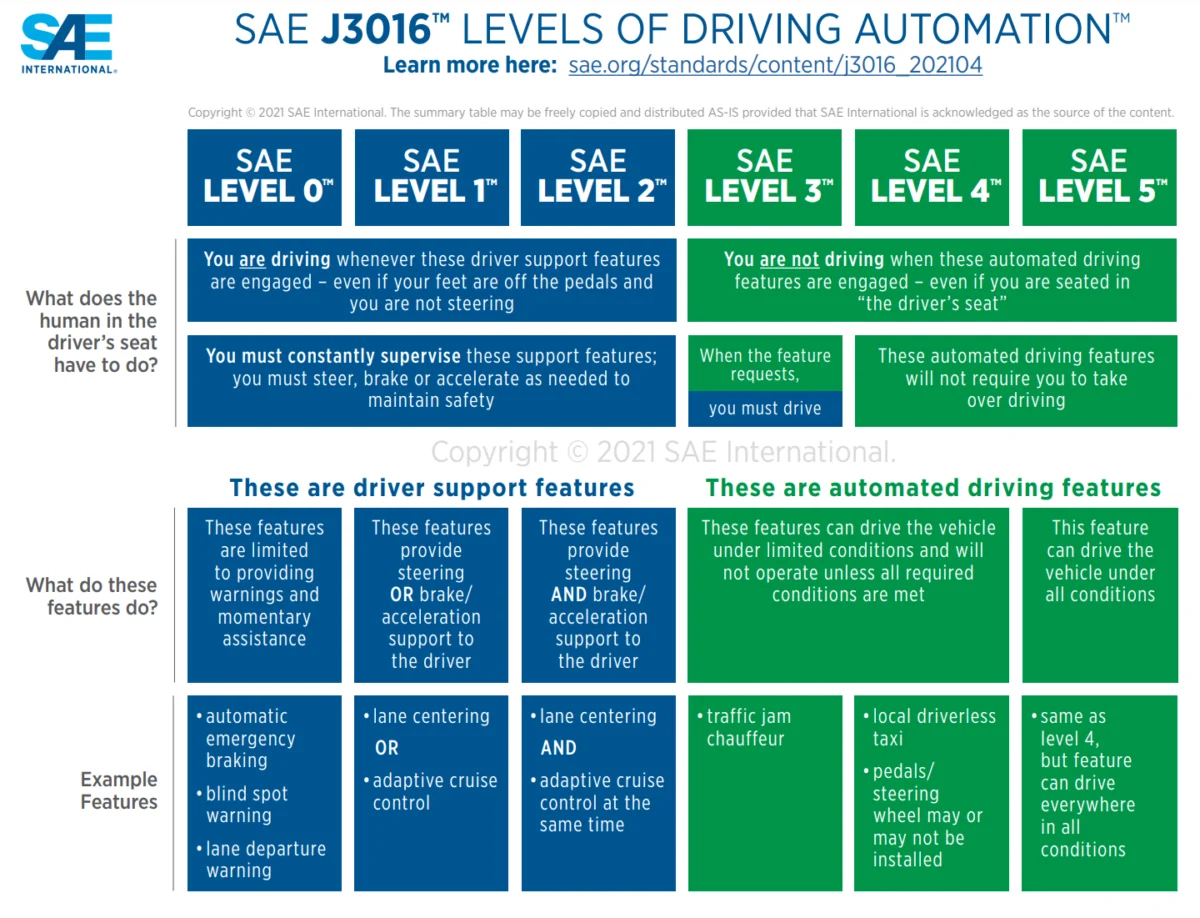
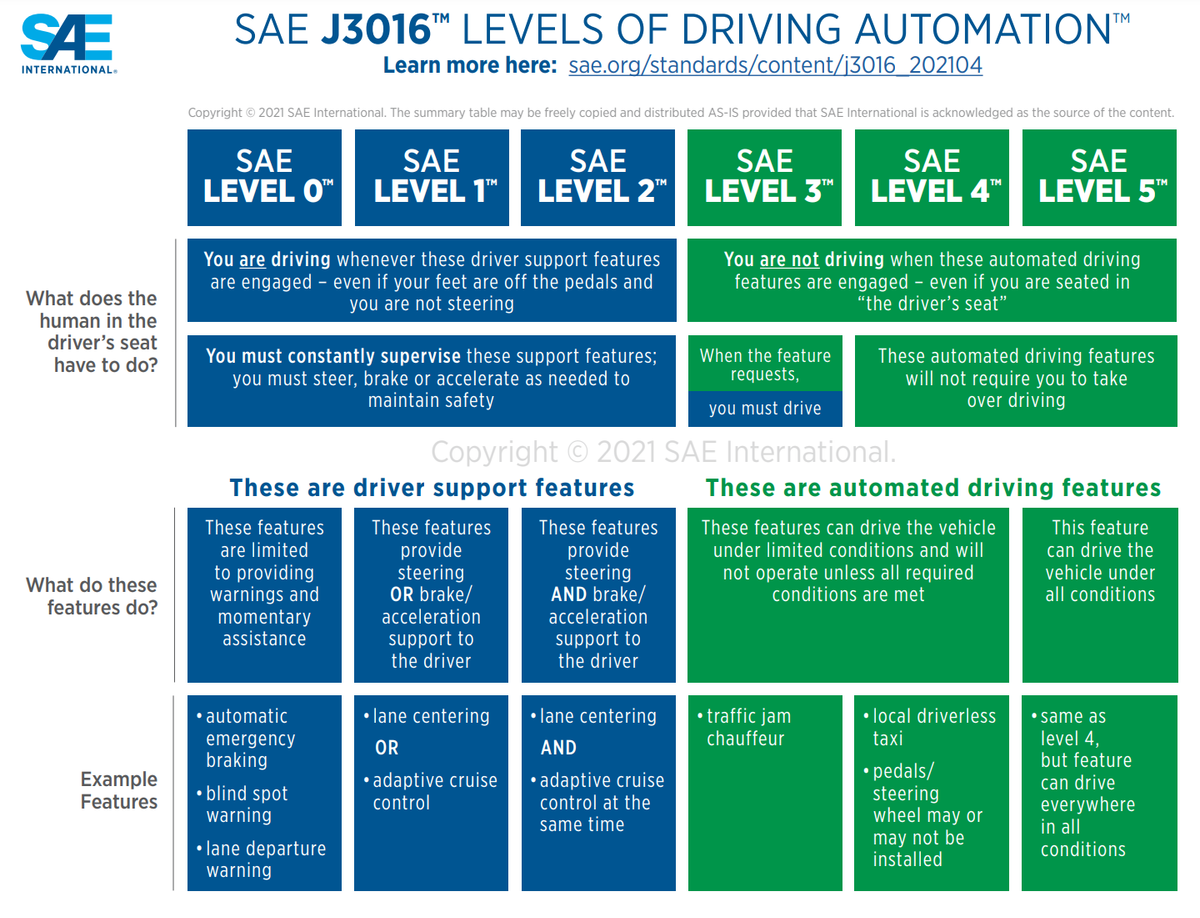
The conditions of the bet are meticulously defined, leaving little room for ambiguity. "Completely autonomous" is strictly interpreted according to the SAE J3016 Level 5 standard. This benchmark represents the pinnacle of autonomous driving, where the vehicle is expected to perform all driving tasks under all conditions, without any human intervention or attention required, save for natural disasters or emergencies. A passenger would simply enter the vehicle, select a destination, and the car would handle the entire journey. This contrasts sharply with lower levels of autonomy, such as Level 2 (partial automation, requiring driver supervision) or Level 3 (conditional automation, where the system handles most tasks but requires human takeover in certain situations), which are more prevalent today.
Furthermore, the term "major cities" is also precisely specified, referring to any of the top 10 most populous cities in the United States. These typically include metropolises like New York City, Los Angeles, Chicago, Houston, Phoenix, Philadelphia, San Antonio, San Diego, Dallas, and San Jose. The inclusion of this geographical constraint acknowledges the unique complexities of urban environments, which present far greater challenges for autonomous systems compared to more predictable highway driving. Navigating dense traffic, unpredictable pedestrians, varied infrastructure, and complex intersections demands an extremely robust and adaptable AI, a far cry from what is currently widely available.
Jeff Atwood articulated his position by stating, "I am betting against because I think everyone is underestimating how difficult fully autonomous driving really is." His skepticism is not born of opposition to the technology itself, as he expresses a personal desire for self-driving vehicles to free up his time for other activities. Instead, it stems from a deep understanding of the intricate computer science problems involved in replicating human driving intuition and adaptability across an infinite number of real-world scenarios. John Carmack, conversely, embodies the optimistic spirit often found at the forefront of technological innovation, believing that the rapid advancements in AI, machine learning, and sensor technology will surmount these challenges within the next six years.
The Protagonists: Minds Behind the Bet
The significance of this wager is amplified by the stature of its participants. Jeff Atwood is a highly respected figure in the software development community, best known for his influential blog "Coding Horror," co-founding Stack Overflow, and his contributions to various open-source projects. His insights into software engineering, user experience, and the future of technology are widely followed. Atwood’s past predictions, such as his skepticism regarding virtual reality’s widespread impact in our lifetimes (a stance he reiterates in this context, favoring AR and projection), highlight his analytical approach to technological feasibility.
John Carmack is a legendary programmer, engineer, and entrepreneur, widely regarded as one of the most influential figures in the history of video games. As co-founder of id Software, he was instrumental in developing groundbreaking titles like Doom and Quake, pushing the boundaries of 3D graphics and game engines. His career has consistently involved tackling seemingly impossible technical challenges, from rendering complex virtual worlds in real-time to his more recent work in virtual reality at Oculus VR and his current venture, Keen Technologies, focused on artificial general intelligence. Carmack’s track record of innovation and his relentless pursuit of technical solutions make him a formidable proponent of Level 5 autonomy by 2030. Atwood himself publicly credits Carmack as one of his "biggest heroes," underscoring the friendly yet intellectually rigorous nature of their engagement.
The Elusive Goal of Level 5 Autonomy: A Deep Dive into Challenges
The core of the bet rests on the formidable challenge of achieving SAE Level 5 autonomy. To truly understand Atwood’s skepticism, one must grasp the vast gulf between current autonomous capabilities and this ultimate goal. Most commercially available "self-driving" features today, such as Tesla’s Autopilot, Waymo’s driverless taxis, or Cruise’s services, operate at Level 2 or, at best, a highly restricted Level 3 or 4.
Level 4 autonomous vehicles (like those deployed by Waymo and Cruise in specific geofenced areas) can perform all driving tasks under certain conditions without human intervention. However, they are limited to defined operational design domains (ODDs), meaning they only work in specific geographical areas, weather conditions, or speeds. They still require a human to be able to take over if the system encounters a situation outside its ODD.
Level 5, by contrast, removes all these limitations. A Level 5 vehicle must be able to drive anywhere, anytime, in any legal conditions a human driver could, without any human input. This means handling:
- Extreme Weather: Heavy rain, snow, dense fog, glare from the sun, which can severely impair sensor performance (cameras, lidar, radar).
- Unforeseen "Edge Cases": The vast, almost infinite number of rare, unusual, or unpredictable scenarios that humans intuitively handle but are incredibly difficult for AI to anticipate and react to. This could include a mattress falling off a truck, a child chasing a ball into the street, complex construction zones, or nuanced social interactions on the road.
- Human Irrationality: Predicting and reacting safely to unpredictable human drivers, pedestrians, and cyclists who may not follow traffic laws.
- Infrastructure Variability: Navigating poorly marked roads, areas with missing signs, temporary traffic changes, or diverse road conditions (potholes, gravel).
- Sensor Fusion and Redundancy: Integrating data from multiple sensors (cameras, lidar, radar, ultrasonic) to create a robust and reliable environmental model, even when one sensor is compromised.
- Real-time Decision Making: Processing vast amounts of data and making split-second, ethical, and safe decisions in complex, dynamic environments.
Current autonomous systems still struggle significantly with these challenges. While deep learning has made incredible strides in perception (identifying objects), robust decision-making in novel situations remains a hurdle. The "long tail" of unforeseen events continues to be a major obstacle, requiring not just more data, but fundamentally more intelligent and adaptable AI.
A Historical Perspective: The Evolution of Autonomous Promises
The dream of self-driving cars is not new. Early concepts date back to the 1930s, with prototypes emerging in the 1980s (e.g., Carnegie Mellon’s ALVINN project). However, the modern era of autonomous vehicle development truly began with the DARPA Grand Challenges in the mid-2000s, which spurred significant investment and innovation in the field.

Following these challenges, Google (now Waymo) launched its self-driving car project in 2009, initially predicting widespread availability by 2017. Tesla, under Elon Musk, famously promised full self-driving capabilities by 2018, then 2020, and continues to push back its timelines for true Level 5 autonomy. These repeated delays highlight the inherent difficulty and over-optimism that has often characterized the industry’s projections.
By the late 2010s and early 2020s, companies like Waymo, Cruise, and Zoox began deploying limited driverless services in specific, carefully mapped urban areas. While these represent significant technological achievements, they are still geofenced (Level 4), operate under strict conditions, and often have remote human supervisors monitoring fleets. The leap from Level 4 in a controlled environment to Level 5 anywhere, anytime, is not merely an incremental step but a monumental technological and regulatory chasm.
Data from the California Department of Motor Vehicles, for example, frequently details disengagements (instances where a human driver takes over an autonomous vehicle) from various companies testing in the state. While disengagement rates have generally decreased, they still occur, underscoring the ongoing need for human intervention in complex scenarios. The average mean distance between disengagements, though improving, is still far from the reliability needed for true Level 5.
Industry Perspectives and Broader Skepticism
Atwood’s bet reflects a growing sentiment among some industry experts and researchers who have become more cautious about the timeline for Level 5 autonomy. While early enthusiasm was boundless, the practical realities of deploying truly driverless vehicles have tempered expectations.
- Regulators: Regulatory bodies globally are grappling with how to certify, legislate, and ensure the safety of autonomous vehicles. The absence of a universal legal framework for Level 5 operation adds another layer of complexity. Liability in the event of an accident involving a truly driverless car remains a thorny issue.
- AI Researchers: Many AI researchers acknowledge that while current machine learning models are powerful, they often lack true common sense reasoning or the ability to generalize effectively to entirely novel situations without extensive retraining. Overcoming this "brittleness" is key to Level 5.
- Hardware Limitations: The cost and robustness of Level 5 sensor suites (multiple lidars, radars, high-resolution cameras, powerful onboard computers) currently make widespread commercial deployment economically challenging. Miniaturization, cost reduction, and increased reliability are still ongoing areas of development.
- Public Trust: High-profile accidents involving autonomous vehicles, even those with human drivers engaged, have eroded public trust. Achieving Level 5 requires not only technological perfection but also convincing the public of its absolute safety and reliability. A 2023 AAA survey, for instance, found that 68% of U.S. drivers are afraid to ride in a self-driving vehicle.
Conversely, Carmack’s optimism might be rooted in the exponential growth of computational power (Moore’s Law, even if slowing for traditional CPUs, is still relevant for specialized AI hardware), breakthroughs in neural network architectures, and the increasing sophistication of simulation environments where autonomous systems can be trained and tested on billions of virtual miles. Proponents argue that the sheer volume of data being collected and the continuous refinement of AI algorithms will eventually close the gap. Companies like NVIDIA are investing heavily in simulation platforms (e.g., DRIVE Sim) to accelerate the training and validation process, potentially overcoming the limitations of real-world testing.
Economic and Societal Implications of the Outcome
The outcome of this wager carries significant implications, irrespective of who wins.
If Level 5 is achieved by 2030 (Carmack wins):
- Economic Boom: A new era of transportation would begin. Logistics and delivery services could be revolutionized, reducing costs and increasing efficiency. The "gig economy" for drivers would transform.
- Urban Planning: Cities could be redesigned with less need for parking, potentially freeing up valuable real estate. Traffic congestion might be reduced, and commute times could become productive time.
- Safety: The potential to drastically reduce traffic accidents, which currently claim over 40,000 lives annually in the U.S., is immense. Human error accounts for over 90% of all collisions.
- Accessibility: Greater mobility for the elderly, disabled, and those unable to drive.
- New Industries: Emergence of new services and business models built around autonomous fleets (e.g., "mobility-as-a-service").
If Level 5 is not achieved by 2030 (Atwood wins):
- Investment Reassessment: Major automotive and tech companies might re-evaluate their investment strategies in full autonomy, potentially shifting focus to more achievable Level 3 or 4 solutions for specific use cases.
- Regulatory Backlash: A failure to meet ambitious timelines could lead to increased regulatory scrutiny and potentially slower adoption of even lower-level autonomous features.
- Public Disillusionment: Further delays could deepen public skepticism, making future adoption even harder.
- Economic Disruption: While not as transformative as full success, the continued slow pace would mean the anticipated economic benefits are deferred, and existing transportation paradigms persist.
- Focus on ADAS: The industry might pivot more strongly towards advanced driver-assistance systems (ADAS) that enhance safety and convenience without aiming for full autonomy, integrating features that assist human drivers rather than replacing them.
Beyond the Bet: Broader Technological Discourse
Atwood’s article also briefly touches upon his other technological predictions, particularly his pessimism regarding virtual reality’s widespread "changing the world" impact in our lifetimes, favoring augmented reality (AR) and projection instead. This highlights a consistent theme in Atwood’s analysis: a cautious, evidence-based approach to evaluating the true potential and practical timelines of emerging technologies, distinguishing between hype and genuine, transformative progress. He challenges the tech world to "prove him wrong," framing these predictions as a call to action for innovation.
The charitable aspect of the wager, where proceeds from the winning party’s chosen organization will benefit, ensures that even if the prediction proves challenging, the spirit of scientific inquiry and philanthropic contribution remains central. This mirrors Atwood’s other charitable initiatives, such as his project to update the foundational programming book of the BASIC era, with proceeds also going to charity.
Conclusion
The $10,000 wager between Jeff Atwood and John Carmack is more than just a personal bet; it’s a public benchmark for one of the most ambitious technological endeavors of our time. It encapsulates the ongoing debate between technological optimism and the pragmatic realities of complex engineering challenges. By setting a clear deadline and precise conditions, this friendly rivalry serves as a potent reminder of the immense hurdles that remain in the path to truly ubiquitous Level 5 autonomous vehicles. Whether Carmack’s faith in rapid innovation or Atwood’s caution about underestimated difficulty prevails, the outcome by January 1st, 2030, will undoubtedly offer invaluable insights into the future of transportation and the capabilities of artificial intelligence. The world will be watching to see if the dream of a truly driverless future becomes a widespread reality within this decade.
About the Author