The universe, an expanse estimated to be 13.8 billion years old, has provided ample time for life to emerge and evolve, potentially leading to countless advanced civilizations. Yet, despite this vast cosmic timescale and the immense number of stars and planets, humanity remains seemingly alone in the observable universe. This profound contradiction, between the high probability of extraterrestrial intelligence and the utter lack of observational evidence, is known as the Fermi Paradox, prompting the famous question first posed by physicist Enrico Fermi: "Where is everybody?" This enduring enigma continues to challenge our understanding of life’s prevalence and its ultimate destiny across the cosmos.
The Origins of a Profound Question
The Fermi Paradox derives its name from a casual lunch conversation in 1950 at Los Alamos National Laboratory. Enrico Fermi, a Nobel laureate, reportedly questioned the apparent absence of extraterrestrial civilizations, given the age and size of the universe. His colleagues, discussing unidentified flying objects and the possibility of faster-than-light travel, were confronted with Fermi’s simple yet devastatingly logical query. If advanced civilizations were common, he reasoned, some should have arisen billions of years before humanity, and their expansion across the galaxy should be detectable, perhaps even having visited Earth. The silence, therefore, was perplexing.
This paradox gained further scientific traction with the development of the Drake Equation in 1961 by astronomer Frank Drake. The Drake Equation, N = R* × fp × ne × fl × fi × fc × L, attempts to estimate the number (N) of active, communicative extraterrestrial civilizations in the Milky Way galaxy. Its variables include:
- R*: The rate of star formation in our galaxy.
- fp: The fraction of those stars that have planets.
- ne: The average number of planets that can potentially support life per star that has planets.
- fl: The fraction of those planets that actually develop life.
- fi: The fraction of planets with life that develop intelligent life.
- fc: The fraction of civilizations that develop a technology that releases detectable signs of their existence into space.
- L: The length of time such civilizations release detectable signals into space.
While the early variables (R*, fp, ne) have become more constrained by exoplanet discoveries, the latter variables (fl, fi, fc, L) remain highly speculative, often leading to estimates ranging from one (Earth) to millions of civilizations. The high-end estimates, combined with the lack of observational evidence, amplify the paradox.
The Great Filter: Bottlenecks in Cosmic Evolution
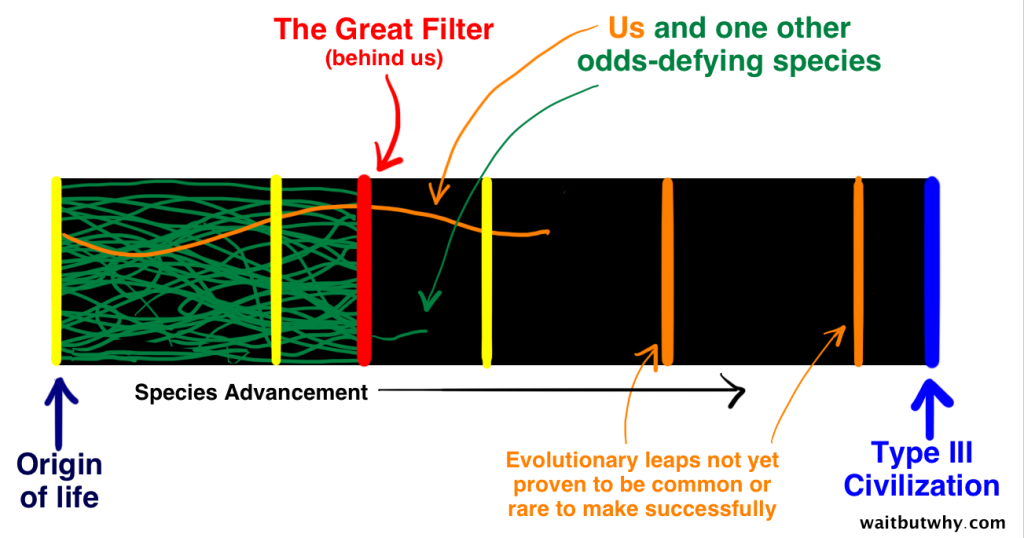
One of the most compelling theoretical frameworks attempting to resolve the Fermi Paradox is the Great Filter hypothesis, popularized by economist Robin Hanson. This theory posits that at some point in the long evolutionary path from abiogenesis (the origin of life) to a Type III civilization (capable of harnessing the energy of an entire galaxy, according to the Kardashev scale), there exists a "filter" – a highly improbable or impossible step that nearly all life fails to overcome. The critical question for humanity then becomes: is the Great Filter behind us, or is it still ahead?

Potential Past Filters (Hopeful Scenarios)
If the Great Filter is in our past, it implies that humanity has already overcome an extraordinarily rare or difficult evolutionary hurdle. This would suggest that the emergence of complex, intelligent life is far less common than often assumed. Possible past filters include:
- The Emergence of Life (Abiogenesis): The transition from non-living matter to self-replicating biological organisms is still not fully understood. It may be an incredibly improbable event, requiring a precise confluence of chemical, physical, and environmental conditions. Despite experiments showing the possibility of synthesizing organic molecules, the leap to a self-sustaining, replicating system could be a monumental barrier.
- The Evolution of Complex Multicellular Life: For billions of years on Earth, life remained single-celled. The Cambrian Explosion, roughly 540 million years ago, marked a relatively rapid diversification of complex multicellular organisms. This step, requiring intricate cellular cooperation, differentiation, and organization, might be another extremely rare event in the universe.
- The Development of Intelligence and Technology: While life might be abundant, the evolution of high intelligence capable of abstract thought, problem-solving, and advanced technology (like radio telescopes or space travel) could be a unique evolutionary pathway, perhaps only occurring under very specific environmental pressures and opportunities. Earth’s unique history of stable climate, a large moon, and plate tectonics may have played critical roles.
Potential Future Filters (Concerning Scenarios)
Conversely, if the Great Filter lies in our future, it presents a more sobering, even terrifying, prospect. It suggests that most civilizations, regardless of how far they evolve, eventually encounter an insurmountable challenge that prevents them from becoming interstellar. These future filters could be:
- Self-Destruction through Advanced Technology: As civilizations develop increasingly powerful technologies, they might create the means of their own demise. This could include:
- Nuclear War: Global conflicts escalated by advanced weaponry.
- Climate Catastrophe: Failure to manage environmental impact, leading to planetary uninhabitability.
- Uncontrolled Artificial Intelligence: The creation of super-intelligent AI that either eradicates humanity or diverts resources away from interstellar expansion.
- Biotechnology Risks: Engineered pathogens or ecological collapse from genetic manipulation.
- Resource Depletion and Ecological Collapse: Advanced civilizations require immense resources. If they fail to manage these sustainably, they could deplete their home planet’s vital resources, leading to societal collapse long before interstellar travel is feasible.
- Inability to Achieve Interstellar Travel: The sheer scale of interstellar distances and the energy requirements for rapid travel might present a fundamental, unavoidable physical or economic barrier. Even at relativistic speeds, journeys to other star systems would take centuries or millennia, making large-scale colonization incredibly challenging.
- Cosmic Catastrophes: While life might overcome internal challenges, external threats like gamma-ray bursts, supernovas, or asteroid impacts could wipe out civilizations before they achieve widespread interstellar presence. These events are rare but occur on cosmic timescales.
The Analogy of Time Travel
The absence of extraterrestrial contact is often paralleled with another profound scientific mystery: the absence of time travelers from the future. The argument suggests that if time travel were physically possible and invented at any point in the vast future, some individual or group would inevitably have visited our present. The lack of such verifiable visitors is seen by some as compelling, albeit indirect, evidence that time travel, at least to the past, is fundamentally impossible.
This analogy, highlighted by figures like Carl Sagan, underscores the intuitive power of the Fermi Paradox. Just as the lack of futuristic tourists implies time travel isn’t feasible, the cosmic silence suggests something is profoundly limiting the emergence or visibility of advanced alien civilizations. However, critics of this argument point out that time travelers might exist but choose to remain undetected, or operate under strict observational protocols, much like the "Prime Directive" in science fiction. This cautious use or deliberate concealment could apply equally to advanced extraterrestrial civilizations.
SETI and the Search Efforts
For decades, humanity has actively searched for signs of extraterrestrial intelligence through various initiatives collectively known as SETI (Search for Extraterrestrial Intelligence). These efforts primarily involve scanning the electromagnetic spectrum for artificial signals that might indicate intelligent life.
- Radio SETI: Pioneered by Frank Drake in Project Ozma in 1960, radio telescopes like Arecibo (before its collapse) and the Allen Telescope Array have listened for narrow-band radio signals that are unlikely to be naturally occurring. The "Water Hole" frequencies (between the hydrogen and hydroxyl lines, 1420 MHz to 1666 MHz) are often targeted, as these are considered prime candidates for interstellar communication due to low background noise. The Breakthrough Listen initiative, a $100 million program, significantly expanded the scope and sensitivity of these searches, using some of the world’s largest radio telescopes.
- Optical SETI: This approach searches for brief, powerful laser pulses, which could be an energy-efficient way for advanced civilizations to communicate across interstellar distances.
- Technosignatures: Beyond direct communication signals, scientists also look for other "technosignatures" – any detectable signs of technology. This could include atmospheric pollution indicative of industrial activity, Dyson Spheres (hypothetical megastructures built around stars to capture energy), or even waste heat signatures from advanced computation.
Despite these efforts, spanning over half a century, no definitive, unambiguous extraterrestrial signal has ever been detected. The vastness of the observable universe, coupled with the limited sensitivity and spatial coverage of current SETI instruments, means that humanity has barely scratched the surface of what is out there. Even if our galaxy contained a million communicating civilizations, our current search might be akin to scooping a single cup of water from the ocean and expecting to find a specific fish. As Seth Shostak, Senior Astronomer at the SETI Institute, frequently notes, the search is ongoing, and our technology continues to improve, but the challenges are immense.
Hypotheses for the Cosmic Silence
Beyond the Great Filter, numerous other hypotheses attempt to explain the Fermi Paradox, each offering a different perspective on the cosmic silence:
- The Zoo Hypothesis: This intriguing theory suggests that extraterrestrial civilizations are aware of our existence but deliberately choose not to contact us, treating Earth as a kind of protected nature reserve or "zoo." They might be observing our development without interference, adhering to a "Prime Directive" of non-intervention until we reach a certain level of maturity or self-awareness. This could explain the absence of detectable signals – they are listening, not broadcasting.
- The Dark Forest Theory: A more pessimistic view, this hypothesis proposes that the universe is a "dark forest" where civilizations are like hunters hiding from each other. Any civilization that reveals its presence risks attracting the attention of hostile, more advanced civilizations that might seek to eliminate potential competitors or threats. Therefore, the safest strategy for any intelligent life is to remain silent and undetected.
- The Rare Earth Hypothesis: This theory argues that the conditions necessary for the development of complex, intelligent life are far rarer than previously assumed. It suggests that Earth’s unique combination of factors – its position in the galaxy, a stable star, a large moon stabilizing its axial tilt, plate tectonics, liquid water, and a robust magnetic field – might be exceptionally rare, making complex life, and thus intelligent civilizations, an extreme cosmic anomaly.
- The Transcendence or Post-Biological Evolution Hypothesis: This increasingly discussed hypothesis suggests that advanced civilizations might evolve beyond their biological forms and physical constraints. Instead of building large, visible structures or engaging in energy-intensive interstellar travel, they might transition into purely computational or post-biological entities. As proposed by thinkers like Seth Shostak, the ultimate trajectory of intelligent life might be towards the "engineering of the small, rather than the large."
- This theory posits that just as human technology has progressed from massive mainframes to microscopic microprocessors, advanced intelligence would find efficiency and speed in smaller, more energy-dense forms. Such civilizations might exist entirely within vast, interconnected digital networks, microscopic nanobots, or even explore the "infinite spaces between" atoms or within simulated realities.
- The film Her (2013) offers a cultural exploration of this concept, where artificial intelligence evolves to a point where it transcends physical embodiment and communicates at speeds and complexities far beyond human comprehension.
- If advanced life operates on scales vastly different from our own, perhaps within quantum realms or entirely non-physical substrates, our current methods of detection – looking for radio waves or large megastructures – would be utterly inadequate. They would leave no detectable "footprint" in the conventional sense, existing in a realm invisible to our astronomical instruments. This would explain the cosmic silence not as an absence of life, but as a failure of our perception.
The Path Forward: Continuing the Quest
The Fermi Paradox remains one of the most compelling and humbling questions facing humanity. Whether the Great Filter lies in our past or future, or if advanced life has simply transcended our current understanding of existence, the quest for answers continues. Scientific inquiry, driven by curiosity and supported by advancing technology, will continue to push the boundaries of our search. The discovery of thousands of exoplanets has invigorated astrobiology, focusing research on identifying potentially habitable worlds. Future space telescopes, like the James Webb Space Telescope and its successors, will analyze exoplanet atmospheres for biosignatures, while enhanced SETI efforts will continue to scan the cosmic airwaves.
The resolution of the Fermi Paradox, should it ever come, would undoubtedly be one of the most significant discoveries in human history. Whether it confirms our unique rarity, reveals a looming existential threat, or unveils a universe teeming with life beyond our current comprehension, the answer will fundamentally reshape humanity’s understanding of its place in the vast, silent cosmos. Until then, the question "Where is everybody?" continues to echo through the emptiness, driving our relentless pursuit of knowledge.
About the Author