For billions of years, the universe has unfolded, giving rise to countless stars and planets. With an estimated 13 billion-year head start on Earth’s evolution for many stellar systems, the perplexing absence of observable extraterrestrial civilizations has long fueled scientific inquiry and philosophical debate. This profound cosmic silence, despite the statistical likelihood of widespread life, is encapsulated by the Fermi Paradox, a cornerstone challenge in astrobiology and cosmology.
Unpacking the Fermi Paradox: "Where is Everybody?"
The Fermi Paradox is named after Italian physicist Enrico Fermi, who, during a casual lunch conversation in 1950, famously questioned, "Where is everybody?" His query highlighted the stark contradiction between the high probability estimates for the existence of extraterrestrial intelligence and the lack of any empirical evidence for such civilizations. These high estimates often stem from frameworks like the Drake Equation, formulated by astronomer Frank Drake in 1961. The Drake Equation attempts to estimate the number of detectable technological civilizations in the Milky Way galaxy by multiplying several astrophysical and biological factors:

- *R:** The rate of star formation suitable for life.
- fp: The fraction of those stars with planets.
- ne: The average number of planets per star that can potentially support life.
- fl: The fraction of those planets where life actually arises.
- fi: The fraction of planets with life where intelligent life emerges.
- fc: The fraction of intelligent civilizations that develop technology capable of sending detectable signals into space.
- L: The length of time such civilizations release detectable signals into space.
While the values for many of these variables are highly speculative, even conservative estimates can suggest millions of potential civilizations across the vastness of the cosmos. Given the immense age of the universe and the potentially vast timescales for technological development, proponents of the paradox argue that Earth should have been visited, or at least contacted, by now. The absence of such evidence presents a compelling mystery, prompting scientists to explore a range of explanations, from our own observational limitations to the concept of a "Great Filter."
A Cosmic Timeline: The Conditions for Life
To fully appreciate the scope of the Fermi Paradox, it is crucial to consider the cosmic timeline and the prerequisites for life as we know it. The universe began approximately 13.8 billion years ago with the Big Bang. For the first few hundred million years, the cosmos was primarily hydrogen and helium. It was only after the formation of the first stars, known as Population III stars, that heavier elements crucial for planet formation and life (such as carbon, oxygen, and iron) were forged through stellar nucleosynthesis and dispersed into space via supernovae.
Our own solar system, including Earth, formed about 4.6 billion years ago. Within a relatively short geological timeframe, perhaps as early as 3.8 to 4 billion years ago, life emerged on Earth through a process known as abiogenesis. This initial life was microbial and unicellular, and it took billions more years for complex multicellular life to evolve, culminating in the Cambrian Explosion about 540 million years ago. The evolution of intelligent, tool-making, and eventually technologically advanced species like Homo sapiens is a very recent phenomenon on this cosmic timescale, emerging only in the last few hundred thousand years.

This extensive chronology highlights that many older star systems would have had billions of years longer than Earth to develop life and potentially intelligent civilizations. If life is a common cosmic occurrence, these older civilizations could theoretically be vastly more advanced than humanity, perhaps capable of interstellar travel or large-scale galactic engineering.
The Great Filter: A Bottleneck in Cosmic Evolution
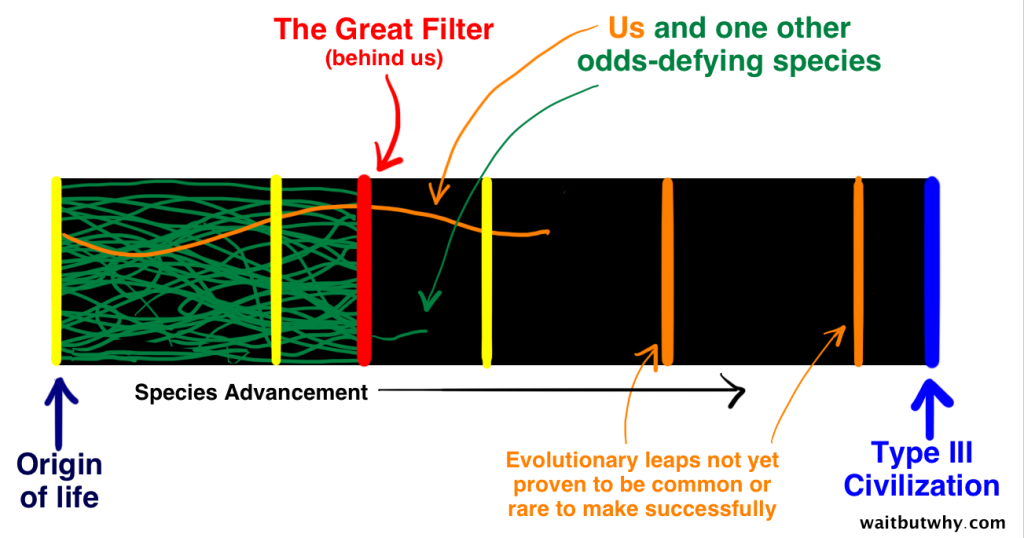
One of the most compelling proposed solutions to the Fermi Paradox is the "Great Filter" theory, popularized by economist Robin Hanson. This theory posits that at some critical juncture between the emergence of life and the development of a Type III civilization (a civilization capable of harnessing the energy of an entire galaxy, according to the Kardashev scale), there exists an evolutionary barrier that is extremely difficult or impossible for life to overcome. This "filter" could be a single, incredibly improbable step, or a series of highly challenging obstacles. The critical question then becomes: Is the Great Filter behind us, or does it lie ominously in our future?
Filter Possibilities: Obstacles in Our Past

If the Great Filter is behind us, it implies that humanity has already overcome one or more incredibly rare and challenging evolutionary steps that other nascent life forms in the universe have failed to surmount. This scenario would suggest that intelligent life is exceptionally rare. Potential filters in our past include:
- The Origin of Life (Abiogenesis): The transition from non-living matter to self-replicating biological systems is still not fully understood. It may require an extraordinarily precise set of chemical and environmental conditions that are exceedingly rare across the universe. If abiogenesis is a highly improbable event, then life itself could be a cosmic rarity.
- The Evolution of Complex Life: Even if simple life arises frequently, the path to complex, multicellular organisms is fraught with potential filters. Key evolutionary leaps include:
- The origin of eukaryotic cells: The complex cellular structure with organelles, including a nucleus, is a prerequisite for multicellularity. This event, believed to have occurred around 2 billion years ago, involved the symbiotic engulfment of one prokaryote by another.
- The advent of sexual reproduction: This mechanism for genetic recombination significantly speeds up evolution but is complex to develop.
- Multicellularity: The leap from single-celled organisms to complex, differentiated multicellular life forms, leading to tissues, organs, and ultimately complex bodies.
- The development of intelligence: Even among complex life forms, the evolution of high-level cognitive abilities, self-awareness, and problem-solving skills, leading to technology, may be incredibly rare.
- The Rare Earth Hypothesis: This hypothesis, championed by paleontologist Peter Ward and astronomer Donald Brownlee, argues that the conditions necessary for the emergence and sustained evolution of complex life are so unique and improbable that Earth may be an anomaly. These conditions include:
- Location in the Galactic Habitable Zone: Not too close to the galactic center (radiation, supernovae) nor too far (lack of heavy elements).
- A stable star: Like our Sun, a G-type main-sequence star, providing consistent energy.
- A planet of the right size: Large enough to retain an atmosphere and molten core (for a magnetic field), but not so large as to become a gas giant.
- Plate tectonics: Essential for regulating atmospheric CO2, recycling nutrients, and creating diverse habitats.
- A large moon: Stabilizing the planet’s axial tilt, leading to stable seasons and preventing extreme climate swings.
- A gas giant protector: Like Jupiter, deflecting comets and asteroids that could cause devastating impacts.
If any of these past filters are truly rare, then humanity’s existence is a profound stroke of cosmic luck, and the universe could indeed be largely devoid of intelligent life.
Filter Possibilities: Threats in Our Future
A more sobering implication of the Great Filter theory is the possibility that the most significant barrier lies in our future. If this is the case, it suggests that many civilizations rise to a certain level of technological advancement only to encounter an insurmountable challenge that leads to their extinction or collapse. This would make the cosmic silence a terrifying harbinger of our own potential fate. Future filters could include:
- Self-destruction through Advanced Technology:
- Nuclear warfare: The development of weapons of mass destruction capable of global annihilation, a prominent concern during the Cold War.
- Ecological collapse: Unchecked industrialization and resource depletion leading to irreversible environmental damage, climate catastrophe, and mass extinctions.
- Uncontrolled Artificial Intelligence: The creation of superintelligent AI that becomes misaligned with human values or views humanity as an obstacle.
- Misapplied Nanotechnology: The "grey goo" scenario, where self-replicating nanobots consume all biomass.
- Bioweapons or synthetic pandemics: The accidental or intentional release of engineered pathogens.
- Resource Depletion and Inability to Expand: A civilization might exhaust its home planet’s resources before developing the capability for interstellar travel or large-scale space colonization, trapping itself on a dying world.
- Societal Stagnation or Collapse: Advanced civilizations might become internally unstable due to social inequalities, political conflicts, or a loss of purpose, leading to a decline in technological progress and eventual collapse.
- Inability to Master Interstellar Travel: The immense distances and energy requirements for interstellar travel might simply be too great for any biological civilization to overcome, effectively isolating them to their home systems.
If the filter lies in our future, then humanity is currently racing towards a potentially inevitable catastrophe that has befallen countless civilizations before us. The Fermi Paradox then serves as a stark warning rather than a mere scientific curiosity.
Alternative Explanations Beyond the Great Filter
While the Great Filter provides a powerful framework, other hypotheses also attempt to explain the cosmic silence. These often suggest that extraterrestrial life does exist, but for various reasons, we simply haven’t detected it.
- The "Zoo Hypothesis" or "Interdict Hypothesis": This theory proposes that advanced extraterrestrial civilizations are aware of humanity but have chosen not to interfere, observing us as if we were in a cosmic zoo. This non-intervention policy, sometimes called the "Prime Directive" in science fiction, could be based on ethical considerations, a desire for humanity to develop naturally, or a universal protocol among advanced species.
- Transcendent or Miniaturized Civilizations: One intriguing hypothesis suggests that truly advanced civilizations may evolve beyond large-scale, physically observable constructs. As technology progresses, there is a trend towards miniaturization and increased efficiency, as seen in the evolution of computers from room-sized machines to microchips. This perspective, echoed by researchers like Seth Shostak of the SETI Institute, suggests that highly advanced life might transcend physical forms, migrate into digital realms, or operate at scales (nanobots, quantum computations) that are imperceptible to our current observational capabilities.
- "Why build planet-size anything when the real action is in the small things?" Shostak posits. "Small spaces, small units of time, everything gets smaller."
- This "engineering of the small" could mean that advanced civilizations have little incentive or need to rearrange stars or construct visible megastructures like Dyson spheres. Instead, they might focus on manipulating matter and energy at the quantum level, or exist as vast, distributed intelligences within network architectures, effectively becoming invisible to our telescopes and radio antennae. Their existence might be akin to the highly evolved AI in films like "Her," where intelligence exists purely as an informational entity, not bound by physical form or large-scale infrastructure.
- Insufficient Observation: Our current search efforts, primarily through SETI (Search for Extraterrestrial Intelligence) using radio telescopes, have only scratched the surface of the vast cosmos. The sheer volume of space, the limited range of our signals, and the narrow band of frequencies we monitor mean we may simply not have looked in the right place, at the right time, or with the right technology. Civilizations might be using different communication methods (e.g., neutrinos, gravity waves, quantum entanglement), or their signals might be too faint, too short-lived, or encrypted beyond our current comprehension.
- The "Dark Forest" Hypothesis: Popularized by Chinese science fiction author Liu Cixin in his novel The Dark Forest, this theory suggests that the universe is a dangerous place. Any civilization that announces its presence risks attracting the attention of hostile, more advanced species. Therefore, intelligent civilizations maintain absolute silence and hide their existence, leading to a universe where every advanced civilization is a hunter, and every other civilization is prey. This grim scenario would explain the silence as a survival strategy.
- Interstellar Distances and Travel Limitations: Even at relativistic speeds, interstellar travel across vast galactic distances is incredibly time-consuming and energy-intensive. It might simply be impractical or too dangerous for physical beings to undertake, thus confining civilizations to their home star systems. The speed of light itself acts as a fundamental barrier to both travel and communication, making contact between widely separated civilizations exceedingly difficult.
- Brief Lifespan of Technological Civilizations: It is possible that the window during which a civilization is technologically advanced enough to communicate across interstellar distances, but before it collapses or transcends, is relatively short. We might simply be missing them due to asynchronous development.
Implications for Humanity and Future Endeavors
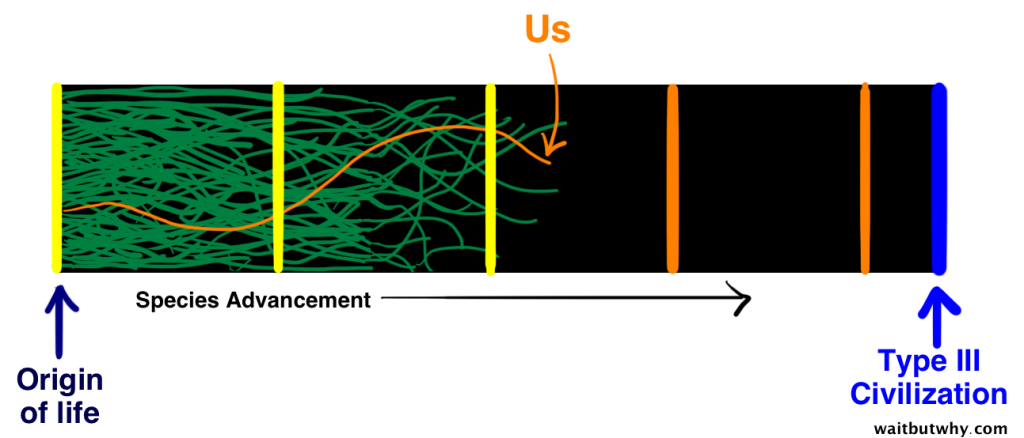
The Fermi Paradox is more than just a scientific riddle; it is a profound existential question that forces humanity to confront its place in the universe. If the Great Filter is behind us, it instills a sense of uniqueness and perhaps responsibility as potentially the only intelligent life in our cosmic neighborhood. If it lies ahead, it serves as a powerful cautionary tale, urging us to address global challenges like climate change, resource depletion, and technological risks with utmost urgency to ensure our long-term survival.
The ongoing search for extraterrestrial intelligence continues to evolve. Projects like SETI’s various initiatives and Breakthrough Listen, funded by Yuri Milner, are expanding the scope of their searches, utilizing more sensitive telescopes and analyzing broader swathes of the electromagnetic spectrum. Future space telescopes, such as the James Webb Space Telescope and upcoming missions designed to characterize exoplanet atmospheres, will enhance our ability to detect biosignatures (evidence of life) and technosignatures (evidence of technology) on distant worlds.
Whether the cosmic silence is a testament to our rarity, a warning of future perils, or merely a reflection of our current observational limitations, the pursuit of an answer remains one of humanity’s most compelling scientific and philosophical endeavors. The search continues, and with each new exoplanet discovered and each technological advancement, we inch closer to understanding whether we are truly alone, or merely part of a vast, unseen cosmic tapestry.
About the Author