
The universe, an expanse of unimaginable scale and antiquity, has existed for approximately 13.8 billion years, offering countless epochs for life to emerge and evolve across its myriad galaxies. With an estimated 200 billion to 2 trillion galaxies, each containing hundreds of billions of stars, many of which host planets, the statistical probability of extraterrestrial life, and even intelligent civilizations, seems overwhelmingly high. Yet, humanity remains in cosmic isolation, receiving no confirmed signals or visitations from other advanced species. This profound discrepancy between the high probability of alien existence and the complete absence of evidence is known as the Fermi Paradox, a question that continues to baffle scientists and philosophers alike: "Where is everybody?"
The Genesis of a Cosmic Conundrum
The Fermi Paradox originated in a casual lunch conversation in 1950 among physicists Enrico Fermi, Edward Teller, Herbert York, and Emil Konopinski at Los Alamos National Laboratory. Discussing a recent cartoon about alien abductions, the conversation shifted to the high likelihood of extraterrestrial life. Fermi, known for his incisive reasoning, suddenly posed his famous question, highlighting the contradiction that if intelligent life were common, it should have already made its presence known. Given the universe’s vast age, any sufficiently advanced civilization would have had ample time to develop interstellar travel and explore or colonize a significant portion of the galaxy. Even at sub-light speeds, the Milky Way could be traversed in a few million years, a mere blink in cosmic time.

The paradox was further formalized and exacerbated by the development of the Drake Equation in 1961 by astronomer Frank Drake. This probabilistic argument attempts to estimate the number of active, communicative extraterrestrial civilizations in the Milky Way galaxy. The equation considers several factors: the rate of star formation, the fraction of those stars with planetary systems, the average number of planets that can potentially support life, the fraction of those planets that actually develop life, the fraction of life-bearing planets where intelligent life emerges, the fraction of intelligent civilizations that develop detectable technology, and the length of time such civilizations release detectable signals into space. While many of these variables remain highly speculative, even conservative estimates using the Drake Equation suggest a considerable number of advanced civilizations could exist within our galaxy alone, intensifying the silence.
The Immense Stage of the Universe
To fully appreciate the scope of the Fermi Paradox, one must grasp the sheer scale and age of the cosmos. The observable universe spans an estimated 93 billion light-years in diameter. Our own galaxy, the Milky Way, contains between 100 billion and 400 billion stars. Recent astronomical surveys, particularly those by the Kepler Space Telescope, have revealed that exoplanets are not only common but that rocky planets in the habitable zones of their stars are abundant. Estimates suggest there could be billions of potentially habitable planets in the Milky Way.
Earth itself is relatively young, forming about 4.5 billion years ago. Life appeared relatively early, around 3.8 billion years ago, evolving from simple single-celled organisms to complex multicellular forms, and eventually, to intelligent, technologically capable humans. This entire process, from abiogenesis to advanced civilization, took billions of years. However, other planetary systems formed much earlier than ours, with stars and planets existing for billions of years before our sun even ignited. This means countless civilizations could have had a significant "head start" of billions of years on humanity, theoretically allowing them to reach technological pinnacles far beyond our current understanding.

The Great Filter: Potential Bottlenecks in Cosmic Evolution
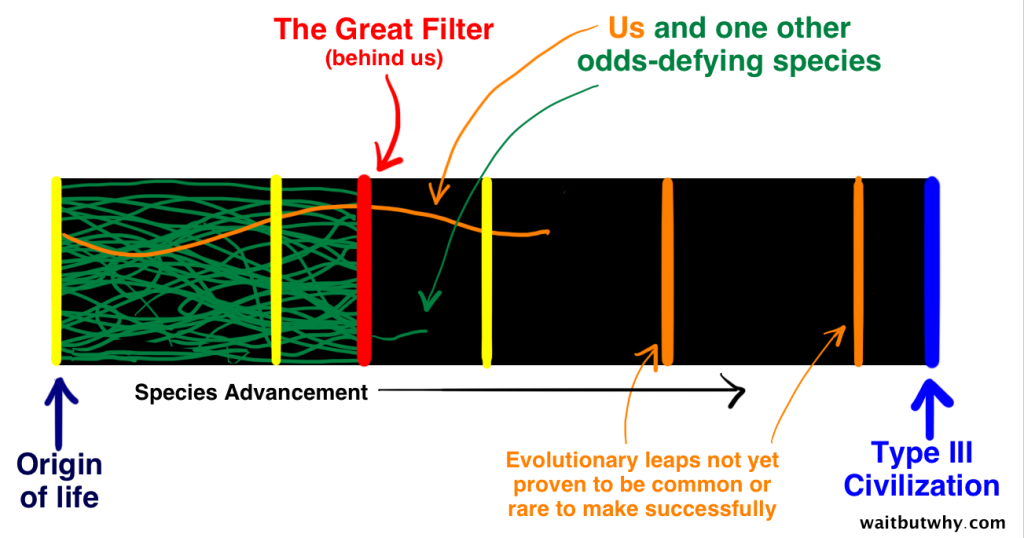
One of the most compelling explanations for the Fermi Paradox is the "Great Filter" theory, proposed by economist Robin Hanson. This theory posits that at some point along the path from pre-life to an advanced, interstellar-traveling civilization, there exists an evolutionary "wall" or "filter" that almost all attempts at life hit. This stage is extremely unlikely or impossible for life to get beyond, thus preventing the widespread emergence of observable advanced civilizations. The Great Filter could be in our past, meaning we are incredibly rare, or it could be in our future, implying a catastrophic end awaits most civilizations, including potentially our own.
The Great Filter can be broadly categorized into several critical junctures:
-
Filters in Our Past (The "Rare Earth" Hypothesis): This category suggests that the steps required for life to arise and evolve to complexity are far more improbable than commonly assumed.

- Abiogenesis (The Origin of Life): The spontaneous generation of life from non-living matter remains one of science’s greatest mysteries. The precise conditions for the complex chemical reactions that led to the first self-replicating molecules might be exceptionally rare. This includes the availability of specific elements, stable energy sources, and the right atmospheric and aquatic environments.
- The Development of Complex Life: Even if life forms, its progression to multicellularity, sexual reproduction, and the emergence of eukaryotes from prokaryotes are considered significant evolutionary hurdles. The "Cambrian Explosion" on Earth, a relatively rapid diversification of complex life forms, might represent another such filter, requiring specific environmental triggers and genetic preconditions that are not universally present.
- Planetary Stability and Habitability: The "Rare Earth Hypothesis" suggests that Earth’s unique combination of geological and astrophysical characteristics is exceptionally rare. This includes a stable orbit within a star’s habitable zone, the presence of a large moon to stabilize its axial tilt (preventing extreme climate swings), plate tectonics for nutrient cycling and CO2 regulation, a strong magnetic field to protect against solar radiation, and the opportune presence of a gas giant like Jupiter to clear out dangerous asteroids. Each of these factors, while seemingly mundane, might be crucial for the sustained evolution of complex life over billions of years.
-
Filters in Our Present (The "We Are First" Hypothesis): This optimistic view suggests that humanity is among the first, if not the first, civilization to reach our current level of technological advancement in our galaxy, or perhaps even the observable universe. Given the universe’s age, it implies that the conditions for intelligent life only recently became widespread enough, or that our specific evolutionary path was simply faster than others.
-
Filters in Our Future (The "Doom Ahead" Hypothesis): This more pessimistic view posits that the Great Filter lies ahead of us, implying that most civilizations, once they reach a certain technological threshold, inevitably destroy themselves or face insurmountable challenges.
- Self-Annihilation: Advanced civilizations might succumb to self-inflicted catastrophes, such as nuclear warfare, runaway climate change, engineered pandemics, or uncontrolled artificial intelligence. The ability to harness immense energy also brings the capacity for immense destruction.
- Resource Depletion and Environmental Collapse: Unchecked technological growth could lead to the exhaustion of planetary resources, rendering a planet uninhabitable and preventing interstellar expansion.
- Technological Stagnation or Regression: Some theories suggest that civilizations might reach a peak and then stagnate or decline, losing the drive or capability for further expansion.
- Transcension to Non-Physical Forms: A more speculative future filter suggests that highly advanced civilizations might transcend their physical forms entirely, migrating into simulated realities, becoming pure information, or evolving into forms unrecognizable and undetectable by us.
Alternative Explanations for the Silence
Beyond the Great Filter, several other theories attempt to explain the Fermi Paradox:
- Distance and Time: The sheer distances between stars and galaxies, combined with the speed of light limit, make interstellar travel and communication incredibly challenging. Even if signals are sent, the time delay can be millennia, making two-way communication impractical. We might simply be too far apart, or our signals haven’t reached them yet, or their signals haven’t reached us.
- Different Communication Methods: Humanity primarily searches for radio signals, assuming extraterrestrial intelligence would use similar electromagnetic radiation for communication. However, advanced civilizations might use entirely different, more efficient, or subtle methods beyond our current detection capabilities – such as neutrinos, gravitational waves, or even quantum entanglement. We might be listening to the wrong "channel."
- Brief Lifespans of Civilizations: It’s possible that civilizations, even if they achieve advanced technology, have relatively short lifespans. They might rise and fall quickly due to internal conflicts, resource issues, or cosmic events, making the window for detection extremely narrow.
- The Zoo Hypothesis: This theory suggests that extraterrestrial civilizations are aware of humanity but choose not to interfere, much like we observe animals in a zoo without interacting directly. This non-intervention policy, often likened to Star Trek’s "Prime Directive," could be due to ethical considerations, a desire to allow natural development, or simply a lack of interest in less advanced species.
- The "Small is Better" Hypothesis: Advanced by figures like Seth Shostak, this theory posits that as civilizations advance, their technologies and even their physical presence might become increasingly miniaturized and energy-efficient. Just as computers evolved from room-sized machines to microscopic processors, intelligent life might shed its large-scale physical requirements. Why build planet-sized megastructures when the real action is in the incredibly small, fast, and efficient? Advanced civilizations might transition to nanotechnology, virtual environments, or even distributed intelligence, operating on scales undetectable by our current astronomical instruments. Their existence might be primarily informational or energetic, not requiring grand, observable engineering projects that rearrange stars. This would render them virtually invisible to our current search methods, which primarily look for large-scale energy signatures or direct communication.
- The Simulation Hypothesis: A more radical idea, this theory suggests that our entire reality, including the universe and our existence, is a sophisticated computer simulation created by an even more advanced civilization. In this scenario, the absence of extraterrestrial life might simply mean that the programmers chose not to include it in our simulation, or they exist "outside" our simulated reality.
The Time Travel Analogy: A Parallel Absence of Evidence
Interestingly, the Fermi Paradox finds a conceptual parallel in the absence of time travelers from the future. Despite the vastness of future time, and the theoretical possibility of time travel in some physics models, there is no convincing evidence of visitors from tomorrow. This lack of evidence leads many to conclude that time travel is either impossible or extremely difficult to achieve or detect. Similar to the Fermi Paradox, where the absence of aliens doesn’t definitively prove their non-existence, the absence of time travelers doesn’t categorically prove time travel is physically impossible. It could be that such technology is never developed, is cautiously used, or that time travelers are simply not recognized as such, as once suggested by Carl Sagan. Both scenarios highlight the profound implications of an "absence of evidence" argument when dealing with vast scales of time and possibility.
The Ongoing Search and Future Implications
Despite the enduring silence, humanity’s quest for extraterrestrial intelligence continues. Projects like SETI (Search for Extraterrestrial Intelligence) tirelessly scan the skies for radio signals, while new astronomical observatories like the James Webb Space Telescope are pushing the boundaries of exoplanet characterization, seeking biosignatures in alien atmospheres. Future endeavors aim to develop even more sensitive instruments capable of detecting subtle signs of life or technology across vast cosmic distances.
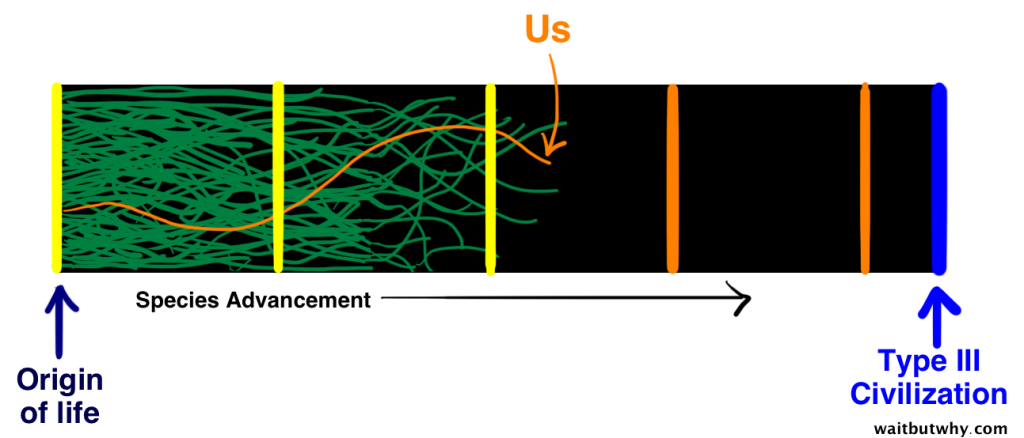
The resolution of the Fermi Paradox, whether through the discovery of alien life or a deeper understanding of why it remains hidden, carries profound implications for humanity. If we find evidence of life, it would fundamentally alter our understanding of our place in the universe. If the Great Filter lies in our past, it would suggest humanity is incredibly special, a rare success story in the cosmic narrative. If the Great Filter lies in our future, it serves as a stark warning, urging us to overcome the existential challenges that may await all advanced civilizations. The cosmic silence, therefore, is not merely an absence of noise, but a powerful, unanswered question that continues to drive scientific inquiry and shape our collective imagination about life beyond Earth.
About the Author