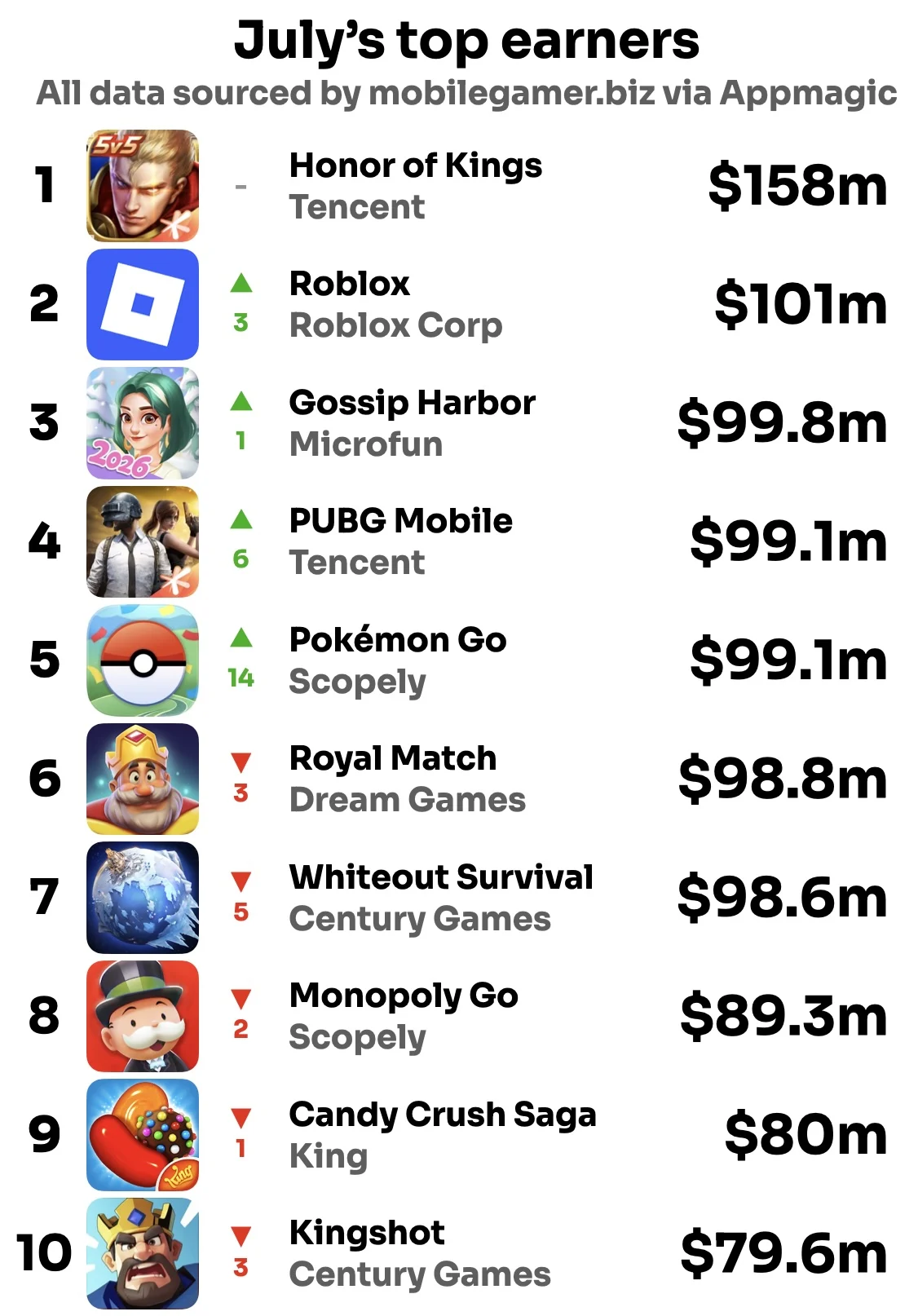
The global mobile gaming landscape in July 2026 witnessed a significant reshuffling of the leaderboard, characterized by a resurgence of established titans and a series of high-impact live-ops events that drove consumer spending to levels not seen in several years. According to the latest data from market intelligence firm Appmagic, the industry saw several titles cross the prestigious $100 million monthly in-app purchase (IAP) threshold, signaling a robust mid-year performance for top-tier publishers. These figures specifically track IAP earnings and exclude secondary revenue streams such as in-game advertising, external web shop expenditures, and the standard 30% platform fees collected by Apple and Google. Furthermore, revenue generated from China’s fragmented third-party Android ecosystem is not factored into these specific estimates, suggesting that total consumer spend is likely significantly higher than the reported figures.
The Return of the Market Leaders
Tencent’s flagship title, Honor of Kings, reclaimed its position at the pinnacle of the charts, surpassing $150 million in IAP revenue for the month of July. This performance marks a decisive return to form for the multiplayer online battle arena (MOBA) giant following a period of relative volatility during the spring and early summer months. Historically, Honor of Kings has exhibited a pattern of sharp fluctuations in its monthly earnings, often tied to the release of high-value seasonal skins and major competitive updates within the Chinese market. The July surge reinforces the game’s enduring dominance in the mobile sector, even as it faces increasing competition from newer entries in the genre.
Parallel to this, PUBG Mobile demonstrated a remarkable recovery. After a concerning dip in June, where the title generated approximately $62 million, the battle royale pioneer rebounded to hit the $100 million mark in July. Industry analysts suggest that this recovery was fueled by a combination of new collaboration events and a stabilization of the player base following a period of content saturation. Since March 2026, $100 million has served as the baseline for PUBG Mobile’s monthly performance, making the June slump appear to be an outlier rather than a trend.

The Summer Holiday Surge and the Milestone for Roblox
The arrival of the summer school holidays in the Northern Hemisphere provided a predictable but potent boost to titles with younger demographics. Roblox, in particular, capitalized on this seasonal shift, crossing the $100 million monthly IAP mark for the first time since the December 2025 holiday period. The platform’s ability to monetize its vast ecosystem of user-generated content remains unparalleled, with the July spike reflecting both increased playtime and the success of various limited-time "Summer Bash" events hosted by popular individual developers within the Roblox environment.
In the casual gaming sector, Gossip Harbor reached a historic milestone. The title achieved its highest-ever chart position in July, raking in just under $100 million. While this figure fell slightly short of its all-time monthly record of $104 million set in March 2026, the game’s consistent performance underscores the growing power of the "merge" sub-genre. Developers in this space have increasingly focused on narrative-driven monetization, using cliffhangers and character development to drive microtransactions, a strategy that appears to be paying dividends for the creators of Gossip Harbor.
Pokémon Go and the Power of the Decade Milestone
Perhaps the most significant narrative of the month belongs to Niantic and Scopely’s collaborative efforts regarding Pokémon Go. Celebrating its 10th anniversary, the augmented reality (AR) pioneer saw its IAP revenue skyrocket from a monthly average of roughly $30 million to approximately $100 million in July. This 233% increase was driven by a sophisticated suite of anniversary events, including global "Go Fest" activities and the introduction of highly sought-after legendary Pokémon variants.
This performance represents Pokémon Go’s strongest month for IAP revenue since June 2022. However, the $100 million figure only tells part of the story. Reports from Sensor Tower indicate that the title is also generating substantial revenue through its proprietary web shop, where players can purchase currency and items directly from the developer, bypassing the 30% platform tax imposed by mobile storefronts. The success of the 10th-anniversary campaign suggests that despite its age, the Pokémon Go brand retains a massive, highly engaged audience capable of driving top-tier financial results when presented with compelling live-ops content.

Shifts in the Top Ten and the Mid-Tier Rankings
The massive gains seen by the top five titles inevitably led to a compression in the lower half of the top ten. While titles like Royal Match and Whiteout Survival experienced slight month-on-month declines in revenue, their drop in rankings was primarily due to the explosive growth of the games above them. In July, the competition between ranks six and ten was exceptionally tight, with several titles separated by less than $3 million in total earnings.
Monopoly Go and Candy Crush Saga both saw marginal growth, maintaining their status as "evergreen" performers. Meanwhile, Kingshot remained effectively flat, holding its ground in an increasingly crowded market. The data suggests that for a game to maintain a top-five position in the current climate, it must consistently generate north of $90 million per month, a threshold that is becoming increasingly difficult to reach without significant marketing spend or major IP-driven events.
Analyzing the Performance of eFootball and the Decline of LastWar
Further down the rankings, Konami’s eFootball emerged as a standout performer in the sports category. Reaching 11th place with $68.7 million in July, the title achieved its best-ever monthly earnings, far surpassing its previous record of $40 million set a year prior. Interestingly, eFootball’s success remains heavily concentrated in the Japanese market, where its "gacha-style" player acquisition mechanics resonate strongly with local consumers. This regional dominance has allowed it to significantly outpace EA FC Mobile, which landed in 42nd place with $17 million in revenue for the same period.
Conversely, LastWar: Survival has seen a dramatic downturn in its financial fortunes. Once a title that regularly cleared $120 million per month, it fell to $64.5 million in July, continuing a downward trend that has alarmed some investors. Insider reports suggest the decline is twofold: a perceived lack of meaningful end-game content has led to player churn, and the developer was forced to remove several high-cost monetization packages following a class-action lawsuit regarding "predatory" pricing structures. The situation with LastWar serves as a cautionary tale for developers relying on aggressive monetization without a corresponding pipeline of fresh content.

The MiHoYo Ecosystem and Global Rises
The "Gacha" giant MiHoYo (HoYoverse) enjoyed a strong month across its entire portfolio. Genshin Impact (20th) and Honkai: Star Rail (21st) both climbed eight places in the rankings, earning $33 million and $31 million respectively. The studio’s newest release, Zenless Zone Zero, also saw a meteoric rise, jumping 56 places to hit $22 million in IAPs. The synchronized success of these three titles demonstrates MiHoYo’s ability to manage multiple high-revenue live-service games simultaneously without significant cannibalization of its own audience.
Other notable mentions in the July charts include Tencent’s Goddess of Victory: Nikke, which earned $26 million, and NetEase’s Eggy Party, which brought in $22 million. These titles saw jumps of 27 and 35 places respectively, largely driven by seasonal summer updates and collaboration events with popular anime franchises.
Broader Market Impact and Future Outlook
The July 2026 revenue data highlights several key trends that are likely to define the remainder of the year. First, the success of Pokémon Go and eFootball proves that "legacy" titles can still achieve record-breaking growth through well-executed live-ops and regional specialization. Second, the rise of web shops is beginning to skew traditional IAP rankings, as more publishers seek to protect their margins by moving transactions away from Apple and Google.
As the industry moves into the third quarter, the focus will likely shift toward retention strategies as the summer holiday boost fades. Publishers who managed to acquire new users in July will now face the challenge of converting those players into long-term spenders. With the "Golden Week" holidays in Asia and the year-end festive season on the horizon, the battle for the top grossing spots remains as fierce as ever. The $100 million monthly benchmark, once a rarity, is increasingly becoming the price of entry for the mobile gaming elite.
About the Author