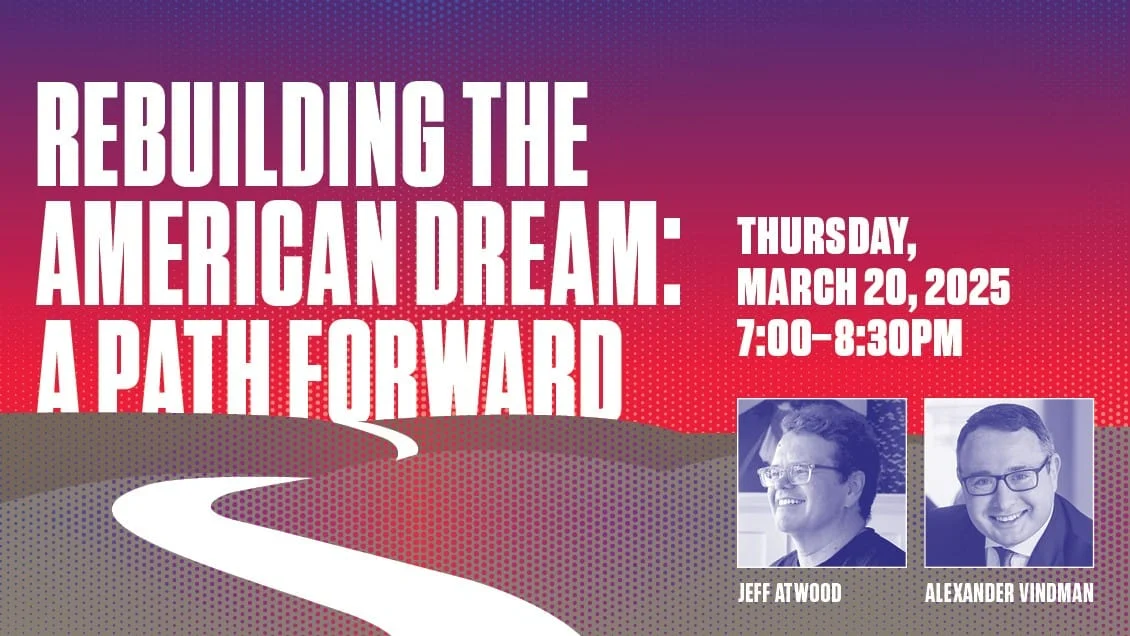
In a pivotal public dialogue, internet entrepreneur Jeff Atwood and decorated military veteran Colonel Alexander Vindman convened at the historic Cooper Union Great Hall to address the pressing question of how to revitalize the American Dream for contemporary society. The joint address, titled "Rebuilding The American Dream: A Path Forward," brought together two distinct voices – one from the realm of digital innovation and community building, the other from the front lines of national security and democratic defense – to dissect the challenges facing the nation’s foundational promise. Their discussion aimed to transcend individual acts of generosity, advocating instead for systemic changes that foster security, dignity, and opportunity for all Americans.
A Historic Venue for Critical Discourse
The Cooper Union Great Hall, nestled in New York City’s East Village, served as a fitting backdrop for this significant discussion. Renowned for its rich history as a crucible of American thought and activism, the venue has hosted luminaries such as Abraham Lincoln, who delivered his pivotal "Might Makes Right" speech there in 1860, laying intellectual groundwork for his presidential campaign. Over the centuries, the hall has been a platform for abolitionists, suffragettes, labor leaders, and civil rights advocates, embodying a tradition of open inquiry and public engagement on matters of national importance. Its legacy underscores the enduring American commitment to public discourse as a cornerstone of democratic progress, making it an ideal setting for Atwood and Vindman to explore the intricate pathways to national renewal. The choice of venue itself signaled the gravity and aspirational scope of the conversation, aligning the contemporary challenges with historical precedents of national transformation.
The Genesis of a Crucial Conversation: "Stay Gold"
The impetus for this joint appearance stems in part from Atwood’s earlier reflections on what it means to "stay gold"—a concept he articulated as actively preserving the best aspects of oneself, one’s community, and the American ideal itself. This notion, rooted in a call for active engagement rather than passive observation, posits that safeguarding these ideals requires conscious effort, difficult conversations, and a willingness to confront past shortcomings, current realities, and future aspirations. The Cooper Union event was presented as a tangible extension of this philosophy, a move from theoretical contemplation to practical exploration of how structural change can be engineered to broaden opportunity. The dialogue sought to transform the abstract ideal of "staying gold" into concrete strategies for national betterment, recognizing that the American Dream, far from being a static inheritance, is a dynamic project requiring continuous effort and adaptation.
Colonel Alexander Vindman: A Defender of Democratic Ideals
Colonel Alexander Vindman’s journey to the Cooper Union stage is a testament to his unwavering commitment to civic duty and the defense of democratic institutions. Born in the Soviet Union, Vindman immigrated to the United States as a child, growing up in Brooklyn and later enlisting in the U.S. Army. His 21-year military career was distinguished by valor and dedication, earning him a Purple Heart for injuries sustained during service in Iraq. He rose through the ranks to become Director for European Affairs on the National Security Council, a role that placed him at the heart of critical foreign policy decisions.
Vindman’s public profile dramatically elevated during the 2019 impeachment inquiry, where he testified before Congress regarding concerns about a phone call between then-President Donald Trump and Ukrainian President Volodymyr Zelensky. His testimony, rooted in his professional expertise and commitment to upholding the rule of law, was widely seen as an embodiment of principled public service, even as it led to his eventual removal from his NSC post and early retirement from the military. His willingness to prioritize constitutional principles over personal career consequences resonated deeply with those who champion integrity and accountability in government. At Cooper Union, Vindman brought the invaluable perspective of an individual who has not only served his country with distinction on the battlefield but also courageously defended its democratic ideals in the halls of power, offering profound insights into the meaning of civic responsibility and ethical leadership.
Jeff Atwood: Architect of Digital Communities and Governance
Jeff Atwood, a prominent figure in the technology landscape, offers a complementary perspective rooted in his extensive experience building and managing large-scale online communities. As the co-founder of Stack Overflow, a globally recognized knowledge-sharing platform for programmers, and Discourse, an open-source forum software, Atwood has spent years grappling with the complexities of digital governance. His work has focused on creating online spaces that foster fairness, encourage participation, and facilitate constructive discourse among diverse user bases.
Atwood’s insights into establishing clear expectations, implementing fair systems, defining strong boundaries, and cultivating a shared sense of purpose within digital communities directly inform his vision for broader societal governance. He posits that the principles governing successful online platforms—transparency, meritocracy, and robust moderation—are surprisingly applicable to the challenges of running a country. His contributions to the discussion highlighted how lessons learned from building resilient and productive digital ecosystems can be leveraged to address real-world issues of democracy and social cohesion. Atwood’s unique background bridges the gap between the rapid evolution of technology and the timeless principles of human organization, suggesting that innovative approaches to community building online hold keys to strengthening the fabric of society offline.
The American Dream Under Scrutiny: Data and Disparity
The core question driving the Cooper Union dialogue—"How can we build on our dream so that it works for everyone?"—reflects a growing national concern about the accessibility and perceived reality of the American Dream. Recent data indicates a significant erosion of public confidence in the dream’s attainability. A 2023 survey by The Wall Street Journal and NORC at the University of Chicago found that only 36% of Americans believe the American Dream is within reach, a stark decline from 53% in 2012. This sentiment is particularly pronounced among younger generations and minority groups, who often face disproportionate barriers to economic mobility and wealth accumulation.
Factors contributing to this disillusionment include persistent income inequality, rising costs of living, stagnant wages for many, and increasing student debt burdens. According to the Federal Reserve, wealth disparity has continued to widen, with the top 10% of households holding over 70% of the nation’s wealth, leaving a smaller share for the majority. Furthermore, intergenerational economic mobility has remained relatively flat for decades, challenging the narrative that hard work alone guarantees upward movement. The discussion at Cooper Union aimed to move beyond simply acknowledging these disparities, instead seeking actionable frameworks that could dismantle systemic barriers and genuinely expand opportunity across all demographics.
A Unified Vision: Democracy, Community, and Economic Mobility
Despite their disparate professional journeys, Atwood and Vindman articulated a shared conviction that everyone’s American Dream is worth fighting for, uniting their perspectives around the pillars of democracy, community, and economic mobility.
-
Democracy: Vindman’s experiences underscored the fragility and necessity of defending democratic institutions against both external and internal threats. His narrative emphasized the importance of adherence to constitutional principles, ethical leadership, and an informed citizenry. Atwood complemented this by drawing parallels to the governance of digital platforms, where robust, transparent systems and mechanisms for fair participation are essential to prevent authoritarian control and foster collective decision-making. Both speakers implicitly argued that a healthy democracy is the prerequisite for all other forms of progress.
-
Community: Atwood’s expertise in fostering online communities highlighted the power of shared purpose and constructive interaction. He elaborated on how well-designed digital spaces can create "artifacts for the common good," akin to physical public parks, where diverse individuals can gather, learn, and contribute. Vindman’s military background also spoke to the profound importance of community, emphasizing the bonds of trust, shared sacrifice, and collective mission that define effective units and, by extension, a resilient nation. The dialogue stressed that strong, inclusive communities are vital for social cohesion and mutual support, acting as a buffer against isolation and division.
-
Economic Mobility: The speakers converged on the idea that true opportunity extends beyond individual ambition. They posited that systemic changes are required to create a level playing field, moving "beyond individual generosity and toward systems that create security, dignity, and possibility for all." This perspective calls for a re-evaluation of policies related to education, healthcare, infrastructure, and access to capital, aiming to dismantle structural barriers that impede upward mobility for marginalized groups. While specific policy recommendations were not detailed in the initial announcement, the overarching message was clear: a renewed American Dream necessitates equitable access to resources and pathways to success, ensuring that hard work genuinely translates into a better future for every citizen.
Anticipated Discussion Points and Broader Implications
The combined expertise of Atwood and Vindman promised a multifaceted approach to these complex issues. Attendees and online viewers likely anticipated discussions touching upon:
- Civic Technology: How digital tools and platforms, designed with principles of fairness and transparency, can enhance civic engagement, combat misinformation, and strengthen democratic processes.
- Ethical Leadership: The critical role of leaders in both public and private sectors in upholding democratic norms and fostering inclusive environments.
- Reforming Institutions: Exploring ways to adapt existing governmental and societal structures to better serve the needs of a diverse and evolving populace.
- Grassroots Empowerment: Strategies for empowering local communities to drive change and build resilience from the ground up.
The event’s implications extend beyond the immediate discussion. It served as a powerful reminder of the importance of interdisciplinary dialogue in addressing national challenges. By bringing together a voice from the technology sector—often seen as detached from traditional governance—and a voice from the heart of national security, the event modeled a collaborative approach to problem-solving. It underscored the notion that the future of democracy and the American Dream are not solely the purview of politicians or policymakers but require active participation and innovative thinking from all sectors of society.
A Call to Collective Action
The streaming of the event via the Cooper Union Great Hall YouTube channel ensured broad accessibility, extending the reach of this critical conversation far beyond the physical hall. The concluding sentiment articulated by Jeff Atwood—"Imagine what we can do if Alex and I work together. Imagine what we could do if we all worked together"—encapsulated the aspirational core of the event. It was a potent call to collective action, urging citizens, leaders, and innovators alike to engage actively in the ongoing project of shaping a more secure, dignified, and opportunity-rich future for all. The event highlighted that while challenges to the American Dream are formidable, the collective will and innovative spirit of its people remain its most powerful assets. The dialogue at Cooper Union represents not an endpoint, but a significant step in an ongoing national conversation, inviting every American to contribute to the construction of a more inclusive and resilient dream.
About the Author