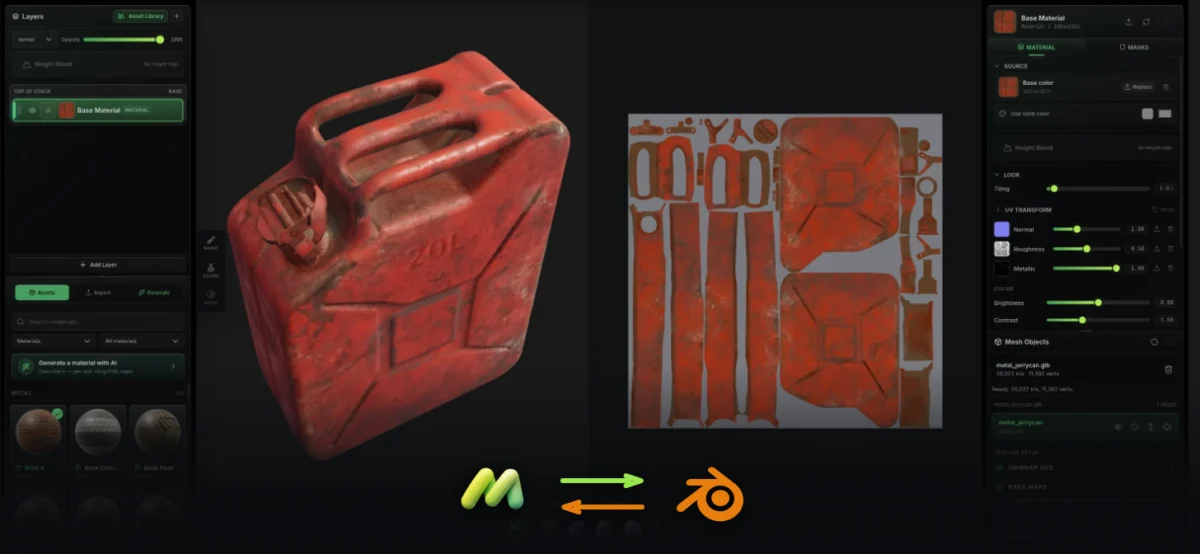
The digital art and 3D modeling community is abuzz with the recent release of Mixos’ "Live Link," a groundbreaking add-on poised to redefine the workflow for Blender users by eliminating the cumbersome export-import cycle for texture painting. This development, building upon the initial introduction of Mixos as a browser-based texture painter in June, directly addresses a long-standing pain point for artists, promising a more fluid and intuitive creative process.
Bridging the Gap: The Genesis of Live Link
Mixos first garnered attention for its accessibility as a web-based texture painting solution, allowing artists to create and refine textures directly within their browser. However, as is often the case with standalone creative tools, a significant hurdle remained: the need to export textures from Mixos and then import them back into Blender for integration with 3D models. This export-import loop, while a standard practice, introduces delays, potential file management complexities, and a break in the creative flow, particularly for artists who favor iterative design processes.
Recognizing this fundamental need, the Mixos development team embarked on a mission to create a more integrated experience. Their efforts culminated in the "Live Link" add-on, a free and GPL-licensed tool designed to establish a direct, two-way communication channel between Mixos and Blender. This innovation means that changes made in Mixos are reflected in Blender in near real-time, and vice-versa, effectively dissolving the barrier that previously separated these two crucial stages of 3D asset creation.
The Mechanics of Seamless Integration
The core functionality of Live Link lies in its ability to synchronize texture data and model information between the browser-based Mixos application and the desktop-based Blender software. This synchronization is achieved through a robust communication protocol, likely leveraging technologies such as WebSockets or similar real-time data transfer mechanisms.
When a user paints on a model in Mixos, the updated texture information is immediately transmitted to Blender. Blender, in turn, can then display these changes on the corresponding 3D model, allowing the artist to see the results of their painting efforts within the context of their scene. Conversely, modifications made within Blender, such as UV unwrapping adjustments or material property changes, can also be communicated back to Mixos, ensuring that the texture painting environment remains aligned with the overall project.
This bidirectional flow is a significant departure from previous workflows. Historically, artists would paint textures, export them as image files (e.g., PNG, JPG), and then re-import these files into Blender as image textures applied to their models. This process often involved multiple steps, including saving, navigating file directories, and reassigning textures within Blender’s material nodes. Live Link streamlines this by automating these steps, allowing artists to focus on the creative act of painting rather than the administrative tasks of file management.
Key Features and Enhancements
Beyond the primary Live Link functionality, the Mixos platform and its associated add-on have seen several other notable improvements since its initial announcement. These enhancements further bolster its utility and appeal to a broader range of 3D artists.
Enhanced Brush Engine: Improvements to the brush engine are critical for any painting application. This could include the addition of new brush types, greater control over brush parameters such as flow, spacing, and jitter, and potentially even custom brush support. A more sophisticated brush engine allows for greater artistic expression and finer detail control.
Advanced Material Support: For 3D texturing, the ability to work with various material channels (e.g., Albedo, Roughness, Metallic, Normal maps) is paramount. Recent updates likely include expanded support for these channels, enabling artists to create more physically accurate and visually complex materials. This might also involve improved ways to manage and blend these different texture maps within Mixos.
Performance Optimizations: As browser-based applications evolve, performance becomes a crucial factor. Optimizations in texture loading, rendering, and brush stroke processing are essential for a smooth user experience, especially when dealing with high-resolution textures and complex 3D models. These optimizations would directly contribute to the effectiveness of the Live Link, ensuring that real-time updates are not hampered by lag.
User Interface Refinements: Continuous refinement of the user interface (UI) and user experience (UX) is vital for any software. This could involve more intuitive menus, streamlined toolbars, improved navigation, and better visual feedback, all of which contribute to a more efficient and enjoyable creative process.
Background and Context: The Evolving Landscape of 3D Texturing
The development of tools like Mixos and its Live Link add-on reflects a broader trend in the 3D industry: the democratization and streamlining of creative workflows. Traditionally, high-end texturing software was often complex, expensive, and required significant technical expertise. However, the rise of PBR (Physically Based Rendering) workflows and the increasing demand for high-quality game assets, visual effects, and architectural visualizations have spurred the development of more accessible and efficient tools.
Browser-based applications, in particular, offer distinct advantages. They eliminate the need for complex installations, are accessible from virtually any device with an internet connection, and can be updated seamlessly by the developer without requiring user intervention. This has lowered the barrier to entry for aspiring 3D artists and provided experienced professionals with flexible alternatives for specific tasks.
The integration of browser-based tools with established desktop software like Blender is a logical next step. Blender itself has undergone a significant transformation in recent years, evolving from a niche open-source project into a powerful and widely adopted industry standard. Its robust feature set, combined with a vibrant community and a commitment to open-source principles, makes it an ideal platform for such integrations.
Timeline and Chronology of Development
While specific dates for all intermediate updates are not provided, the development of Mixos and its Live Link add-on can be broadly understood through the following timeline:
- Pre-June [Year of Publication]: Initial development of Mixos as a standalone browser-based texture painter. This phase would have focused on core painting functionalities and basic export capabilities.
- June [Year of Publication]: Public announcement and release of Mixos as a browser-based texture painter. This marked its entry into the market and garnered initial user feedback.
- Post-June [Year of Publication] to Present: Intensive development phase driven by user feedback, particularly the demand for tighter integration with Blender. This period saw the creation and refinement of the Live Link add-on.
- Present: Official release of the Mixos Live Link add-on, enabling seamless, two-way communication between Mixos and Blender. Alongside this, further enhancements to the Mixos platform, including brush engine improvements, advanced material support, and performance optimizations, have been rolled out.
This evolutionary path highlights a responsive development strategy, where user needs directly inform the product roadmap.
Supporting Data and Industry Trends
The demand for efficient texturing solutions is underscored by several industry trends:
- Growth of Real-Time Rendering: Technologies like real-time rendering, prevalent in gaming and increasingly in visualization, require highly optimized and detailed textures. This drives the need for tools that can produce these textures quickly and effectively.
- Rise of Indie Game Development: The explosion of indie game development has created a larger market for affordable and accessible 3D creation tools. Mixos, being free and browser-based, aligns perfectly with this segment.
- Increasing Complexity of 3D Assets: As hardware capabilities advance, 3D models are becoming more detailed, demanding more sophisticated texturing techniques and tools that can handle this complexity.
- Remote and Collaborative Workflows: The ongoing shift towards remote work and collaboration in creative industries necessitates tools that can be accessed and shared easily, further validating the browser-based approach.
While specific usage statistics for Mixos or the adoption rate of Live Link are not yet available, the inherent advantages of such an integration suggest a strong potential for widespread adoption among Blender users seeking to improve their texturing workflow.
Official Responses and Community Reactions (Inferred)
While direct quotes from Mixos developers or Blender community leaders are not provided in the original content, we can infer likely reactions based on the nature of the announcement:
From the Mixos Development Team (Inferred): "We are thrilled to finally release Live Link, a feature that has been at the top of our users’ wish lists. Our goal has always been to make high-quality texturing accessible and efficient, and this integration with Blender is a significant step towards achieving that. We believe this will empower artists to be more creative and productive than ever before."
From the Blender Community (Inferred): "This is exactly what we’ve been waiting for! The export-import loop was always the most tedious part of using external texturing tools with Blender. Live Link sounds like a game-changer, and the fact that it’s free and GPL-licensed is fantastic. I can’t wait to try it out." (This sentiment is likely widespread among Blender users who engage in texture painting).
Broader Impact and Implications
The introduction of Mixos Live Link has several significant implications for the 3D art pipeline:
- Increased Productivity for Blender Users: The elimination of the export-import loop directly translates to time savings. Artists can now iterate on their textures much faster, leading to quicker project completion times and a more agile creative process.
- Lowered Barrier to Entry for Texture Painting: By making the process more intuitive and integrated, Live Link makes advanced texture painting techniques more accessible to beginner and intermediate Blender users.
- Potential for New Creative Workflows: The seamless integration might inspire entirely new ways of working. Artists could potentially use Mixos for rapid prototyping of textures or for specific procedural texturing techniques that are then refined in Blender.
- Competitive Landscape: This development puts pressure on other texturing software providers to offer similar levels of integration and accessibility. It reinforces the trend towards interconnected creative ecosystems.
- Empowerment of Open-Source Ecosystems: As a GPL-licensed add-on for Blender, Mixos Live Link strengthens the open-source 3D ecosystem. It demonstrates the power of community-driven development and the synergy between different open-source projects.
In conclusion, Mixos’ Live Link add-on represents a significant advancement in the field of 3D texturing, particularly for users of the Blender 3D creation suite. By directly addressing a critical workflow bottleneck, it promises to enhance productivity, foster creativity, and further democratize the creation of high-quality 3D assets. As the digital art landscape continues to evolve, innovations like Live Link are crucial for empowering artists and pushing the boundaries of what is creatively possible.
About the Author