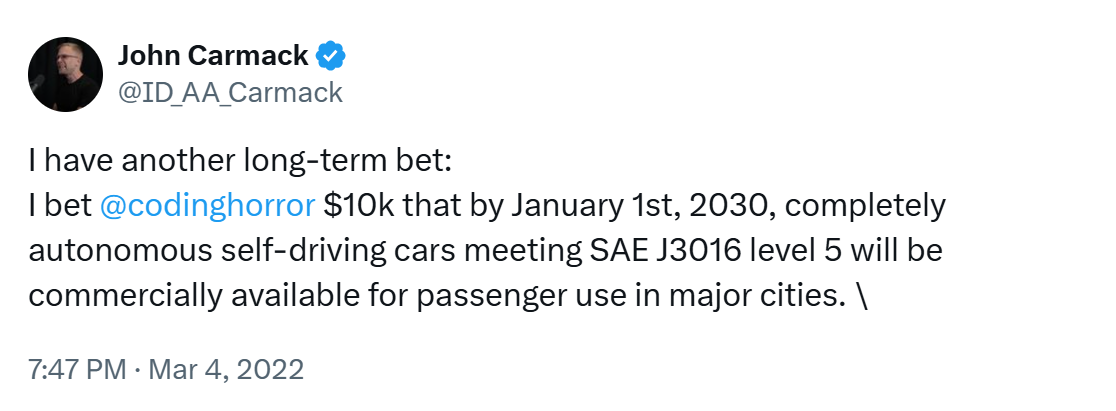
In a move that has captured the attention of the technology world and sparked renewed debate on the future of transportation, prominent software developer and "Coding Horror" blogger Jeff Atwood has publicly announced a friendly, high-stakes wager with legendary game programmer and aerospace engineer John Carmack. The bet, set at $10,000, to be donated to a 501(c)(3) charity of the winner’s choice, centers on a pivotal question for the automotive and artificial intelligence industries: whether completely autonomous self-driving cars, meeting the rigorous SAE J3016 Level 5 standard, will be commercially available for passenger use in major U.S. cities by January 1, 2030. Atwood is taking the position against this ambitious timeline, while Carmack is betting in favor, setting the stage for a fascinating technological race against the clock.
The Specifics of the Groundbreaking Wager
The parameters of the bet are meticulously defined to avoid ambiguity. "Completely autonomous" refers strictly to the SAE Level 5 definition, which mandates that the vehicle must perform all driving tasks under all conditions, with the sole exceptions being natural disasters or emergencies. This means a human passenger would simply enter the vehicle, select a destination, and require zero attention or interaction throughout the entire journey. This represents a monumental leap from even the most advanced driver-assistance systems available today.
Furthermore, the term "major cities" is also precisely delineated, referring to any of the top 10 most populous cities in the United States of America. This geographical specificity adds another layer of challenge, as deploying Level 5 autonomy in dense, complex urban environments presents a unique set of obstacles compared to more predictable highway driving. The wager also includes a provision for adjusting the $10,000 amount for inflation in 2030, ensuring the charitable impact remains consistent with its intended value.
The Protagonists: A Clash of Tech Titans
The participants in this wager are not mere observers but influential figures with deep insights into software, engineering, and technological development.
Jeff Atwood, known for his influential blog Coding Horror and his co-founding of Stack Overflow, is a respected voice in the software development community. His perspective often blends a pragmatic understanding of engineering challenges with a healthy skepticism towards overhyped technological promises. Atwood’s stance against the 2030 deadline for Level 5 autonomy stems from his belief that the industry is "underestimating how difficult fully autonomous driving really is." While he is a proponent of self-driving technology and envisions a future where driving is replaced by more engaging activities, his assessment highlights the immense computational and real-world complexities involved in achieving true Level 5. His previous public takes, such as his skepticism regarding virtual reality’s widespread adoption, underscore a pattern of grounded evaluation over unbridled futurism.
John Carmack, a legendary figure in the gaming world, is celebrated for his pioneering work on iconic titles like Doom and Quake, which revolutionized 3D graphics and game engines. Beyond gaming, Carmack has ventured into aerospace with Armadillo Aerospace and later served as CTO of Oculus VR (Facebook Reality Labs), demonstrating a career trajectory defined by tackling complex engineering challenges and pushing technological boundaries. His optimism for Level 5 autonomy by 2030 reflects a deep-seated belief in the exponential progress of artificial intelligence, sensor technology, and computational power. Carmack’s track record suggests a willingness to embrace ambitious timelines, often backed by a profound understanding of underlying technical feasibility. His suggestion of this wager, as noted by Atwood, was partly to generate STEM publicity, highlighting its role as both a serious technical challenge and a public discussion point.
The Road to Autonomy: A Historical Perspective and SAE Levels
The dream of self-driving cars has captivated engineers and futurists for decades. Early experiments date back to the 1980s, but significant progress accelerated in the 21st century with advancements in sensors, computing power, and artificial intelligence. Companies like Google (later Waymo), Tesla, General Motors (Cruise), and others began investing billions into research and development, often making bold predictions about the imminent arrival of fully autonomous vehicles.
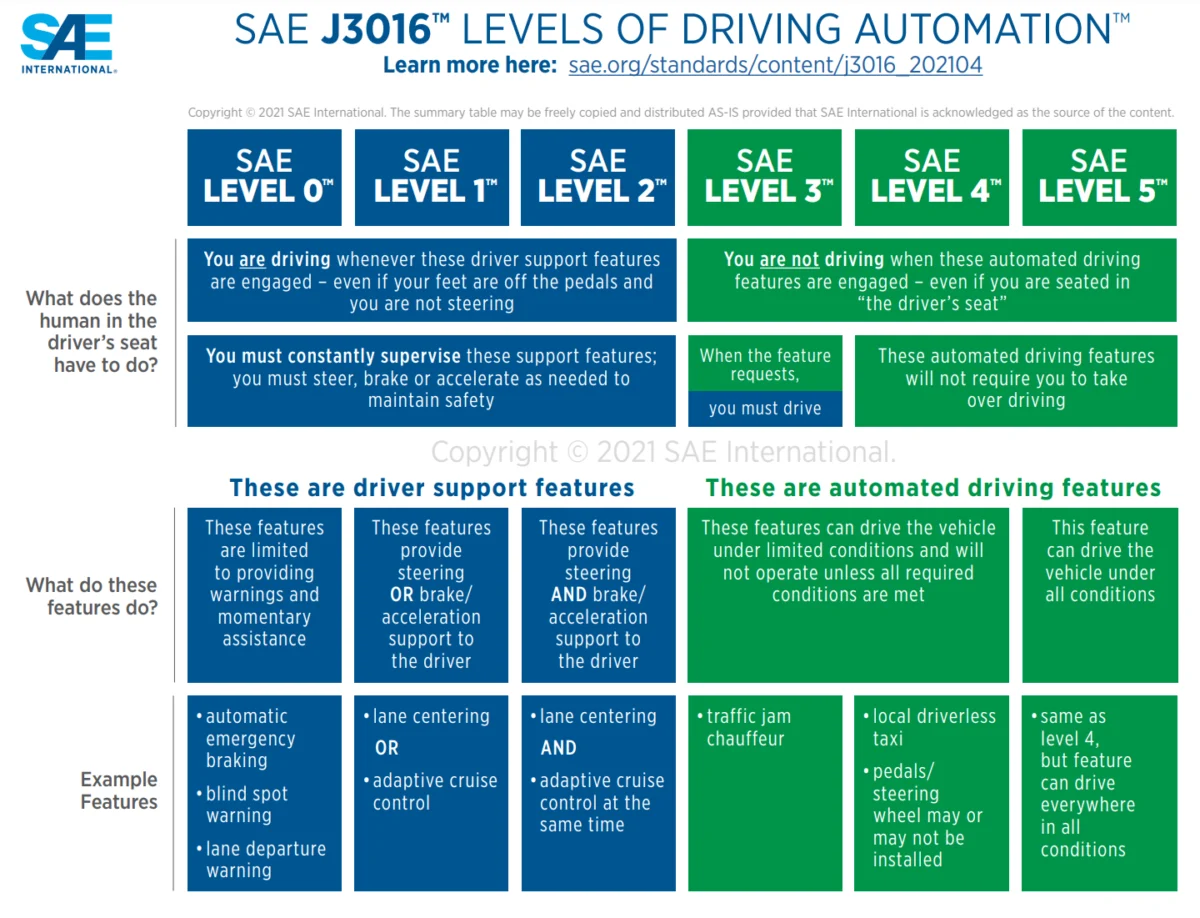
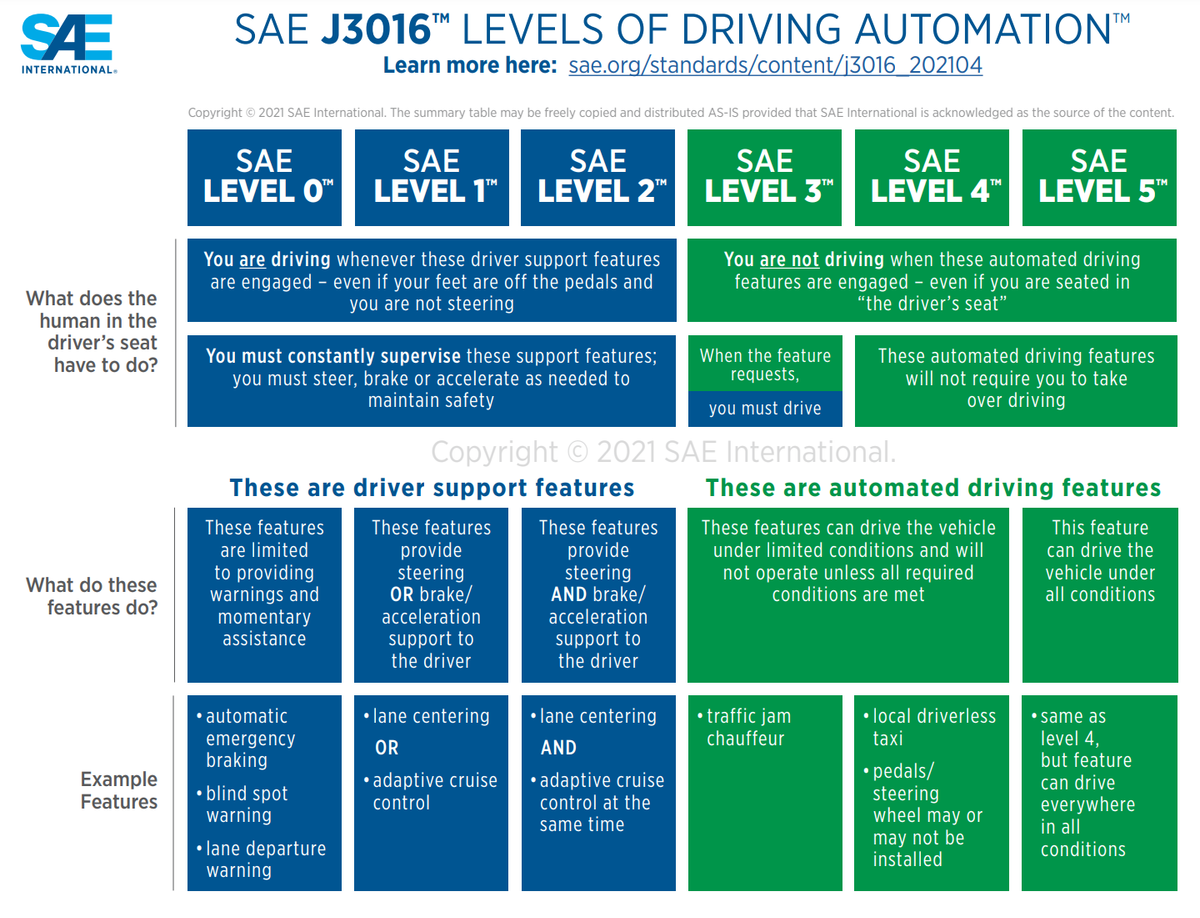
To standardize the discussion around autonomous capabilities, the Society of Automotive Engineers (SAE) developed the J3016 standard, defining six levels of driving automation from Level 0 (no automation) to Level 5 (full automation). Understanding these levels is crucial for appreciating the scale of Atwood and Carmack’s bet:
- Level 0 (No Automation): The human driver performs all driving tasks.
- Level 1 (Driver Assistance): The vehicle has either steering or acceleration/braking support (e.g., adaptive cruise control or lane keeping).
- Level 2 (Partial Automation): The vehicle can control both steering and acceleration/braking simultaneously, but the human driver must constantly supervise and be ready to intervene. This is where many current advanced driver-assistance systems (ADAS) reside.
- Level 3 (Conditional Automation): The vehicle can handle all driving tasks under specific conditions, but the human driver must still be available to take over when prompted (e.g., in certain highway scenarios). This is often referred to as "eyes off" but "mind on."
- Level 4 (High Automation): The vehicle can perform all driving tasks and monitor the driving environment under specific, limited conditions (e.g., geofenced areas, certain weather). If the system encounters a situation it cannot handle, it will safely bring the vehicle to a minimal risk condition (e.g., pull over). A human is not required to take over in these operating domains.
- Level 5 (Full Automation): The vehicle performs all driving tasks under all conditions, everywhere, at all times, equivalent to a human driver. No human intervention is ever required. This is the ultimate goal and the focus of the Atwood-Carmack wager.
The jump from Level 4 to Level 5 is considered by many to be the most significant hurdle, requiring the vehicle to operate flawlessly in literally any scenario a human driver could encounter, without any operational design domain (ODD) limitations.
The Optimist’s Perspective: Carmack’s Implicit Argument for 2030

John Carmack’s optimistic stance likely stems from several key areas of technological advancement and industry momentum. Proponents of Level 5 by 2030 often point to:
- Rapid AI and Machine Learning Progress: The exponential growth in deep learning capabilities, particularly in areas like computer vision and decision-making algorithms, suggests that increasingly complex scenarios can be handled by AI. Neural networks are constantly improving at recognizing objects, predicting behaviors, and learning from vast datasets.
- Sensor Fusion and Redundancy: Advances in LiDAR, radar, cameras, and ultrasonic sensors, combined with sophisticated sensor fusion algorithms, provide autonomous vehicles with an ever-richer and more reliable understanding of their environment. The decreasing cost and increasing performance of these sensors make robust redundancy more feasible.
- Massive Investment and Development: Billions of dollars are being poured into autonomous driving R&D globally by tech giants, traditional automakers, and dedicated startups. This financial commitment fuels intense competition and accelerates innovation cycles. Companies like Waymo and Cruise have accumulated millions of autonomous miles in controlled environments and increasingly complex urban settings.
- Incremental Progress as a Foundation: While Level 5 is a giant leap, the continuous refinement of Level 2, 3, and 4 systems provides invaluable data and builds a foundation of robust software and hardware components. Each mile driven and each edge case encountered contributes to the learning process for the AI.
- The Power of Data and Simulation: The ability to collect vast amounts of real-world driving data and simulate countless scenarios allows AI systems to learn and improve at a pace unmatched by human experience. Cloud computing and specialized hardware accelerate this iterative development.
Carmack’s background in pushing the boundaries of what computers can do, combined with his immersion in cutting-edge fields like VR (which relies heavily on sophisticated spatial understanding and real-time processing), likely informs his belief that sufficient breakthroughs can occur within the next six years.
The Skeptic’s Challenge: Atwood’s Emphasis on Extreme Difficulty
Jeff Atwood’s skepticism, shared by many engineers and experts, is rooted in the inherent complexities of achieving true Level 5 autonomy, particularly within the defined scope of "major cities" by 2030. The arguments against include:
- The "Long Tail" of Edge Cases: While AI can handle common driving scenarios, the sheer number of unpredictable "edge cases" is astronomical. These include unusual weather conditions (blizzards, torrential rain), ambiguous road markings, complex construction zones, unexpected human behavior (jaywalkers, erratic drivers, emergency responders), animals, debris, and countless other rare but critical situations. Programming or training an AI for every conceivable scenario, and ensuring it reacts safely and appropriately, remains an unsolved problem.
- The Unpredictability of Human Behavior: Humans are not perfectly rational agents. Their driving, walking, and cycling behaviors are often unpredictable, illogical, and non-compliant with rules. An autonomous system must not only perceive these actions but also anticipate and react safely to them, a task even experienced human drivers find challenging.
- Regulatory and Legal Hurdles: Even if the technology were ready, the regulatory and legal frameworks for widespread Level 5 deployment are far from mature. Questions of liability in accidents, national and international standards, and public acceptance would require significant time and legislative effort to resolve. The fragmented nature of U.S. state laws adds further complexity.
- Public Trust and Acceptance: High-profile incidents involving autonomous vehicles, even those operating at lower levels of autonomy, significantly impact public perception and trust. For Level 5 vehicles to be commercially viable, public confidence in their absolute safety must be exceptionally high, which is a significant psychological and social hurdle.
- Computational Demands and Real-time Processing: Navigating complex urban environments in real-time, making split-second decisions based on a deluge of sensor data, requires immense computational power and ultra-low latency. Ensuring this performance consistently under all conditions, while being energy-efficient and cost-effective for commercial deployment, is a formidable engineering challenge.
- Ethical Dilemmas: Autonomous vehicles will inevitably face "trolley problem" scenarios where they must choose between undesirable outcomes. Programming these ethical decisions, and gaining societal consensus on them, is a philosophical and technical quagmire that may not be fully resolved by 2030.
- The "Last Mile" Problem: While Level 4 systems might operate well within geofenced areas, expanding that capability to truly "all conditions" across entire major cities means handling every alley, every unpaved road, every temporary detour, and every construction site without fail. This "last mile" of complexity is proving to be incredibly stubborn.
Atwood’s emphasis on the "difficulty" is a recognition that the difference between 99% and 100% reliability in safety-critical systems like driving is exponential. Achieving that final percentage point often requires disproportionately more effort and innovation.
Current State of Play: Level 4 Deployments and Remaining Challenges
As of the current landscape, autonomous vehicle technology has made considerable strides, yet Level 5 remains elusive. Companies like Waymo (Google’s self-driving unit) and Cruise (GM’s autonomous vehicle subsidiary) have launched commercial Level 4 robotaxi services in select, geofenced areas of cities like Phoenix, San Francisco, and Austin. These services operate under specific conditions, often with remote human supervision and in designated operating domains. While impressive, these are not Level 5. They still have limitations regarding weather, specific road types, and geographical boundaries.
Tesla’s "Full Self-Driving" (FSD) Beta, while widely deployed, is explicitly a Level 2 system requiring constant driver supervision and readiness to intervene. Its capabilities, despite the nomenclature, are far from Level 5. Incidents and regulatory scrutiny surrounding these systems underscore the ongoing challenges in perfecting the technology and ensuring safety. The vast amount of data collected by these systems is invaluable for training AI, but transforming that data into infallible decision-making across an infinite spectrum of real-world scenarios is the core problem.
Implications of the Wager
Regardless of who wins, the Atwood-Carmack bet serves several significant purposes:
- Public Engagement and STEM Publicity: As John Carmack intended, the wager draws public attention to the ambitious goals of autonomous driving and the complex engineering and computer science problems involved. It encourages a deeper understanding of the technology and its potential.
- A Barometer for Progress: The 2030 deadline provides a tangible benchmark for the industry. While not legally binding, it represents a high-profile prediction from two respected technologists. Its outcome will offer a real-world assessment of how far autonomous technology has truly advanced in a relatively short timeframe.
- Fueling Debate and Innovation: The public declaration of such a bet will inevitably spark further debate among experts, researchers, and the public, potentially inspiring new approaches, research directions, and critical evaluations of current strategies.
- Defining Success and Failure: The clear definition of Level 5 and "major cities" forces a precise evaluation of success. It moves beyond vague promises to a concrete, verifiable outcome.
Beyond the Bet: The Broader Vision
Even if Level 5 autonomy is not fully realized by January 1, 2030, the pursuit of this goal continues to drive significant innovation across various fields. Advancements in sensors, AI, mapping, and vehicle control, even if they only contribute to more robust Level 2, 3, or 4 systems, will have profound impacts on road safety, traffic efficiency, and accessibility. Enhanced driver-assistance features, improved public transportation options, and more efficient logistics networks are all potential benefits that will emerge from this ongoing technological quest.
The friendly wager between Jeff Atwood and John Carmack is more than just a bet; it’s a public challenge, a testament to the ambition of technological progress, and a vivid illustration of the complex hurdles that remain on the path to a truly autonomous future. The world will be watching to see which visionary’s prediction holds true as the deadline approaches.
About the Author