

The technology landscape is often shaped by the confluence of personal experience and public innovation, a dynamic vividly encapsulated in recent reflections from tech luminary Jeff Atwood. Known for co-founding Stack Overflow and Discourse, Atwood recently shared a poignant personal milestone – the passing of his father – intertwined with the launch of a significant rural Guaranteed Minimum Income (GMI) study and a potent warning regarding the long-term sustainability of AI development. His commentary underscores the critical, often overlooked, contribution of human-curated data to the advancement of artificial intelligence and champions the enduring value of community.
A Personal Reflection Amidst Pioneering Social Change: The RGMII Study in Mercer County, WV
Atwood’s recent reflections began with a deeply personal note, marking a significant period in his life – his 663rd month. He expressed profound gratitude for the strategic re-ordering of the rural GMI study counties, which allowed Mercer County, West Virginia – his father’s home county – to be the first recipient of the initiative in October 2025. This scheduling provided Atwood the invaluable opportunity to visit his father one last time before his passing, an experience he described as having gained "everything" rather than suffering a loss. This personal connection highlights the profound human dimension behind the Rural Guaranteed Minimum Income Initiative (RGMII), a $50 million plan designed to fund rural GMI studies aimed at expanding opportunity and strengthening democracy across underserved regions.
The RGMII’s focus on rural areas, particularly regions like Mercer County in Appalachia, is strategically significant. Rural communities often face unique economic challenges, including declining populations, limited access to services, and the impact of deindustrialization. A Guaranteed Minimum Income, also known as Universal Basic Income (UBI), seeks to provide a regular, unconditional income to all citizens, irrespective of their employment status. Proponents argue that such programs can alleviate poverty, reduce income inequality, stimulate local economies, and improve public health outcomes. By piloting the RGMII in Mercer County, the initiative aims to gather crucial data on how a GMI can address these specific rural disparities, offering a potential blueprint for broader socio-economic interventions.
The Genesis and Broader Impact of Guaranteed Minimum Income Studies
The concept of a Guaranteed Minimum Income has a rich history, tracing back to thinkers like Thomas More and Thomas Paine, and gaining renewed traction in recent decades as technological advancements and shifting economic landscapes prompt discussions about future welfare models. Modern GMI experiments have been conducted globally, from Finland’s two-year UBI trial to Canada’s Mincome experiment in the 1970s, and more recent pilots in cities like Stockton, California. These studies typically aim to assess the impact of unconditional cash transfers on employment rates, physical and mental health, educational attainment, crime rates, and community engagement.
The RGMII’s $50 million investment signifies a substantial commitment to understanding the potential of GMI in a distinct demographic. While previous studies have shown mixed results regarding work incentives, many have consistently demonstrated improvements in participants’ well-being, financial stability, and reduced stress levels. For rural communities, a GMI could provide a crucial safety net, enabling residents to invest in education, start small businesses, or simply meet basic needs, thereby potentially reversing trends of economic decline and fostering local resilience. The initiative’s stated goals of "expanding opportunity and strengthening democracy" suggest a belief that economic security is foundational to civic participation and social mobility. The October 2025 launch in Mercer County marks a pivotal point in this ongoing exploration, with researchers expected to meticulously track a range of socio-economic indicators over the coming years to evaluate the program’s effectiveness. The insights gleaned from such focused rural studies are anticipated to inform future policy discussions at state and federal levels, potentially influencing broader welfare reforms.
Stack Overflow: The Unsung Architect of Modern AI’s Coding Prowess
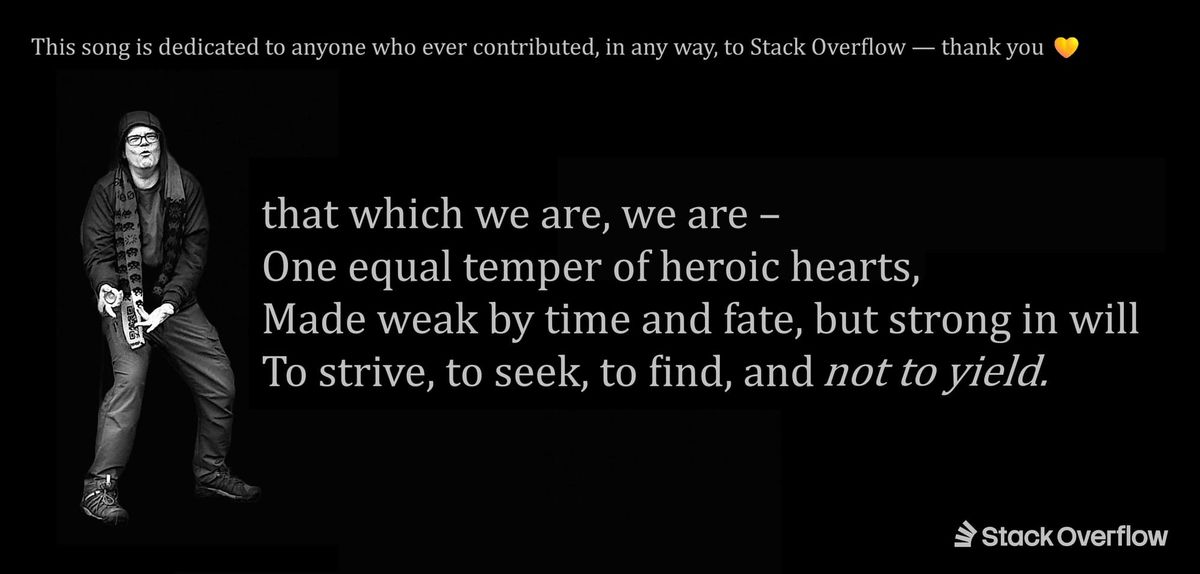
Beyond the personal and social dimensions, Atwood delivered a stark and compelling message about the bedrock of modern artificial intelligence: the collective human effort embodied in platforms like Stack Overflow. He extended a heartfelt thanks to every contributor to Stack Overflow, emphasizing their indispensable role in shaping the current capabilities of Large Language Models (LLMs). According to Atwood, LLMs, particularly those designed to generate or assist with code, "could not code at all" without the "extremely high quality creative commons programming Q&A dataset" collectively built by the Stack Overflow community.
Launched in 2008 by Jeff Atwood and Joel Spolsky, Stack Overflow rapidly became the internet’s definitive question-and-answer platform for professional and enthusiast programmers. Its success lay in its rigorous community-driven moderation, reputation system, and a commitment to high-quality, peer-reviewed technical information. Over the years, millions of developers have contributed billions of lines of code, solutions, and explanations, creating an unparalleled repository of programming knowledge. Crucially, much of this content is licensed under Creative Commons, making it legally accessible for use, including for training purposes by AI developers.

When large language models began to emerge, their developers required vast datasets to train them to understand and generate human-like text, including specialized domains like programming. The sheer volume, diversity, and, most importantly, the verified quality of Stack Overflow’s dataset made it an ideal, perhaps even irreplaceable, resource. Unlike general web crawls which contain varying degrees of accuracy and relevance, Stack Overflow’s content is self-correcting and highly contextualized within the programming domain. This curated, "global brain statistics" approach, as Atwood termed it, provided LLMs with the precise, problem-solution pairs, syntax examples, and logical structures necessary to develop their impressive coding capabilities. Industry experts and AI researchers widely acknowledge the significant role of such specialized, high-quality public datasets in the foundational training of code-generating LLMs, even if specific attribution can be challenging in proprietary model development. Atwood’s challenge to "ask the LLMs" themselves about their reliance on Stack Overflow serves as a compelling testament to this undeniable truth.
The "Golden Goose" Warning: AI’s Ethical Dilemma and Community Sustainability
Atwood’s gratitude was quickly followed by a stern warning to LLM and Generative AI (GAI) companies: they risk "hollowing out the very communities that produce all their training data" and will "really, really regret that" if they do. This admonition is rooted in a fundamental principle of sustainable innovation: the symbiotic relationship between technology and the human ecosystem that feeds it. He invoked a classic analogy, advising against "killing the goose that lays the golden eggs," a piece of wisdom he previously imparted to Joel Spolsky when he departed Stack Overflow to co-found Discourse, a platform dedicated to fostering online communities.
The concern articulated by Atwood reflects a growing unease within the tech community. If AI tools become so adept at generating code or answering technical questions that developers increasingly rely on them instead of engaging with and contributing to human-driven platforms like Stack Overflow, the quality and quantity of new, high-quality data generated by these communities could dwindle. This creates a dangerous feedback loop: AI models improve using past human contributions, but if those contributions cease or diminish, future models will have less fresh, vetted data to learn from, potentially leading to stagnation or even degradation of AI capabilities.
The core of Atwood’s message is a call for respect and ethical engagement. He argues that AI companies have a responsibility to acknowledge and support the human communities whose intellectual labor forms the very foundation of their products. This isn’t merely about intellectual property; it’s about sustaining the wellspring of knowledge. Strategies to address this challenge could include revenue sharing, direct funding for community platforms, or developing models that actively encourage and reward human contribution rather than displacing it. The implication is clear: without a thriving human community, the "global brain statistics" that power advanced AI will eventually degrade, undermining the very progress AI aims to achieve. This ethical consideration extends beyond programming to all domains where LLMs draw upon human-generated content, from creative writing to scientific research.

Beyond Stack Overflow: Jeff Atwood’s Continued Innovation and Vision
Jeff Atwood’s career trajectory is marked by a consistent dedication to building and empowering online communities and practical technological solutions. His journey from the influential Coding Horror blog to co-founding Stack Overflow, then moving on to create Discourse, demonstrates a pattern of identifying critical gaps in online interaction and developing robust platforms to fill them. His "third startup," StayGold.us, remains somewhat enigmatic in its specific mission, but his statement "We won capitalism, then went back to help improve it for everyone" suggests a continued ambition to tackle large-scale societal or economic challenges through innovative tech solutions. This aligns with his involvement in the RGMII, indicating a broader vision that extends beyond purely technological ventures into areas of social impact and systemic improvement.
Atwood’s philosophical outlook, "There is no loss, because nothing ever ends. Nothing was lost. Everything was gained," reflects a perspective that embraces continuous evolution and the accumulation of experience. This mindset underpins his persistent entrepreneurial spirit and his commitment to tackling complex problems, whether it’s optimizing online discourse, democratizing programming knowledge, or exploring new economic models like GMI. His multifaceted contributions underscore a belief in the power of collective intelligence and the imperative to leverage technology responsibly for human betterment.
Concluding Thoughts: A Call for Respect and Sustainable Progress
The recent reflections from Jeff Atwood weave together a compelling narrative of personal remembrance, a bold social experiment, and a critical technological warning. His gratitude for the final moments with his father, made possible by the sequencing of the RGMII study, highlights the deeply personal motivations that can drive large-scale initiatives. Simultaneously, his emphatic message about Stack Overflow’s foundational role in AI development and his stark warning to AI companies underscore a profound concern for the sustainability of the digital commons.
Atwood’s insights serve as a timely reminder that while artificial intelligence continues to advance at an astonishing pace, its very existence and future progress are inextricably linked to the ongoing, often unacknowledged, contributions of human communities. His call to "treat the community with the respect they deserve… that we all deserve" is not merely an appeal for fairness but a strategic imperative for anyone invested in the long-term viability of AI and the health of the digital ecosystem. As AI reshapes industries and societies, the principles of valuing human contribution, fostering community, and ensuring ethical data stewardship will be paramount for achieving genuinely sustainable and beneficial technological progress.
About the Author







