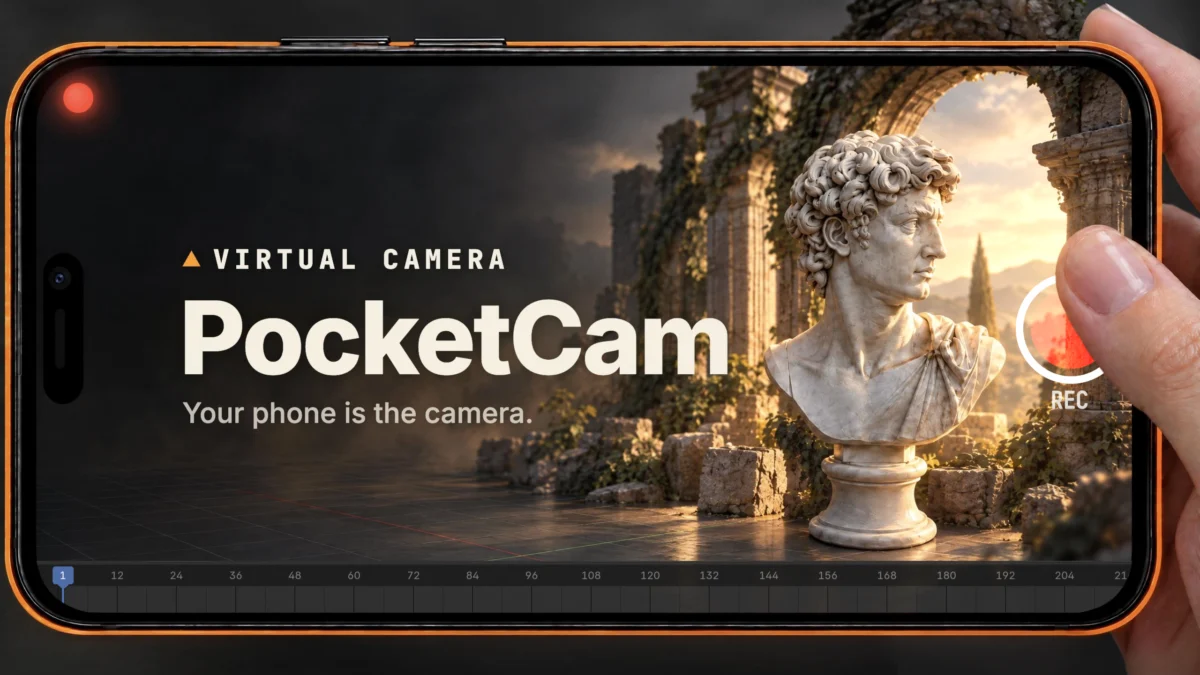
A groundbreaking new Blender add-on, PocketCam, has been released, offering 3D artists and animators an unprecedented level of intuitive control by transforming their smartphones into real-time virtual cameras. This innovative tool leverages the sophisticated motion-tracking capabilities of modern mobile devices to capture fluid, handheld camera movements directly within Blender scenes, promising to streamline the animation and previs process for professionals and hobbyists alike.
The core functionality of PocketCam revolves around its custom-built six degrees of freedom (6 DoF) tracker. This system meticulously interprets data from a smartphone’s gyroscope, capturing every subtle turn and tilt with remarkable accuracy. Simultaneously, the device’s camera actively follows the user’s physical movements, allowing for dynamic exploration of virtual environments. This means users can physically walk through a room to define camera paths, crouch for dramatic low-angle shots, crane upwards for epic vistas, or orbit a subject with natural, unscripted motion. Crucially, all these actions are recorded directly to the Blender timeline, preserving the authentic feel of handheld cinematography.
Background and Development Context
The development of tools that bridge the gap between physical action and digital creation has been a persistent trend in the computer graphics industry. For decades, 3D animators have relied on complex rigs, keyframing, or expensive motion-capture systems to imbue their virtual cameras with life-like movement. While advancements in virtual production and real-time rendering have made significant strides, the accessibility and affordability of sophisticated camera control have remained a barrier for many.
The emergence of powerful mobile sensors, particularly gyroscopes and accelerometers, has opened new avenues for intuitive interaction. Developers have increasingly explored how to harness this readily available technology for creative purposes. PocketCam appears to be a direct response to this evolving landscape, aiming to democratize advanced camera control within the widely adopted open-source 3D creation suite, Blender. The decision to integrate directly with Blender, a platform known for its vibrant community and commitment to open access, suggests a strategic move to empower a broad user base.
Technical Implementation and User Experience
A key aspect of PocketCam’s design is its emphasis on a frictionless user experience. Notably, the system bypasses the need for any downloadable mobile application or recurring subscription fees. Instead, users initiate the connection by scanning a single QR code within the Blender interface. This QR code serves as a secure bridge, connecting the Blender scene to the user’s smartphone.
The mobile component of PocketCam operates directly within the Safari web browser on iPhones. This browser-based approach eliminates the need for app store approvals and simplifies updates. Furthermore, the system is hosted on the user’s personal Cloudflare account, which PocketCam assists in setting up directly from within Blender. This decentralized hosting model enhances privacy and user control over their data. The current iteration of PocketCam requires Blender version 4.2 or later and is compatible with iPhones. This specific hardware and software requirement is likely due to the advanced sensor capabilities and the browser environment optimized for iOS.
Key Features and Functionality
While specific detailed feature lists were not provided in the initial announcement, the core functionality described implies several critical capabilities:
- Real-time 6 DoF Tracking: Capturing positional and rotational data from the smartphone for precise virtual camera movement.
- Gyroscope Integration: Utilizing the phone’s internal sensors to detect turns, tilts, and rotations.
- Camera Following: The phone’s actual camera feed can potentially be used for visual reference within the Blender viewport, although its primary role in the tracking mechanism is through sensor data.
- Direct Timeline Recording: Seamlessly transferring recorded camera motion into Blender’s animation timeline.
- Handheld Motion Emulation: Preserving the natural imperfections and nuances of real-world camera operation.
- No App Download or Subscription: Simplifying setup and reducing ongoing costs.
- QR Code Integration: A straightforward method for establishing a connection between Blender and the smartphone.
- Cloudflare Hosting: Decentralized and user-controlled data management.
- Blender 4.2+ and iPhone Compatibility: Specific system requirements for optimal performance.
Community and Commercial Aspects
The release of PocketCam is accompanied by a commitment to supporting the Blender ecosystem. A significant aspect of its commercial model is the allocation of 1% of every sale to the Blender Development Fund. This initiative directly contributes to the ongoing development, maintenance, and expansion of Blender, reinforcing the symbiotic relationship between third-party developers and the open-source project. This practice aligns with the ethos of many Blender add-on creators who actively contribute back to the community that enables their work.
PocketCam is currently available for purchase through Superhive, a platform that often features specialized tools and assets for 3D artists. The availability on such a platform suggests a targeted marketing approach towards professional and semi-professional 3D creators.
Potential Implications and Analysis
The introduction of PocketCam has several significant implications for the 3D animation and virtual production pipelines:
- Democratization of Advanced Camera Control: Traditionally, achieving sophisticated handheld camera movements in 3D required specialized hardware or extensive manual animation. PocketCam makes this capability accessible to a much wider audience, including independent animators, small studios, and even educators and students who may not have access to high-end motion capture systems.
- Accelerated Previsualization (Previs): The ability to quickly and intuitively block out camera shots using real-world movements can dramatically speed up the previs process. This allows directors and animators to iterate on shot composition and camera choreography much faster, leading to more efficient production workflows.
- Enhanced Realism and Organic Motion: The natural imperfections and subtle jitters inherent in handheld camera work are often difficult to replicate convincingly through keyframing alone. PocketCam’s direct capture of real-world motion can lend a unique sense of organic realism and authenticity to 3D animations.
- New Creative Possibilities: By removing technical barriers, PocketCam empowers artists to experiment more freely with camera language. The intuitive nature of the tool might inspire new forms of animation and visual storytelling, where the camera itself becomes a more dynamic and expressive character.
- Integration with Existing Workflows: The direct integration into Blender’s timeline means that captured motion can be immediately refined, edited, or combined with other animation data, fitting seamlessly into established production pipelines.
- Impact on Indie Game Development: For indie game developers who often work with limited budgets, PocketCam could provide a cost-effective way to create dynamic in-game cinematics or to capture motion for character animations.
- Educational Tool: The accessibility and intuitive nature of PocketCam make it an excellent educational tool for teaching fundamental principles of cinematography and animation to aspiring artists.
Challenges and Future Outlook
While the initial announcement is highly promising, potential users might have questions regarding the precision and calibration of the tracking system, especially in complex or fast-moving scenes. The reliability of the Wi-Fi connection between the phone and the computer will also be a critical factor in ensuring a smooth recording experience. Furthermore, the current iPhone and Blender 4.2+ requirement might limit adoption for users on other platforms or older software versions.
However, given the rapid pace of technological advancement in mobile sensors and the ongoing development of Blender, it is plausible that future iterations of PocketCam could expand compatibility and enhance tracking accuracy. The success of this add-on could also spur further innovation in similar real-time capture technologies for 3D software.
In conclusion, PocketCam represents a significant leap forward in making advanced virtual camera control accessible and intuitive within the Blender ecosystem. By transforming a ubiquitous device like a smartphone into a powerful creative tool, it promises to streamline workflows, enhance realism, and unlock new creative possibilities for 3D artists worldwide, all while contributing to the continued growth of the open-source Blender project.
About the Author