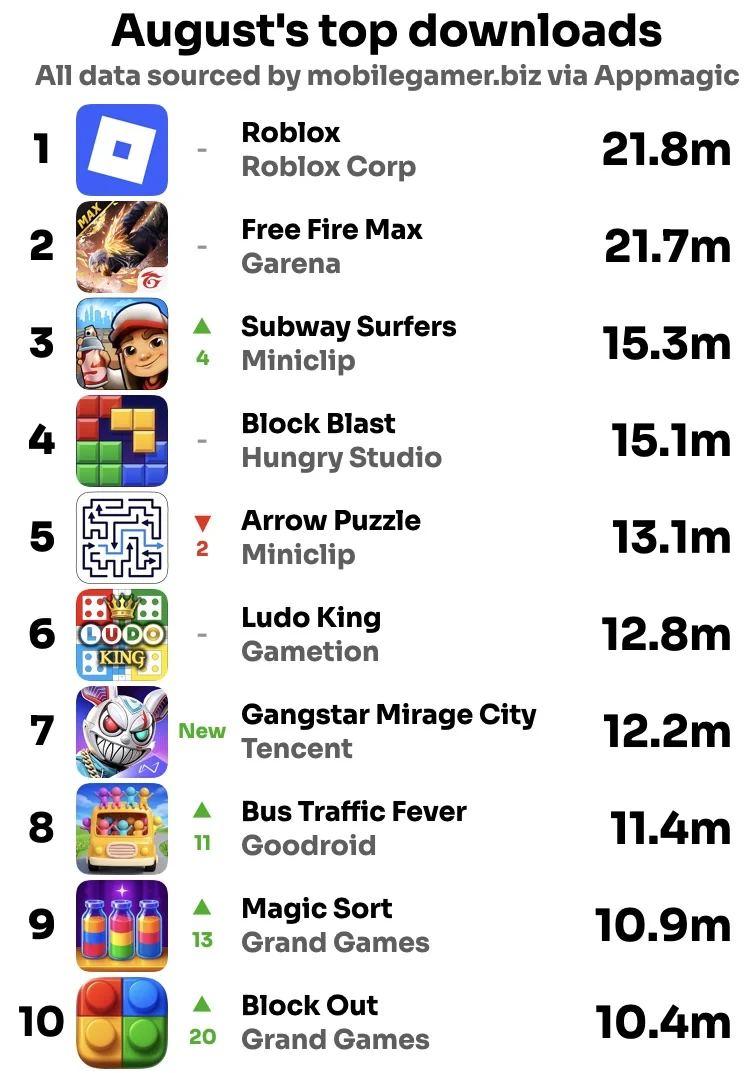
The global mobile gaming landscape in August 2026 demonstrated a sophisticated balance between established legacy titles and aggressive new entries, according to the latest market intelligence provided by Appmagic. While the industry continues to navigate a post-IDFA (Identifier for Advertisers) environment, the data suggests that player acquisition remains robust for titles that successfully blend high-engagement mechanics with social or creative platforms. Notably, the report excludes data from China’s fragmented third-party Android marketplaces, focusing instead on the global Google Play Store and Apple App Store ecosystems.
The Unshakable Dominance of Platform-Based Ecosystems
For the second consecutive month, the rankings were spearheaded by two juggernauts: Roblox and Garena’s Free Fire Max. Despite a slight month-on-month dip in absolute download numbers, these titles maintained a significant lead over the rest of the market. Roblox’s continued dominance is largely attributed to its evolution from a mere game into a comprehensive social metaverse. By allowing user-generated content (UGC) to drive the platform’s variety, Roblox Corp has effectively insulated itself from the hit-or-miss nature of traditional game development.
Free Fire Max continues to capitalize on its optimization for mid-to-low-tier mobile hardware, particularly in Southeast Asia and Latin America. Its ability to maintain the number two spot highlights the enduring popularity of the battle royale genre when paired with consistent "Live Ops" (live operations) and regionalized events. Industry analysts note that both Roblox and Free Fire Max have moved beyond being simple applications; they are now social hubs where the "gameplay" is often secondary to social interaction, a factor that ensures high retention even when marketing spend fluctuates.
Resurgence of the Classics: Subway Surfers and Block Blast
A notable highlight of the August data is the resurgence of Sybo’s Subway Surfers. Climbing four places to reach the third spot, the title recorded its highest installation rate since January, surpassing 15 million downloads. This spike is indicative of the "evergreen" status of high-quality endless runners. Analysts suggest that periodic content updates—often themed around global cities or seasonal holidays—continue to pull in new generations of mobile users while re-engaging lapsed players.

In the fourth position, Hungry Studio’s Block Blast showed signs of stabilization. The Tetris-inspired puzzler had experienced a meteoric rise in late 2025, peaking at a staggering 38 million downloads in December of that year. Following a sharp decline throughout the first half of 2026, the game’s performance plateaued in June and has now seen two consecutive months of modest growth, also hovering around the 15-million-download mark. The trajectory of Block Blast serves as a case study for the "viral puzzle" cycle, where initial hyper-growth is followed by a "cooling period" before settling into a steady state of baseline popularity.
The Rise of Tencent’s Gangstar Mirage City and the GTA Effect
Perhaps the most significant disruption in the top ten was the arrival of Tencent’s Gangstar Mirage City. Launched on August 20, the game initially bypassed several major Western markets, yet it managed to secure the seventh spot globally with over 12 million installs in less than a fortnight. Gangstar Mirage City is an open-world action title that many industry insiders describe as a strategic "pre-emptive strike" ahead of the anticipated release of Grand Theft Auto VI on consoles.
Tencent’s strategy appears to be capturing the immense appetite for "urban sandbox" gameplay on mobile devices. By blending elements of the Grand Theft Auto series with a Cyberpunk aesthetic, the title has resonated deeply in emerging markets. Reports suggest that Tencent is currently refining the game’s localization and monetization structures in preparation for a "proper" Western launch. The success of Mirage City underscores a growing trend where AAA-style experiences are being successfully downscaled for mobile audiences, challenging the notion that mobile gamers only desire short-session casual titles.
The Hybridcasual Breakthrough: Bus Traffic Fever
Securing the eighth position, Bus Traffic Fever from Japanese developer Goodroid represents the burgeoning "hybridcasual" sector. Since its full launch in March 2026, the game has steadily climbed the charts, reaching a record high of 13 million installs in August. Unlike traditional hypercasual games that rely almost exclusively on ad revenue, Bus Traffic Fever has successfully integrated meaningful in-app purchases (IAPs).
According to Appmagic’s estimates, the title has generated nearly $6.3 million in IAP revenue to date. This shift toward "hybrid" models is a response to the diminishing returns of interstitial ads. By offering players deep progression systems and cosmetic upgrades worth paying for, Goodroid has demonstrated that casual mechanics—like managing bus routes—can support a more sustainable financial model than the "churn-and-burn" strategy typical of 2020-era mobile gaming.

Puzzle Market Volatility and the Turkish Influence
The puzzle genre remains a battleground of high volatility. Arrow Puzzle, published by the Easybrain/Miniclip partnership, saw its rapid ascent halted in August. After hitting nearly 20 million installs in July, it dropped to approximately 13 million. Conversely, Turkiye-based Grand Games saw a banner month, placing two titles in the top ten: Magic Sort (#9) and Block Out (#10).
Magic Sort’s entry into the top ten marks the first time the title has exceeded 10 million monthly downloads. Block Out reached this milestone even faster, showing consistent growth since its scaling phase began in March. The success of these Turkish developers reinforces Istanbul’s reputation as a global hub for mobile gaming innovation, particularly in the puzzle and logic categories.
Post-Tournament Slump in the Sports Category
The rankings from 11 to 20 revealed a significant cooling-off period for sports titles. Following the conclusion of the 2026 FIFA World Cup in July, titles such as Football League 2026, EA FC Mobile, and Konami’s eFootball all saw declines in their rankings. While these games remain highly profitable, the post-tournament fatigue was most visible in Soccer Superstar, which plummeted 30 places month-on-month after a top-five showing in July.
This trend highlights the cyclical nature of sports gaming, where major real-world events drive massive spikes in user acquisition that are difficult to sustain once the global spotlight shifts. EA and Konami are expected to counter this trend with "new season" updates in the coming months to stabilize their user bases.
Noteworthy Movers: Voodoo and King
Further down the charts, Voodoo’s Mob Control rose five places to 16th, proving the longevity of "multiplier-gate" runners when supported by aggressive UA (User Acquisition) and clever level design. King’s perennial favorite, Candy Crush Saga, also saw a notable resurgence, jumping ten places to 19th. The ability of a decade-old game like Candy Crush to re-enter the top 20 rankings during a competitive month like August is a testament to King’s peerless mastery of live operations and player psychology.

Broader Market Implications and Future Outlook
The August 2026 data illustrates a mobile market that is becoming increasingly bifurcated. On one side are the "Platform Games" (Roblox, Free Fire) that act as permanent fixtures of the digital social fabric. On the other are "Trend Riders" and "Hybridcasual Hits" that must constantly innovate to capture the fleeting attention of the casual audience.
The entry of Tencent’s Gangstar Mirage City suggests that the "mid-core" segment—games with higher production values and more complex gameplay—is poised for a comeback on mobile. As hardware capabilities continue to improve, the gap between mobile gaming and traditional console gaming is narrowing, allowing for more ambitious titles to find massive audiences.
Looking ahead to the final quarter of 2026, the industry will likely see a continued focus on hybrid monetization. As privacy regulations make traditional ad-based models more difficult to optimize, the success of titles like Bus Traffic Fever provides a roadmap for developers to achieve both high download volumes and sustainable revenue. The mobile gaming sector remains a high-stakes environment where the ability to adapt to shifting player demographics and global trends is the only true guarantee of success.
About the Author