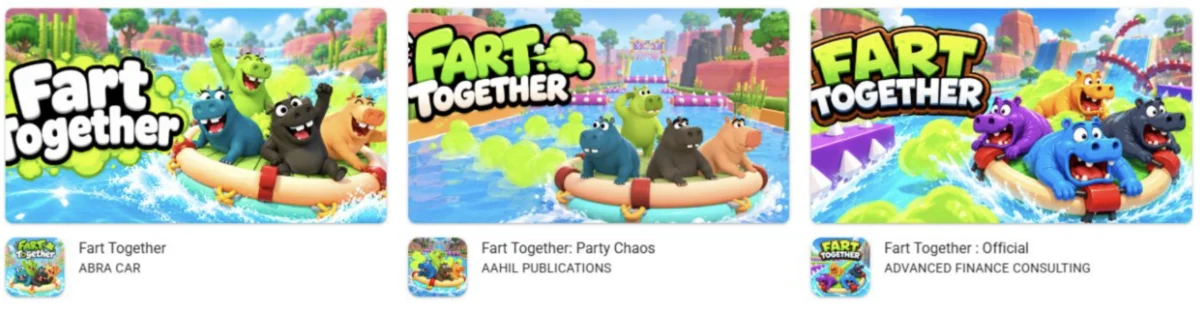
The digital gaming landscape is currently grappling with a surge in intellectual property infringement as "Fart Together," a highly anticipated indie title on the Steam platform, has become the target of an unprecedented cloning campaign on the Google Play Store. Despite the fact that the original game has yet to see an official full release, more than a dozen unauthorized lookalike applications have already proliferated across Android devices, raising significant concerns regarding the efficacy of mobile storefront moderation and the role of generative artificial intelligence in accelerating digital plagiarism.
Emrah İşlek, the co-founder and CEO of the development firm GamesMrkt, recently brought the issue to light through a public disclosure on LinkedIn. In his report, which was later amplified by the industry analysis publication GameDiscoverCo, İşlek shared a comprehensive grid featuring 15 distinct listings on Google Play that blatantly mimic the aesthetics, branding, and core mechanics of Fart Together. The situation is exacerbated by the boldness of the cloners; one specific listing, published by a developer identified as Advanced Finance Consulting, has gone so far as to title its application "Fart Together: Official," a move clearly designed to deceive consumers into believing they are downloading the legitimate product from the original creators.
The rapid appearance of these clones marks a potentially record-breaking instance of pre-emptive cloning. Typically, clones appear after a game has achieved viral success or sustained profitability. In this instance, however, the "cloning economy" has moved upstream, targeting a game that is still in its promotional demo phase. This shift suggests a new era of predatory publishing where automated tools and market-tracking algorithms identify trending demos on Steam to populate mobile stores with low-quality facsimiles before the original developer can even consider a cross-platform port.
The Rise of Fart Together and the Appeal for Cloners
To understand why Fart Together has become a primary target for such aggressive cloning, one must look at its performance during the most recent Steam Next Fest. The game is a physics-based cooperative obstacle course designed for up to four players. Its gameplay loop revolves around a quirky and humorous premise: players must steer a shared raft by coordinating well-timed flatulence. While the concept is intentionally irreverent, the execution relies on sophisticated physics interactions and synchronized multiplayer mechanics that have resonated deeply with the PC gaming community.
Since its Steam demo launched on October 8, Fart Together has maintained a trajectory of significant growth. According to data tracked by PC Games Hardware, the title emerged as one of the 20 most-played demos during the October Steam Next Fest, achieving a peak concurrent player count of nearly 4,000. Furthermore, the game has secured a "Very Positive" rating on Steam, backed by over 1,200 user reviews. For predatory developers looking for the "next big thing," these metrics serve as a green light for exploitation. The high visibility of Steam Next Fest provides a curated list of high-potential intellectual properties, which cloners then use as a roadmap for their next projects.
Failures in the App Store Moderation Pipeline
The core of the controversy lies in the apparent ease with which these clones bypassed Google’s submission and review protocols. Emrah İşlek expressed profound frustration over the discrepancy between the rigorous hurdles faced by legitimate developers and the seemingly frictionless entry afforded to clones. In his public statement, İşlek noted that when GamesMrkt attempts to publish legitimate content on Android or iOS, they are frequently subjected to multiple rounds of revisions and stringent manual checks.
"How do these clones get approved so easily?" İşlek questioned, pointing to a systemic failure in the automated and manual vetting processes. He argued that even before a human reviewer looks at a submission, modern AI-powered checks should be capable of identifying blatant trademark infringement and asset duplication. The fact that an app can be titled "Fart Together: Official" by a developer with no prior link to the original intellectual property suggests a significant gap in the metadata validation systems used by major mobile platforms.
This incident has reignited a long-standing debate within the developer community regarding the "Wild West" nature of mobile app stores. While Google and Apple frequently tout their security measures and commitment to quality, the sheer volume of clones suggests that quantity often overwhelms quality control. For indie developers, who often lack the legal resources to pursue international copyright litigation, these clones represent not just a loss of potential revenue but a dilution of their brand identity before they have even established a foothold in the market.
A Historical Context of Mobile Game Cloning
The plight of Fart Together is not an isolated event; rather, it is part of a growing trend of "pre-emptive cloning" that has plagued the industry throughout 2024. Earlier this year, the survival-horror hit "Lethal Company" faced a similar onslaught. As the game went viral on PC, dozens of clones appeared on both the Apple App Store and Google Play Store. Some of these unauthorized versions garnered more than 100,000 downloads, effectively siphoning off the momentum of the original creator, Zeekerss, who had not yet released an official mobile version.
The financial incentive for this behavior is clear. By being the first to market on a specific platform with a trending name, cloners can capture organic search traffic. These apps are typically laden with aggressive monetization schemes, including intrusive interstitial advertisements and data-harvesting trackers. In many cases, the "game" itself is barely functional, often consisting of a few basic assets slapped together in a generic engine, but by the time the platform holders take action, the cloners have already moved on to the next trend.
The Role of Generative AI in the Cloning Crisis
The acceleration of the cloning cycle is largely attributed to the democratization of game development through generative AI tools. Large Language Models (LLMs) and specialized coding assistants like Claude Code have made it possible for individuals with minimal programming knowledge to generate functional codebases in a matter of hours. This "vibe coding" phenomenon was highlighted earlier this year when a solo creator used Claude Code to build a game called "38-0-0," which subsequently became the number one iOS game in the United Kingdom overnight.
While these tools offer immense potential for creativity, they are also being weaponized by bad actors. In response to the ethical concerns surrounding the recreation of existing intellectual property, Anthropic, the developer of Claude, recently implemented rules against recreating existing games. However, these restrictions are often easily bypassed; the AI now offers to build an "original" game within the same genre, which in practice allows users to prompt the AI to create something "exactly like Fart Together but with different assets." This creates a legal gray area where the mechanics are stolen, but the specific code and art are technically unique, making copyright enforcement even more difficult.
Impact on App Store Performance and Review Times
The flood of AI-generated content is not only hurting developers through cloning but is also crippling the infrastructure of the app stores themselves. Multiple reports from small and mid-sized developers indicate a severe slowdown in app review times. Historically, a submission might take 24 to 48 hours to be approved. Currently, some developers are reporting wait times of several weeks.
Data from The Information indicates that AI-generated apps and games contributed to an 84% year-on-year jump in submissions to Apple’s App Store in the early months of 2024. This tidal wave of content has overwhelmed human reviewers, leading to a bottleneck that punishes legitimate developers who are trying to push critical updates or time-sensitive releases. Apple’s developer forums are currently inundated with complaints regarding these delays, and trackers like Runway’s app review times suggest that the average wait period is continuing to climb.
Legal and Industry Implications
The legal landscape regarding game cloning remains complex and often favors the cloners. While direct asset theft (stealing art, music, or code) is a clear violation of copyright law, the theft of "gameplay mechanics" is much harder to litigate. In the United States and many other jurisdictions, ideas and functional systems are generally not copyrightable, only the specific expression of those ideas is.
However, some recent cases suggest a shifting tide. The developer Oakever Games, known for "Vita Mahjong" and "Meowdoku," recently lost a copyright case to Hungry Studio, the maker of "Block Blast." The court’s decision highlighted that excessive similarity in UI, progression systems, and "feel" can constitute infringement. Despite this, the cost of litigation remains a barrier for most. For a developer like GamesMrkt, the primary defense is not a courtroom, but rather the speed of their own development and the loyalty of their community.
Conclusion and Future Outlook
The case of Fart Together serves as a stark warning for the indie development community. In an era where Steam Next Fest acts as a public catalog for cloners and AI tools provide the means for rapid duplication, the traditional "launch and then port" strategy may no longer be viable. Developers are increasingly being forced to consider simultaneous multi-platform launches or to secure their trademarks and mobile "placeholders" months in advance to prevent squatting.
For platform holders like Google and Apple, the pressure is mounting to overhaul their review systems. The current reliance on AI-powered checks is clearly failing to catch high-profile infringements, and the human review teams are being buried under a mountain of AI-generated shovelware. If the stores continue to allow blatant clones to thrive while legitimate developers struggle with long review times, the perceived value of these ecosystems will continue to decline.
As for Fart Together, the developer’s best path forward lies in the quality of the original product. While the clones may offer a superficial imitation of the "fart-based raft steering" mechanic, they lack the polished physics and community-driven updates that have made the Steam demo a success. However, the incident remains a sobering reminder that in the modern digital economy, success often brings with it a shadow industry dedicated to its exploitation. The industry now waits to see if Google will take decisive action against the 15+ clones currently cluttering the Play Store, or if this "record-breaking" cloning event will simply become the new standard for the mobile gaming market.
About the Author