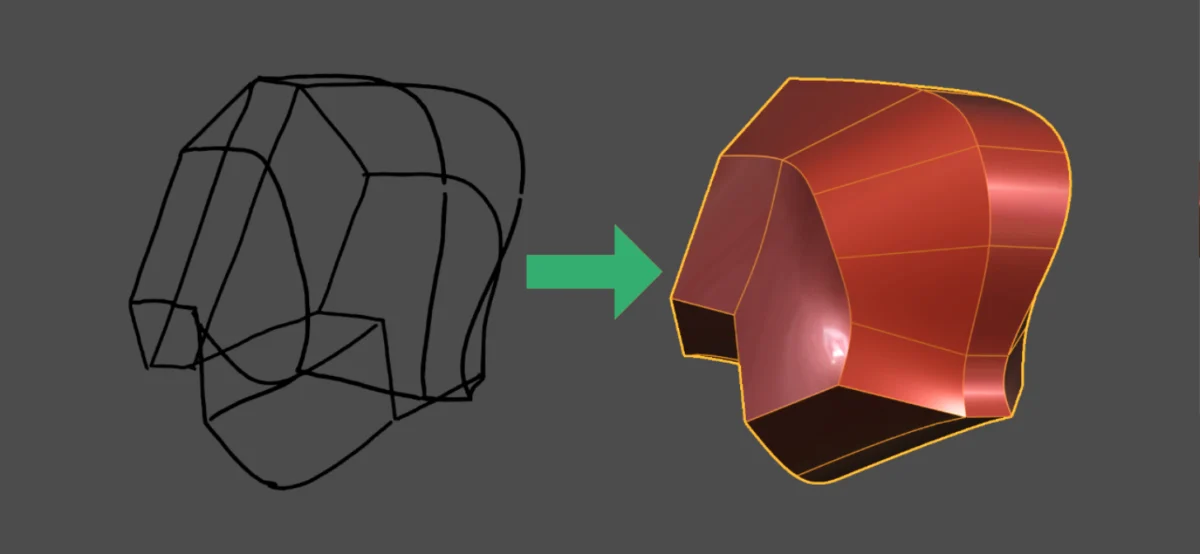
A recent tutorial published on BlenderNation, originating from the "Blender Secrets" channel, has illuminated an experimental and potentially groundbreaking workflow for 3D artists: the conversion of Grease Pencil sketches directly into solid surface mesh objects within Blender. While the creator, identified as a Community Reporter, acknowledges the nascent and somewhat unreliable nature of this technique, deeming it unsuitable for most users and requiring significant practice, the revelation has sparked considerable interest within the 3D design and animation community. The tutorial, embedded within the report, showcases a method that bridges the gap between freehand 2D sketching and the creation of tangible 3D geometry, a development that could, with further refinement, offer new avenues for rapid prototyping, conceptual design, and artistic expression.
The Genesis of the Workflow: Bridging 2D and 3D
The core of this innovative workflow lies in leveraging Blender’s powerful Grease Pencil tool, originally designed for 2D animation and annotation within a 3D environment, and transforming its output into traditional polygonal meshes. Grease Pencil allows artists to draw directly in the 3D viewport, offering a fluid and intuitive sketching experience. Historically, converting these 2D strokes into usable 3D geometry has involved more laborious processes, often requiring manual retopology or complex workarounds. The "Blender Secrets" tutorial appears to offer a more direct, albeit experimental, route.
While specific details of the technical implementation are not fully elaborated in the original report, the implication is that the tutorial demonstrates a series of steps or a script that analyzes the Grease Pencil strokes and generates corresponding mesh geometry. This could involve algorithms that interpret the curves and shapes of the strokes to create vertices, edges, and faces, effectively "filling in" the sketched lines to form a solid object. The "experimental" tag suggests that this process may not always yield clean, production-ready topology, and might require significant post-processing or manual adjustments to achieve desirable results.
Context and Potential Applications
The development of such a workflow is situated within a broader trend in 3D software to democratize and streamline the creation process. For decades, the barrier to entry for 3D modeling has been the steep learning curve associated with understanding complex modeling tools and techniques. Workflows that allow for more intuitive, sketch-based creation can significantly lower this barrier, enabling a wider range of individuals to translate their ideas into three-dimensional forms.
Potential applications for this Grease Pencil-to-mesh workflow are diverse:
- Rapid Prototyping and Concept Art: Designers and artists could quickly sketch out initial ideas for products, characters, or environments and immediately see them rendered as 3D forms. This would accelerate the iterative design process, allowing for faster feedback and refinement. Imagine a product designer sketching a new chair design and then instantly having a basic 3D model to rotate and examine from all angles.
- Sculptural Exploration: For artists focused on organic shapes and sculpting, this method could offer a unique starting point. Instead of beginning with a primitive shape like a sphere or cube, they could sketch a rough form with Grease Pencil and then refine it into a sculptable mesh.
- Procedural Generation and Artistic Tools: In the hands of experienced users, this technique could be integrated into more complex procedural generation systems or used to create unique brushes and tools for specialized artistic effects.
- Educational Purposes: While not recommended for absolute beginners due to its experimental nature, the workflow could serve as an advanced topic for students learning about the interplay between 2D and 3D within Blender, fostering a deeper understanding of mesh generation and topology.
The "Blender Secrets" Channel and its Audience
The "Blender Secrets" channel, as its name suggests, is known for delving into less commonly known or more advanced techniques within Blender. Its tutorials often cater to users who are already familiar with the software’s fundamentals and are looking to expand their skillset or discover more efficient ways of working. The cautious framing of this particular workflow by the reporter – emphasizing its experimental nature and the required practice – is consistent with the channel’s reputation for showcasing genuine exploration and development rather than polished, out-of-the-box solutions.
The audience for such content typically includes freelance 3D artists, small studios, hobbyists, and students of computer graphics. They are often eager to experiment with new tools and techniques that can give them a competitive edge or simply enhance their creative output. The announcement of this Grease Pencil-to-mesh workflow, even with its caveats, is likely to have generated a buzz, prompting many to explore the tutorial and test its capabilities for themselves.
Analysis of Implications and Future Development
The primary implication of a successful Grease Pencil-to-mesh workflow is the potential for a more intuitive and accessible entry point into 3D modeling. If the technique can be refined to produce cleaner, more predictable results, it could significantly alter how initial 3D forms are conceived and generated.
Technical Challenges and Future Refinements:
The "experimental" nature of the workflow suggests several potential technical challenges that would need to be addressed for wider adoption:
- Topology Quality: Converting freehand 2D strokes into a structured 3D mesh can be prone to creating messy or non-manifold geometry. This would necessitate robust algorithms for edge flow, face generation, and vertex placement to ensure the resulting mesh is clean and workable for further modeling, sculpting, or animation.
- Stroke Interpretation: The system needs to accurately interpret the artist’s intent from the strokes. For example, how does it differentiate between a line that should be an edge and one that should define a surface boundary? How does it handle overlapping strokes or varying line weights?
- Control and Precision: While sketch-based input is fluid, achieving precise results can be challenging. Future developments might focus on providing artists with more control over the mesh generation process, allowing them to guide the conversion with specific parameters or constraints.
- Integration with Existing Tools: Seamless integration with Blender’s existing modeling, sculpting, and texturing tools would be crucial. Artists would want to be able to immediately take the generated mesh and apply standard 3D workflows to it.
Industry Impact:
If this workflow matures, it could influence several areas:
- Software Development: It might encourage other 3D software developers to explore similar sketch-to-mesh functionalities, pushing the boundaries of 3D creation tools.
- Artist Skillsets: While not replacing traditional modeling skills, it could add a valuable new tool to an artist’s arsenal, particularly for ideation and rapid concept development.
- Workflow Efficiency: For certain types of projects, especially those where organic or loosely defined forms are desired, this could drastically reduce the time spent on initial modeling.
Broader Context within Blender’s Evolution
Blender has consistently demonstrated a commitment to innovation, with its development roadmap often featuring ambitious new features and improvements. The Grease Pencil itself, introduced in Blender 2.80, was a significant addition, elevating Blender’s 2D animation capabilities within a 3D context. The exploration of converting Grease Pencil data into 3D meshes represents a natural progression, pushing the tool’s utility beyond its initial scope.
The open-source nature of Blender also fosters a vibrant community of developers and users who actively contribute to its growth. Tutorials like the one from "Blender Secrets" are not just educational content; they are also a form of community-driven development, showcasing potential new directions and inspiring further experimentation. This collaborative ecosystem is what allows for the rapid exploration of novel workflows, even those that are initially unpolished.
Conclusion: A Glimpse into the Future of 3D Creation
The "Grease Pencil to Solid Surface" workflow, as presented by "Blender Secrets" and reported by BlenderNation, is a compelling demonstration of the ongoing evolution in 3D content creation. While currently positioned as an experimental technique with a steep learning curve, it offers a tantalizing glimpse into a future where the intuitive fluidity of 2D sketching can be more directly and efficiently translated into tangible 3D forms. As with many pioneering techniques, its true potential will be realized through continued development, refinement, and the ingenuity of the artists who embrace it. The art of 3D modeling has always been about bridging the gap between imagination and execution, and this experimental workflow represents a significant step in making that bridge even more accessible and direct. The community’s engagement with this tutorial will undoubtedly play a role in shaping its future trajectory within the vast and ever-expanding landscape of Blender’s capabilities.
About the Author