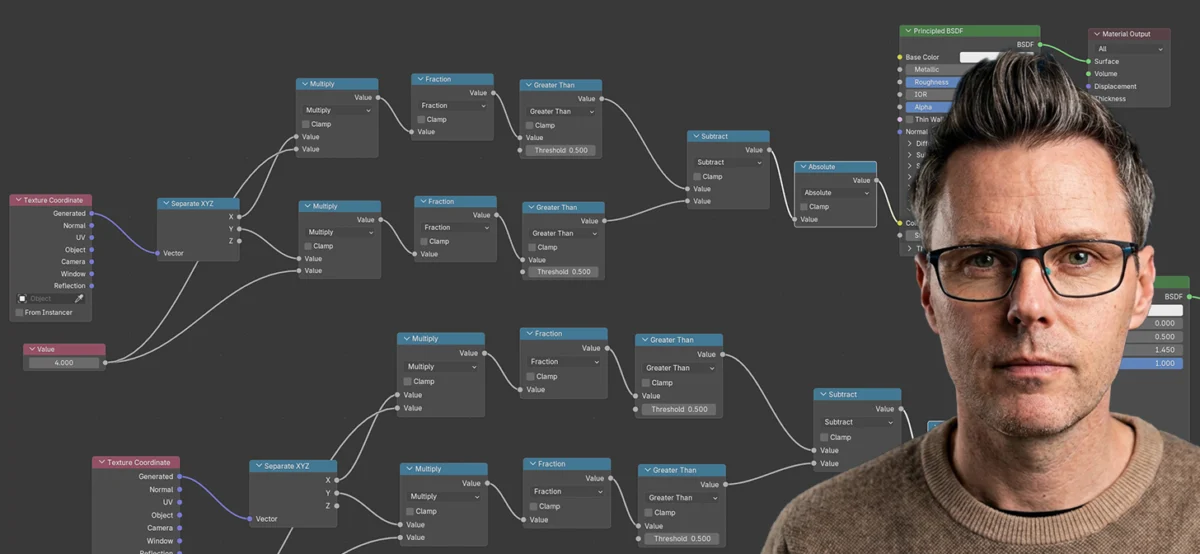
A groundbreaking tutorial by renowned Blender educator Richard Yot is set to revolutionize how 3D artists approach texture generation within the popular open-source 3D creation suite, Blender. Titled "Grey Is Just a Number," the comprehensive video and accompanying resources demystify the often-intimidating realm of Blender’s Math nodes, revealing their profound potential for creating sophisticated and dynamic textures. Yot demonstrates that these seemingly complex mathematical operations are, in essence, analogous to familiar image manipulation tools, offering a fresh and accessible perspective for both novice and experienced users.
The Fundamental Connection: Math as Image Adjustment
At its core, Yot’s tutorial establishes a crucial paradigm shift: viewing mathematical operations not as abstract equations, but as direct controls over pixel values, or in the context of 3D rendering, grayscale intensity. The presenter meticulously illustrates how fundamental arithmetic operations like addition, subtraction, multiplication, division, and exponentiation can be directly mapped to familiar image editing concepts.
For instance, a simple addition operation can function as an "exposure" adjustment, increasing the overall brightness of a texture. Conversely, subtraction can emulate a "brightness" or "level" adjustment, darkening specific areas. Multiplication, Yot explains, acts similarly to contrast adjustments, expanding or compressing the tonal range of an image. The invert operation, a staple in image editing, is directly replicated by multiplying by -1 or using a specific node setup. Furthermore, the concept of a "threshold" in image processing, which converts grayscale values into binary black and white, is also shown to be readily achievable with Math nodes.
This direct correlation between mathematical functions and visual outcomes is a key takeaway from the tutorial. It transforms the abstract nature of nodes like "Add," "Multiply," and "Power" into tangible tools for artistic control. By understanding that each number processed by these nodes represents a specific shade of gray – ranging from pure black (0) to pure white (1) in Blender’s linear color space – artists can begin to "paint" with numbers, achieving intricate patterns and realistic material surfaces.
From Abstract Concepts to Tangible Textures: A Practical Approach
The tutorial moves beyond theoretical explanations to provide practical, hands-on demonstrations of how to leverage Math nodes for actual texture creation. Yot showcases the process of building complex procedural textures from scratch, utilizing only the built-in Math nodes and basic procedural textures like Noise, Voronoi, or Musgrave.
One of the compelling aspects of Yot’s methodology is its emphasis on a "node-first" approach to texturing. Instead of relying solely on image textures or pre-made shaders, artists are empowered to construct their materials from the ground up, offering unparalleled flexibility and control. This approach is particularly valuable for creating seamless tiling textures, unique patterns, and dynamic materials that can react to changes in lighting and geometry.
The tutorial highlights specific examples, such as generating procedural scratches, worn edges, or intricate geometric patterns. By chaining together various Math nodes, artists can meticulously sculpt the grayscale values that define these textures, effectively controlling the distribution, density, and intensity of surface details. This method bypasses the limitations of fixed image textures, allowing for infinite variations and resolutions.
The "Grey Is Just a Number" Cheat Sheet: Empowering the Community
To further support artists in their exploration of Math nodes, Richard Yot has released a free, no-signup-required "cheat sheet." This invaluable resource serves as a quick reference guide, consolidating the core concepts and node setups demonstrated in the tutorial. It acts as a practical companion for users as they experiment with different combinations and explore the vast creative possibilities. The availability of such a readily accessible resource underscores Yot’s commitment to democratizing advanced 3D art techniques and fostering a more skilled and innovative Blender community.
Background and Context: The Evolution of Procedural Texturing in Blender
The development and increasing sophistication of Blender’s node-based material system have been a cornerstone of its evolution into a professional-grade 3D creation tool. Prior to the widespread adoption of node-based workflows, texture creation often involved external image editing software and a more linear, less flexible process. The introduction of the Shader Editor and its powerful node system, particularly with the advent of Cycles and Eevee rendering engines, has enabled artists to create highly complex and dynamic materials directly within Blender.
Math nodes, while always present, have historically been perceived as a more advanced or specialized toolset, often relegated to specific technical applications. Tutorials like Richard Yot’s play a crucial role in bridging this gap, demonstrating that these nodes are not merely for complex mathematical simulations but are fundamental building blocks for creative expression. This shift in perception is critical for artists looking to push the boundaries of photorealism and artistic stylization in their 3D projects.
The timing of this tutorial also coincides with a growing trend in the 3D industry towards more efficient and versatile workflows. As the demand for high-quality 3D assets continues to rise across industries like film, game development, and virtual reality, artists are constantly seeking ways to optimize their creative processes. Procedural texturing, powered by node-based systems, offers a significant advantage in terms of flexibility, reusability, and iteration speed.
Analysis of Implications: A Paradigm Shift in Texturing Workflow
Richard Yot’s "Grey Is Just a Number" tutorial has the potential to significantly impact the way 3D artists approach material creation in Blender.
- Increased Artistic Control: By demystifying Math nodes, the tutorial empowers artists with a deeper level of control over their textures. This allows for the creation of highly customized and unique materials that are not limited by the constraints of pre-existing image maps.
- Enhanced Efficiency: Learning to generate textures procedurally using Math nodes can lead to significant time savings. Artists can create a wide variety of textures from a single node setup, and modifications can be made instantly without the need for re-painting or re-exporting image files.
- Improved Scalability and Resolution: Procedural textures are resolution-independent. This means they can be rendered at any desired resolution without loss of quality, a critical advantage for high-end productions.
- Fostering Innovation: By providing a clear and accessible pathway into procedural texturing, the tutorial encourages experimentation and innovation. Artists are likely to discover new and creative ways to combine Math nodes, leading to novel material designs and artistic styles.
- Lowering the Barrier to Entry for Advanced Techniques: The tutorial’s emphasis on the analogy between Math operations and familiar image adjustments makes complex concepts more approachable. This can attract artists who may have been intimidated by the mathematical aspects of procedural generation.
The broader implication is a more self-sufficient and creatively empowered Blender user base. Artists will be less reliant on external assets and more capable of realizing their unique visions entirely within the software. This aligns with Blender’s ethos of providing a comprehensive and free creative toolkit.
Chronology of Development and Release
While the exact timeline of the tutorial’s creation is internal to Richard Yot’s production process, the release date of November 21, 2026, places it within a period of continued innovation in 3D graphics. The development of such a comprehensive tutorial likely involves:
- Initial Research and Concept Development: Identifying the need for a clearer explanation of Math nodes and establishing the core analogy to image adjustments.
- Node Setup and Experimentation: Building and testing various node combinations to achieve desired texture effects. This phase would involve extensive iteration and refinement.
- Scripting and Content Creation: Developing the narrative, explanations, and visual demonstrations for the video tutorial.
- Resource Creation: Designing and finalizing the accompanying "cheat sheet."
- Filming and Editing: Capturing the screen recordings, voiceovers, and final editing of the video content.
- Publication and Promotion: Releasing the tutorial on platforms like YouTube and promoting it through relevant channels, such as Blender Nation, to reach the target audience.
The release of the tutorial signifies the culmination of this developmental process, making Yot’s insights and techniques readily available to the global Blender community.
Community Reception and Potential Official Responses
While direct official responses from Blender development teams to individual tutorials are not always immediate or public, the impact of such educational content is significant. High-quality tutorials like "Grey Is Just a Number" contribute to:
- Increased User Engagement: By making advanced features accessible, these tutorials encourage more users to explore and utilize the full capabilities of Blender.
- Feedback for Development: Widespread adoption and discussion of techniques demonstrated in tutorials can sometimes inform future development priorities or highlight areas where the user interface could be improved. For instance, if a particular node setup is consistently praised for its utility, it might inspire UI tweaks or new node additions in future Blender releases.
- Community Growth and Skill Enhancement: The proliferation of well-explained tutorials directly contributes to the growth and skill level of the Blender community, reinforcing its status as a vibrant and collaborative ecosystem.
Based on the history of Blender’s community-driven growth, it is highly probable that such an insightful and practical tutorial will be met with widespread positive reception. Users are likely to share their creations derived from Yot’s techniques, further spreading the knowledge and inspiring new artistic avenues. Discussions on forums and social media platforms dedicated to Blender are expected to flourish, with users sharing their experiences and further exploring the possibilities presented by Math nodes.
In conclusion, Richard Yot’s "Grey Is Just a Number" tutorial represents a significant contribution to the Blender educational landscape. By effectively bridging the gap between abstract mathematical concepts and tangible artistic results, it empowers 3D artists to unlock a new level of creative control and efficiency in their texture creation workflows, solidifying the power and versatility of Blender’s node-based system.
About the Author