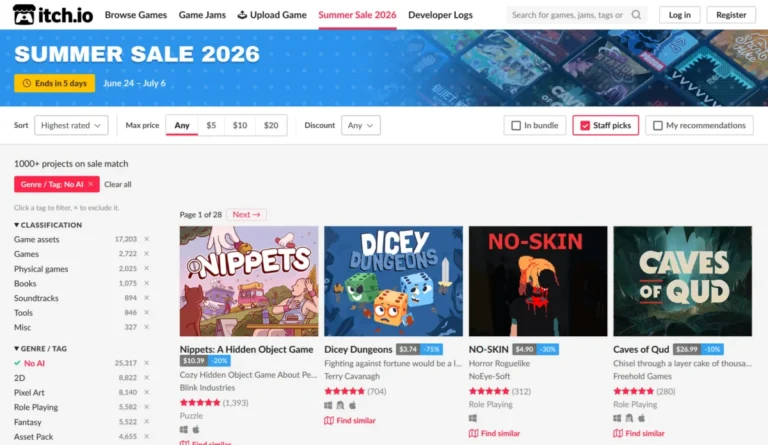
In a significant and sudden move that sent ripples through the independent game development community, itch.io, a prominent marketplace for indie games, announced in late July 2025 that it had "deindexed" all adult and Not Safe For Work (NSFW) content from its browse and search pages. This drastic action was taken under intense pressure from the platform’s payment processors, primarily Stripe and PayPal, following a targeted campaign by the advocacy group Collective Shout. The decision, characterized by itch.io as an urgent measure to safeguard its core payment infrastructure, has sparked widespread debate regarding content moderation, the power of financial institutions over digital platforms, and the future of adult-oriented content in the gaming space.
Background: itch.io’s Open Platform Philosophy
To understand the magnitude of itch.io’s decision, it is crucial to appreciate the platform’s unique position within the digital distribution landscape. Launched in 2013, itch.io quickly distinguished itself from larger, more curated storefronts like Steam by championing an open, user-generated content (UGC) model. This philosophy allowed virtually any creator to publish their games, tools, assets, and even physical games, with minimal barriers to entry. Developers benefited from flexible revenue sharing, a strong emphasis on DRM-free content, and a vibrant community that celebrated experimentation and niche genres, including a significant segment of adult-themed games. With over 2 million product pages, itch.io fostered a diverse ecosystem, often serving as a haven for creators whose work might be too experimental or controversial for more restrictive platforms. This openness, however, also made the platform vulnerable to external pressures regarding content standards, especially when those pressures came from critical financial partners.
The Catalyst: Collective Shout and "No Mercy"
The immediate impetus for itch.io’s policy shift can be traced back to a specific incident involving a game titled No Mercy. While details of the game’s content were not extensively publicized by itch.io, its temporary availability on the platform in early 2025 drew the attention of Collective Shout, an Australian-based organization known for its campaigns against the sexualization and objectification of women and children in media. After No Mercy was banned from itch.io in April 2025, Collective Shout expanded its focus, launching a broader campaign against both Steam and itch.io. The group’s strategy involved directly contacting the payment processors used by these platforms, expressing concerns about the nature of certain content hosted on their respective storefronts. This tactic proved particularly effective, leveraging the financial leverage of payment providers to influence content policies.
A Rapidly Developing Crisis and Urgent Action
itch.io openly acknowledged the sudden and disruptive nature of its deindexing decision. In its initial statement, the platform underscored the time-critical nature of the situation, explaining that the scrutiny from payment processors developed rapidly. The ability to process payments is an existential concern for any digital marketplace, as it directly impacts every creator’s ability to earn revenue and the platform’s operational viability. Faced with the potential loss of critical payment partners like Stripe and PayPal, itch.io stated it had to act urgently to protect its core payment infrastructure. This urgency, unfortunately, precluded providing creators with advance notice, a decision for which the platform apologized, recognizing the frustration and confusion it caused within its developer community. The platform’s small team size and comparatively lower transaction volume, especially when contrasted with industry giants like Valve’s Steam, meant it had limited capacity to "push back" against the demands of its financial partners. Losing even one major payment processor could significantly hinder its ability to send payouts to a large segment of its global creator base.
Chronology of Events: A Timeline of Policy Shifts
- April 2025: The game No Mercy is temporarily available on itch.io before being banned. Collective Shout launches a campaign against itch.io and Steam, directing concerns to their payment processors.
- Mid-July 2025 (Approximate): Payment processors initiate scrutiny and raise compliance concerns with itch.io.
- Late July 2025 (Prior to July 28th): itch.io implements the "deindexing" of all adult NSFW content from its browse and search pages, making it inaccessible via standard discovery methods.
- July 28th, 2025: itch.io publishes its initial "Update on NSFW Content" blog post, detailing the reasons for the deindexing and announcing a comprehensive content audit. An Addendum FAQ is also released, addressing common concerns.
- July 31st, 2025: A further update, "Reindexing adult NSFW content," is posted, likely detailing ongoing efforts or minor adjustments to the deindexing process.
- Ongoing: itch.io commences a comprehensive content audit, works on implementing new compliance measures, and actively seeks alternative payment processors more amenable to adult content. Stripe payments for 18+ content are suspended indefinitely.
The Scope of Deindexing and Access to Owned Content
The deindexing means that adult NSFW content is no longer discoverable through itch.io’s public browse pages or search results. However, itch.io clarified that pages that are deindexed are still accessible to users who already own them. Content has not been removed from personal libraries or collections. The platform stated that if users had previously purchased or received a download key for such pages, the downloadable files remain available in their library, provided the creator has not independently taken down the page or removed the files. The platform even went so far as to recommend users download and back up their owned content, emphasizing its DRM-free philosophy from day one as a safeguard against corporate content control. Some pages, however, have received a "content notice," indicating a conclusion by the itch.io team that they can no longer support the business of those specific titles, potentially leading to permanent removal. Affected accounts are being notified via email.
New Compliance Measures and Policy Evolution
As part of its response, itch.io is conducting a comprehensive audit of its vast content library to ensure compliance with payment processor requirements. This review process is expected to lead to the permanent removal of some pages. Looking ahead, the platform plans to introduce new compliance measures for NSFW content. This will include a mandatory step for creators to confirm that their content adheres to the policies of the specific payment processors linked to their accounts. The platform also updated its adult content policy, adding a specific list of prohibited themes commonly found in card processing networks’ acceptable use policies. While acknowledging that such lists can be open to semantic debate, itch.io stated its intention to provide creators with more information to navigate the evolving landscape, with further refinements to this policy expected as more clarity emerges from their discussions with payment partners.
Payouts and Financial Stability for Creators
A significant concern among creators following such policy shifts often revolves around payouts. itch.io directly addressed this, stating unequivocally that it has "no interest in withholding anyone’s earnings." The measures taken were explicitly aimed at ensuring the platform’s ability to maintain relationships with its financial partners, which is essential for the continuous and unimpeded payment of creators. The platform distinguished the current situation from its long-standing policy against "bad-actor" accounts that blatantly violate terms (e.g., content involving sexualized minors or real-life imagery), where payouts might be withheld. This clarification aimed to reassure the legitimate NSFW content creators that their past earnings would not be jeopardized by the platform’s compliance efforts.
Comparing Responses: itch.io vs. Steam
The FAQ section of itch.io’s update also shed light on why its response appeared more sweeping than Steam’s, which also faced pressure from Collective Shout. The key difference lies in the fundamental architecture of the two platforms. Steam operates as a "closed" platform, where every product page undergoes an approval process before appearing on the storefront. This pre-screening allows Steam to have a general awareness of its hosted content and enables a more targeted approach when addressing specific compliance issues.
In contrast, itch.io’s "open" UGC model, with its millions of product pages published by anyone at any time, meant that a targeted approach based solely on user-provided tags would not be accurate enough for a thorough review. Given its smaller team and limited resources compared to a behemoth like Steam, itch.io determined that a broader, platform-wide deindexing followed by a comprehensive audit was the only realistic and effective way to ensure immediate compliance and protect its critical payment processing capabilities.
Broader Implications and Industry Outlook
This event on itch.io highlights a growing tension within the digital content industry: the conflict between open platforms fostering diverse content and the stringent, often conservative, acceptable use policies of major financial service providers. Payment processors, acting as gatekeepers of digital commerce, increasingly exert significant influence over the types of content that can be monetized online. This has led to similar challenges across various platforms hosting user-generated content, from social media to crowdfunding sites.
For the independent game development community, especially those specializing in adult content, itch.io’s decision represents a significant blow to discoverability and potential earnings. While the platform’s commitment to finding alternative payment processors offers a glimmer of hope, the immediate future for NSFW creators on itch.io remains uncertain. The situation underscores the precarious position of niche content creators who often rely on the more permissive policies of indie platforms, which themselves are vulnerable to external economic pressures.
The incident also reignites discussions about "deplatforming" and the role of third parties in dictating content standards. While itch.io has maintained its dedication to its creators and its DRM-free principles, the necessity of its actions demonstrates the formidable power wielded by payment companies in shaping the digital landscape. As itch.io navigates this challenging period, its efforts to secure new payment partners and refine its content policies will be closely watched, potentially setting precedents for other open platforms striving to balance artistic freedom with financial viability. The platform has asked for patience and understanding from its community as it continues to gain a full understanding of the evolving situation, promising further updates on its blog as developments unfold.
About the Author