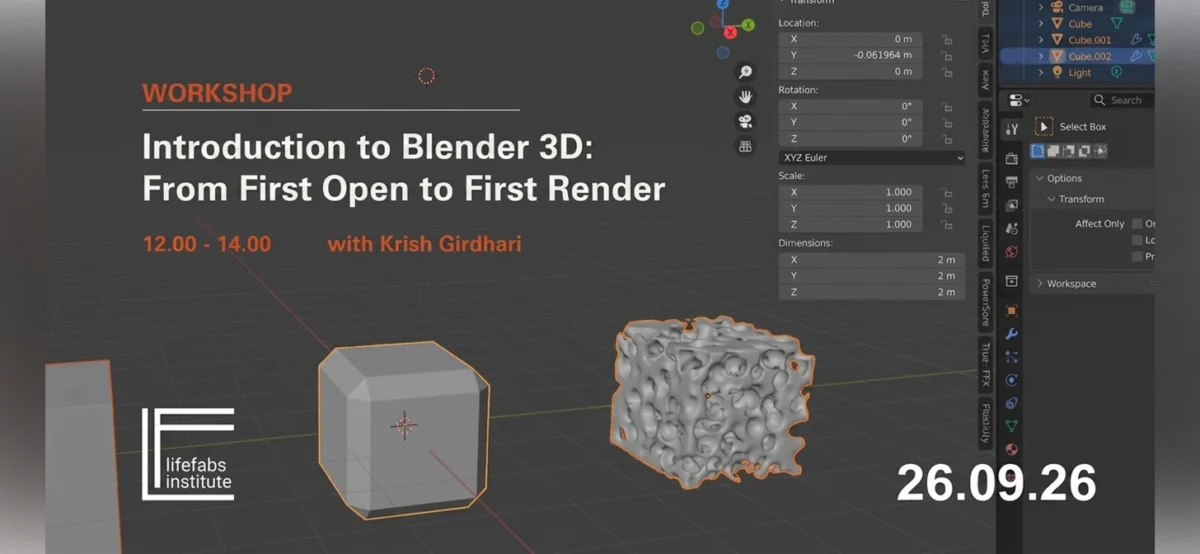
A comprehensive two-hour workshop designed to demystify the powerful, free, and open-source 3D creation suite, Blender, is scheduled to take place on Saturday, September 26th, 2026. This introductory session, titled "Introduction to Blender 3D: From First Open to First Render," aims to guide absolute beginners through the fundamental aspects of 3D design, culminating in the creation of their first rendered image. The event will be accessible both in person at Lifefabs, located in the vibrant Dalston district of London, and virtually for remote participants.
The workshop is spearheaded by Krish Girdhari, an educator and advocate for accessible creative technologies. Girdhari’s stated objective is to eliminate any perceived barriers to entry for individuals interested in exploring 3D art and animation. "Never opened Blender? Perfect," Girdhari stated in promotional materials. "In two hours I’ll take you from a blank viewport to a finished render – no experience needed. We’ll cover navigation, modelling, materials, lighting and hitting that render button for the first time. Free and open-source software, zero barriers to entry." This pedagogical approach underscores a commitment to inclusivity and skill-building within the burgeoning field of digital content creation.
The curriculum promises a structured learning path, covering essential Blender functionalities. Participants will begin with the basics of navigating the 3D interface, a crucial first step for any new user. This will be followed by an introduction to modeling techniques, the process of creating three-dimensional shapes and objects within the software. Subsequently, the workshop will delve into the application of materials to these models, defining their surface properties such as color, texture, and reflectivity. Lighting, a critical element in establishing mood and visual realism, will also be a core component of the session. Finally, the workshop will conclude with the practical experience of rendering, the process by which the 3D scene is translated into a 2D image.
Event Details and Logistics
The workshop is scheduled to commence at 2:00 PM and conclude at 4:00 PM local time on Saturday, September 26th, 2026. This two-hour timeframe is strategically chosen to provide a concentrated yet digestible learning experience. Lifefabs, the physical venue, is a known hub for creative and technological events in London, suggesting an environment conducive to learning and networking. The provision of an online participation option significantly broadens the workshop’s reach, allowing individuals from across geographical boundaries to benefit from Girdhari’s instruction.
Registration for the event is being managed through Eventbrite, a popular online platform for event ticketing and management. The announcement emphasizes that "Spaces are limited – grab a ticket on Eventbrite." This scarcity suggests a desire to maintain an optimal instructor-to-participant ratio, ensuring personalized attention and a more effective learning environment, particularly for the in-person component. Prospective attendees are directed to the Eventbrite listing for further details regarding the ticket purchase and the specific link for online access.
The Rise of Blender and the Importance of Accessible Training
Blender’s journey from a niche open-source project to a globally recognized professional 3D creation suite is a testament to the power of community-driven development and the growing demand for affordable, high-quality creative tools. Founded in 1998 by NaN (Not a Number), Blender was initially commercial software. However, following the company’s bankruptcy in 2002, a grassroots crowdfunding campaign led to its release as open-source under the GNU General Public License. This pivotal moment democratized access to powerful 3D software, previously dominated by expensive proprietary solutions.
Since its open-sourcing, Blender has experienced exponential growth in its user base and feature set. It is now widely adopted by independent artists, small studios, and even larger production houses for a diverse range of applications, including animation, visual effects, game development, architectural visualization, and motion graphics. The Blender Foundation, a non-profit organization, oversees its development, fostering a collaborative ecosystem that continuously innovates and improves the software.
The increasing accessibility of powerful creative tools like Blender has fueled a surge in digital content creation. However, the learning curve for such complex software can be a significant hurdle for newcomers. Workshops like the one offered by Krish Girdhari play a crucial role in bridging this gap. By providing structured, beginner-friendly instruction, these events empower individuals to acquire valuable digital skills, potentially opening doors to new career opportunities or enabling personal creative expression. The current market for 3D artists and animators is robust, with demand across industries such as film, gaming, advertising, and virtual reality. Organizations like the U.S. Bureau of Labor Statistics project a steady growth in employment for animators and multimedia artists, further underscoring the value of accessible training.
Krish Girdhari’s Background and Educational Philosophy
While specific details about Krish Girdhari’s professional background are not extensively provided in the initial announcement, the framing of the workshop suggests a deep understanding of the challenges faced by beginners in Blender. His emphasis on "zero barriers to entry" aligns with a broader movement towards digital literacy and skill development that prioritizes inclusivity. The choice to cover core functionalities from navigation to rendering within a two-hour window indicates a well-structured and efficient curriculum designed for maximum impact within a limited timeframe.
Girdhari’s approach appears to be hands-on and results-oriented, focusing on enabling participants to achieve a tangible outcome – a finished render – by the end of the session. This pragmatic methodology is highly effective for introductory courses, providing immediate gratification and building confidence for further exploration. The integration of both in-person and online formats also reflects an awareness of diverse learning preferences and geographical constraints, a common practice in modern educational outreach.
Potential Implications and Broader Impact
The "Introduction to Blender 3D" workshop, while seemingly a single event, contributes to a larger trend of democratizing creative technology. By equipping individuals with foundational 3D skills, such workshops can:
- Foster New Talent: Identify and nurture emerging talent within the digital arts, potentially leading to future professionals in animation, VFX, and game development.
- Enhance Creative Industries: Increase the pool of skilled individuals available to a rapidly growing creative economy, benefiting studios and production houses.
- Promote Digital Literacy: Empower individuals with the technical skills necessary to participate in and contribute to the digital world, fostering innovation and entrepreneurship.
- Support Open-Source Ecosystems: Encourage wider adoption and contribution to open-source software projects like Blender, ensuring their continued development and accessibility.
The success of such introductory workshops can also serve as a model for future educational initiatives. The clear learning objectives, practical application, and accessible delivery methods are key components that can be replicated to introduce a wide range of complex software and technical skills to a broader audience. The growing demand for 3D content across various media, from feature films and streaming series to interactive gaming and immersive virtual experiences, makes foundational training in tools like Blender increasingly valuable. Industry reports from organizations like Statista consistently highlight the growth of the global 3D animation market, projecting significant expansion in the coming years, driven by advancements in technology and increasing consumer engagement with digital content.
Future Outlook and Community Engagement
The announcement of this workshop, posted on September 5th, 2026, for an event on September 26th, 2026, indicates a relatively short lead time, suggesting a focused and perhaps recurring series of events. The emphasis on limited spaces and ticket purchase on Eventbrite implies a structured approach to participant management and potentially a modest fee, which could contribute to the sustainability of such educational efforts.
The success of this "Introduction to Blender 3D" workshop will likely inform future offerings. If the demand is high and feedback is positive, it could pave the way for more advanced workshops, specialized training modules, or even a broader curriculum covering various facets of 3D production. The presence of a physical venue like Lifefabs in London also suggests potential for local community building and networking opportunities for attendees, fostering a collaborative environment that extends beyond the workshop itself. The broader impact of such initiatives is multifaceted, contributing not only to individual skill development but also to the growth and innovation within the digital creative sector. As Blender continues to evolve and solidify its position as a leading 3D creation tool, accessible and well-structured introductory training will remain a critical component in nurturing the next generation of digital artists and innovators.
About the Author