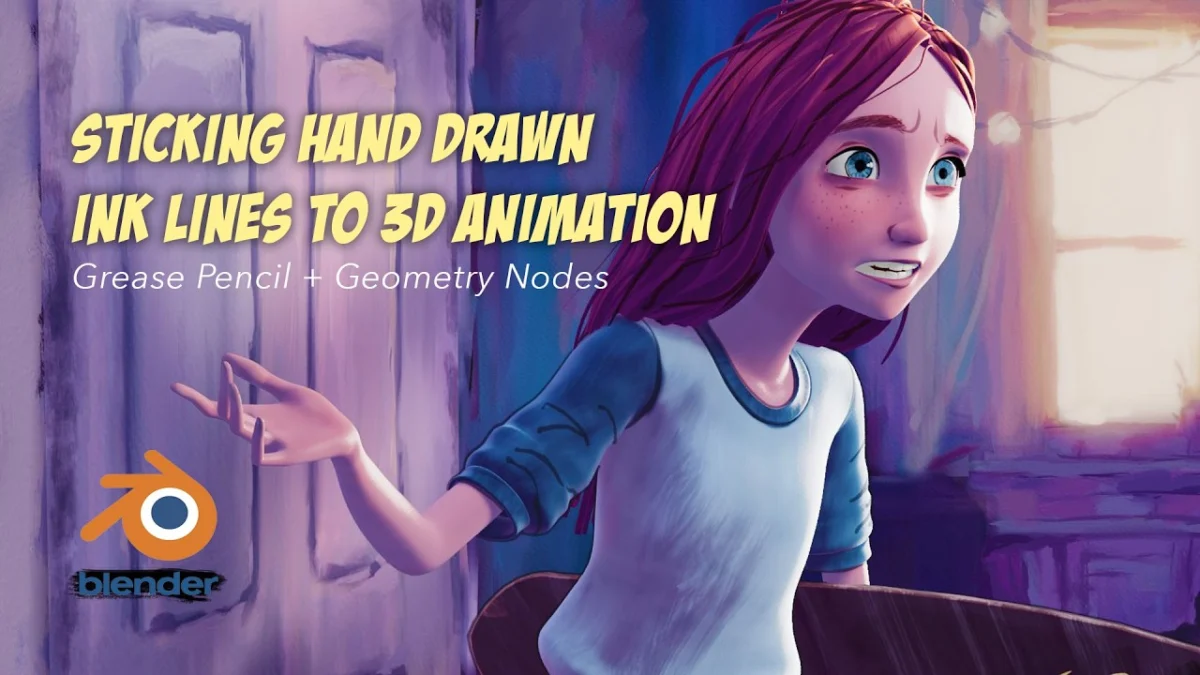
The vibrant and dynamic animation style that captivated audiences in Sony’s Spider-Verse films is now more accessible to independent creators thanks to innovative techniques emerging within the 3D animation community. A recent tutorial shared by Derek Flood offers a comprehensive guide on replicating the signature hand-drawn line work that adheres dynamically to animated characters, a key visual element of the Spider-Verse aesthetic. Flood’s method leverages the powerful capabilities of Blender, specifically its Grease Pencil and Geometry Nodes tools, providing a pathway for animators to achieve similar results without the proprietary software developed by Sony Pictures Animation.
The genesis of this innovative approach lies in the unique challenges faced by the Spider-Verse production. Sony’s development of proprietary tools was crucial in achieving the seamless integration of hand-drawn linework with 3D character animation. This allowed for a level of artistic control and expressiveness that significantly contributed to the films’ groundbreaking visual identity. The ability for hand-drawn elements to fluidly follow the contours and movements of 3D models, giving the impression of a living, breathing comic book, was a significant technical and artistic achievement. Prior to such advancements, integrating traditional 2D line art with 3D animation often resulted in a disconnect, either through stiff, static lines or awkward, unconvincing adherence. The Spider-Verse films, however, demonstrated a masterful fusion, creating a visual language that felt both familiar and entirely new.
Derek Flood’s tutorial addresses this by demonstrating how to achieve a comparable effect using widely available tools within Blender. The core of his technique involves utilizing Grease Pencil, Blender’s robust 2D animation toolset, and Geometry Nodes, a powerful procedural generation system. Grease Pencil allows artists to draw directly in a 3D environment, enabling them to create linework that can then be manipulated and attached to 3D objects. Geometry Nodes, on the other hand, provides a node-based system for creating and manipulating geometry, which Flood employs to dynamically control the placement and deformation of the Grease Pencil lines in response to the animated character’s movement.
Flood showcases his method through a specific demonstration, rendering a short animation sequence created by the acclaimed animator Tiffany Huang. This particular shot is styled to emulate the painterly aesthetic of Gwen Stacy’s world (Earth-65) from Spider-Verse. The tutorial video, embedded within the original announcement, provides a visual walkthrough of the process, allowing viewers to follow along and understand the practical application of these tools. Flood’s use of his "Brushed shading tools" further enhances the painterly, hand-crafted feel, aiming to capture the textural nuances present in the Spider-Verse films.
The Technical Foundation: Grease Pencil and Geometry Nodes
Understanding the individual strengths of Grease Pencil and Geometry Nodes is crucial to appreciating Flood’s integrated approach.
Grease Pencil: A 2D Animation Powerhouse in a 3D World
Blender’s Grease Pencil, introduced in more substantial forms in recent years, has evolved from a simple drawing tool to a fully-fledged 2D animation system that exists within a 3D scene. This duality is its most significant advantage for this specific application. Artists can draw strokes that have depth, volume, and can interact with 3D objects. For Spider-Verse style animation, this means artists can sketch the characteristic comic book outlines directly onto their 3D characters, allowing these lines to become an integral part of the character’s rendering. The ability to draw in perspective, with varying line weights and styles, directly contributes to the unique visual appeal of the Spider-Verse.
Geometry Nodes: Procedural Control and Dynamic Adaptation
Geometry Nodes offer a procedural workflow, meaning that instead of manually adjusting every element, users can define a set of rules and operations that generate and modify geometry. In Flood’s tutorial, Geometry Nodes are instrumental in ensuring that the Grease Pencil lines behave realistically and dynamically. They can be used to:
- Project Lines onto Surfaces: Ensuring the lines accurately follow the curvature of the 3D model.
- Deform Lines with Animation: Allowing the lines to stretch, compress, and bend in sync with the character’s movements, mimicking the organic feel of hand-drawn animation.
- Control Line Thickness and Appearance: Dynamically adjusting line weight based on factors like camera distance or surface curvature, a technique often employed in comic art to emphasize form and movement.
- Add Secondary Details: Potentially generating subtle textures or hatching effects that further enhance the hand-drawn aesthetic.
By combining these two powerful tools, Flood provides an accessible workflow for animators to imbue their 3D projects with the distinctive visual flair of the Spider-Verse.
Background and Context: The Evolution of Animation Styles
The Spider-Verse films, Spider-Man: Into the Spider-Verse (2018) and Spider-Man: Across the Spider-Verse (2023), were not merely successful box office hits; they represented a significant leap forward in animated filmmaking. The films’ directors and visual effects teams, including artists from Sony Pictures Animation and an array of external studios, pushed the boundaries of what was considered possible in computer-generated animation.
The Spider-Verse aesthetic is characterized by its deliberate departure from the hyper-realistic CGI often seen in animated features. Instead, it embraces a visually diverse range of styles, drawing inspiration from comic books, graphic novels, and various art movements. Key elements include:
- Halftone Dots and Ben-Day Dots: Mimicking the printing techniques of classic comic books.
- Textural Overlays: Incorporating paper textures, ink bleed effects, and brush strokes.
- Dynamic Line Work: Bold, expressive linework that is often integral to the character design and action.
- Comic Book Panel Transitions: Employing visual cues like speech bubbles, sound effects lettering, and panel borders to transition between scenes.
- Varying Frame Rates: Deliberately using different frame rates for different characters or elements to create a unique sense of motion and visual rhythm.
The development of proprietary tools was a necessity to achieve this level of stylistic integration. These tools allowed animators to create and manipulate hand-drawn elements with a precision and fluidity that traditional methods struggled to replicate within a 3D pipeline. For instance, the ability for ink lines to maintain their hand-drawn quality while deforming naturally with character movement was a significant technical hurdle overcome by Sony’s internal development. This innovation not only enhanced the visual storytelling but also solidified the Spider-Verse as a distinct cinematic universe with its own unique visual language.
The Impact of Open-Source and Community-Driven Innovation
Derek Flood’s contribution, by sharing his techniques for achieving Spider-Verse style animations in Blender, highlights the power of the open-source community and the democratization of advanced animation techniques. Blender itself has a rich history of community-driven development, dating back to its origins as a project developed by Not a Number (NaN) and its subsequent open-sourcing. BlenderNation, founded by Bart, the author of the original announcement, has played a pivotal role in disseminating information and fostering this community for nearly two decades.
The availability of tutorials and workflows like Flood’s has several implications:
- Lowering Barriers to Entry: Independent animators, small studios, and even hobbyists can now access sophisticated visual styles that were previously exclusive to large, well-funded production houses. This can lead to a surge in creative output and experimentation.
- Fostering New Artistic Visions: By providing the tools, creators are empowered to blend established styles with their own unique artistic sensibilities, potentially leading to the emergence of entirely new visual genres.
- Accelerating Technical Advancement: When techniques are shared and adopted by a wider community, they are often iterated upon, refined, and improved. This collective innovation can lead to faster progress in animation technology and artistry.
- Challenging the Status Quo: The ability for independent creators to produce high-quality, stylized animation can challenge the dominance of traditional animation studios and encourage greater diversity in the animated content landscape.
The timing of Flood’s tutorial is also significant. The ongoing success and critical acclaim of the Spider-Verse films have cemented their visual style as a benchmark in modern animation. As audiences continue to appreciate this aesthetic, the demand for similar visual experiences in other media, from independent films to video games and even short-form online content, is likely to increase. Flood’s work directly addresses this burgeoning demand.
A Chronology of Influence and Accessibility
While the Spider-Verse films provided the visual inspiration, the journey to making such styles accessible in Blender has been a gradual evolution:
- Early 2000s: Blender begins its journey as an open-source project, laying the groundwork for a powerful, free 3D creation suite. Early tutorials and community forums emerge, fostering a collaborative environment.
- Mid-2010s: Significant advancements in Blender’s rendering capabilities and modeling tools make it a viable alternative for professional-level work. The development of the Grease Pencil feature begins to take shape, hinting at future 2D/3D integration possibilities.
- 2018: Spider-Man: Into the Spider-Verse is released, revolutionizing animated feature film aesthetics and sparking global interest in its unique visual style.
- Late 2010s – Early 2020s: Blender’s Grease Pencil matures into a robust 2D animation tool. Simultaneously, Geometry Nodes are introduced and rapidly developed, offering unprecedented procedural control over scene elements. Artists begin experimenting with combining these tools for stylized rendering.
- 2023: Spider-Man: Across the Spider-Verse further expands the visual lexicon of the Spider-Verse, showcasing even more diverse and complex animation techniques.
- Present Day: Tutorials like Derek Flood’s emerge, synthesizing years of Blender development and the artistic breakthroughs of the Spider-Verse into practical workflows for the wider community.
This timeline illustrates a convergence of technological advancement within Blender and a significant cultural moment in animation history. The availability of tools like Grease Pencil and Geometry Nodes, coupled with the clear artistic ambition demonstrated by the Spider-Verse franchise, has created a fertile ground for this type of tutorial.
Broader Implications and Future Outlook
The implications of being able to replicate Spider-Verse style animation in Blender extend beyond individual animators. For smaller studios and independent filmmakers, this offers a significant competitive advantage. They can now produce visually distinctive content that rivals the polish and artistic merit of larger productions, without the prohibitive costs associated with proprietary software and specialized hardware.
This trend could lead to:
- Increased Diversity in Animated Content: A wider range of voices and artistic visions can be realized, leading to more experimental and genre-bending animated works.
- Innovation in Visual Storytelling: As more creators adopt and adapt these techniques, new forms of visual language and storytelling within animation may emerge.
- Educational Opportunities: The accessibility of these tutorials will likely fuel a new generation of animators trained in advanced, stylized 3D techniques.
- Potential for Cross-Media Integration: The techniques developed for Spider-Verse style animation could find applications in video games, interactive media, and even live-action visual effects, further blurring the lines between different forms of digital art.
The democratization of high-end animation tools, exemplified by Derek Flood’s tutorial, is a testament to the power of open-source software and collaborative knowledge sharing. As Blender continues to evolve, and as the influence of films like Spider-Verse continues to resonate, we can anticipate even more innovative and visually stunning animation emerging from independent creators worldwide. The ability to imbue 3D animation with the dynamic energy and hand-crafted charm of traditional comic art is no longer a distant dream but a tangible reality for those willing to explore the evolving capabilities of tools like Blender.
About the Author