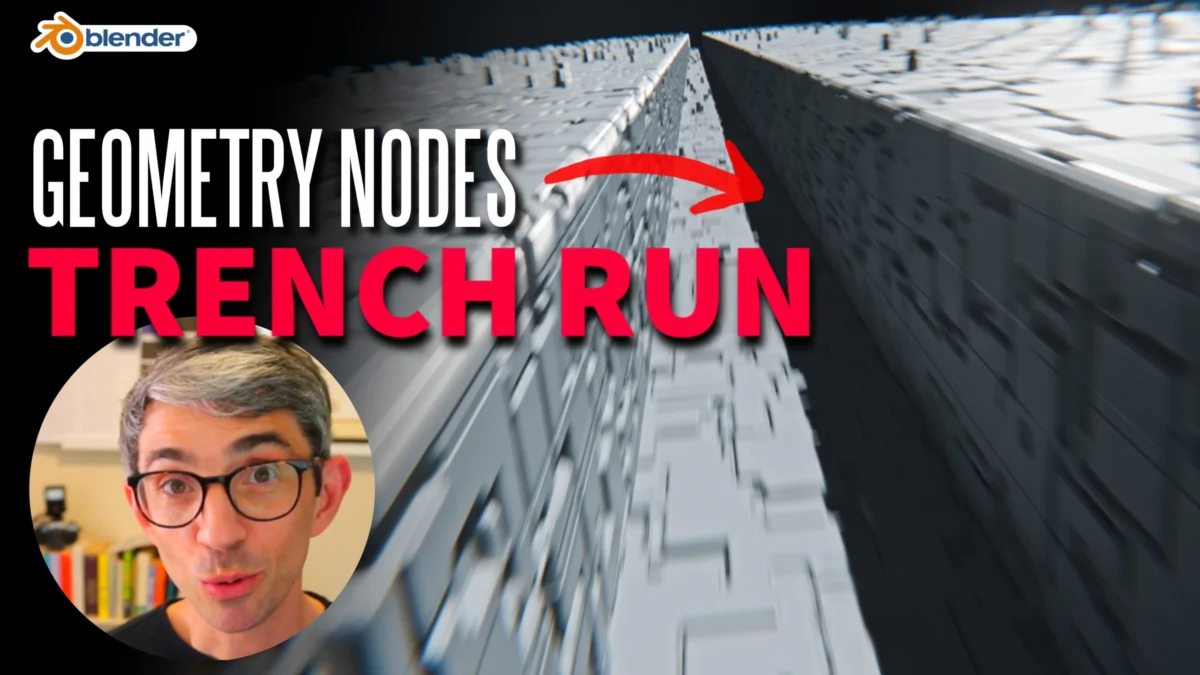
Chris Bailey, a prominent figure in the Blender community and a contributor to BlenderNation, has unveiled an innovative tutorial that leverages a recently introduced feature within Blender’s powerful Geometry Nodes system. This new methodology allows users to efficiently and effectively construct intricate "Death Star trench" environments, a technique particularly advantageous for generating complex greebled surfaces with remarkable speed and ease. The tutorial, detailed in a recent video release, promises to equip artists with advanced skills for procedural asset generation, a cornerstone of modern 3D content creation.
The core of Bailey’s technique revolves around the novel capabilities of Blender’s Geometry Nodes, a procedural modeling system that has seen significant development in recent versions. Geometry Nodes allow users to create and manipulate geometry through a node-based interface, offering a non-destructive and highly flexible workflow. This approach replaces traditional manual modeling techniques for certain tasks, enabling the creation of complex patterns and structures that can be easily modified and iterated upon. Bailey’s specific application focuses on creating the detailed, repeating patterns characteristic of the iconic Death Star trenches seen in the Star Wars franchise.
The Power of Procedural Generation for Complex Environments
The creation of detailed environments, especially those with intricate, repeating elements like those found in science fiction settings, has historically been a time-consuming process. Traditional methods often involve painstakingly modeling each individual component and then arranging and duplicating them. This approach is not only labor-intensive but also presents challenges when modifications are required, as changes may necessitate extensive rework.
Procedural generation, powered by tools like Blender’s Geometry Nodes, offers a transformative solution. By defining a set of rules and parameters, artists can generate complex geometry algorithmically. This means that once the node setup is established, users can adjust a few parameters to alter the entire structure, leading to rapid iteration and experimentation. For environments like the Death Star trench, where repetitive yet detailed elements are crucial for visual fidelity, procedural generation becomes an indispensable tool.
Bailey’s tutorial highlights how this new Geometry Nodes feature can be harnessed to "greeble" surfaces. Greebling, a term derived from the visual design of the original Star Wars films, refers to the process of adding a multitude of small, intricate details to a surface to make it appear more complex and functional. This often involves adding panels, pipes, vents, and other mechanical elements. While traditionally achieved through manual placement of pre-made assets, Geometry Nodes allow for the dynamic and procedural generation of these greebles, ensuring consistency and scalability.
A Glimpse into the Tutorial’s Methodology
The publicly available portion of Chris Bailey’s tutorial, accessible via YouTube, provides a comprehensive overview of the foundational techniques. While the full details of the advanced members-only content are not disclosed in the initial announcement, the public segment focuses on the core principles of utilizing the new Geometry Nodes feature for trench creation.
The tutorial demonstrates how to set up a node network that generates the basic trench structure. This likely involves creating curves or basic shapes that define the path of the trench and then using modifiers to extrude, bevel, and detail these shapes. The key innovation lies in the specific nodes or node combinations that Bailey employs, which enable the procedural placement and variation of smaller geometric elements along the trench walls. This could involve distributing points along the surface and then instancing pre-made greeble assets onto those points, with controls for rotation, scale, and density.
A significant aspect of this technique is its efficiency. By automating the placement and detailing process, artists can achieve highly detailed results in a fraction of the time it would take with manual methods. Furthermore, the procedural nature of the setup means that the trench can be easily scaled, reshaped, or modified without starting from scratch. This adaptability is crucial for game development, film production, and other applications where assets need to be adjusted to fit various scene requirements.
Expanding Capabilities: The Members-Only Content
The announcement also teases a members-exclusive version of the tutorial, which delves deeper into the possibilities of this Geometry Nodes setup. This advanced segment is reported to include the addition of "laser towers" to the geometry node setup. This suggests a further level of complexity and integration, where not only the trench structure but also its interactive elements can be procedurally generated.
The inclusion of laser towers implies a more sophisticated node graph that likely incorporates instancing of more complex models, potentially with animation or dynamic placement capabilities. This could involve creating variations of laser tower designs and distributing them along the trench at strategic points, perhaps even with procedural control over their orientation and scale. This expansion of the technique demonstrates the scalability and versatility of Geometry Nodes, allowing for the creation of entire complex scenes from a single, well-constructed node tree.
Supporting Data and Community Impact
The release of such advanced tutorials by community figures like Chris Bailey is a testament to the ongoing evolution and democratization of powerful 3D creation tools. Blender, a free and open-source software, has experienced a surge in popularity and capability, largely driven by its active and innovative community. Geometry Nodes, in particular, represent a significant leap forward, empowering artists with tools previously only accessible in high-end proprietary software.
While specific download or usage statistics for this particular tutorial are not yet available, the topic itself – the creation of iconic sci-fi environments – is highly relevant to a broad spectrum of 3D artists. Tutorials focusing on procedural techniques and specific thematic elements consistently garner significant attention within the Blender community. The implication is that this tutorial will likely see widespread adoption among aspiring and professional 3D artists looking to enhance their workflow efficiency and creative output.
The growing accessibility of such sophisticated techniques democratizes the creation of complex visual effects. Previously, creating environments of this caliber might have required large teams and significant budgets. Now, with tools like Blender and innovative tutorials, individual artists and smaller studios can achieve comparable results.
Background and Chronology
The development of Blender’s Geometry Nodes has been an ongoing process. Introduced in a significant way in Blender 2.92 (released in February 2021), the system has undergone continuous refinement and expansion in subsequent versions. Each major release of Blender has brought new nodes, improved performance, and enhanced functionality to Geometry Nodes, making them increasingly powerful and user-friendly.
Chris Bailey’s tutorial, released in October 2026, capitalizes on the latest advancements in this system. The specific "brand new feature" mentioned likely refers to recent additions or significant improvements to node functionalities that facilitate the precise control and distribution of geometry required for complex greebling and environmental detailing. The date of the tutorial’s release suggests it is leveraging features available in recent or upcoming versions of Blender, underscoring the rapid pace of development in the software.
The concept of procedural generation for environments has roots in early computer graphics and has been a focus in game development for decades. However, the integration of such powerful and accessible tools within a free and open-source 3D application like Blender has significantly lowered the barrier to entry for artists seeking to employ these advanced techniques.
Broader Impact and Implications
The implications of Chris Bailey’s tutorial extend beyond simply learning how to create a Death Star trench. This technique represents a broader shift in 3D asset creation towards more procedural and automated workflows. Such methods are not only beneficial for creating visually complex scenes but also offer significant advantages in terms of:
- Efficiency and Time Savings: Artists can generate highly detailed assets much faster, freeing up time for other creative aspects of a project.
- Flexibility and Iteration: Procedural setups allow for easy modification and experimentation, enabling artists to explore various design possibilities quickly.
- Scalability: Assets created procedurally can be easily scaled up or down without a loss in detail or quality.
- Asset Reusability: A well-designed procedural node tree can be adapted to create a variety of similar assets, promoting efficient asset management.
- Technical Art Skills: Tutorials like this foster the development of "technical art" skills, bridging the gap between artistic vision and technical implementation.
The ability to quickly generate detailed environmental elements like greebled surfaces and structural components is particularly valuable in industries such as video game development, where vast and detailed worlds need to be populated efficiently. It also has significant applications in architectural visualization, automotive design, and the creation of visual effects for film and television.
As Geometry Nodes continue to evolve, tutorials demonstrating their practical application in creating complex and visually compelling assets will become increasingly important. Chris Bailey’s contribution highlights the ongoing innovation within the Blender community and its role in pushing the boundaries of what is possible in 3D content creation. The accessibility and power of these tools, coupled with expert guidance, are empowering a new generation of artists to create sophisticated visual experiences.
About the Author