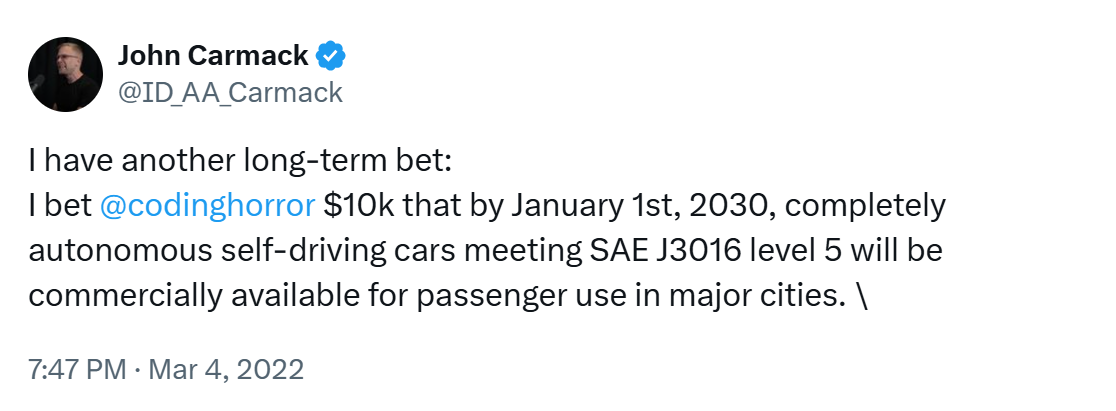
In a move that has captured the attention of the technology and automotive industries, renowned software engineer and entrepreneur Jeff Atwood, creator of Coding Horror and Stack Overflow, has announced a friendly but significant wager with legendary programmer John Carmack, co-founder of id Software and a pivotal figure in virtual reality. The bet, totaling $10,000 to be donated to a 501(c)(3) charity of the winner’s choice, centers on the ambitious prediction that completely autonomous self-driving cars, meeting the rigorous SAE J3016 Level 5 standard, will be commercially available for passenger use in major U.S. cities by January 1st, 2030. Atwood is betting against this timeline, expressing a deep conviction that the challenges of achieving true Level 5 autonomy are widely underestimated, while Carmack, known for his optimistic view on technological progress, is betting for it. This high-profile wager not only puts a spotlight on the evolving landscape of autonomous vehicle development but also underscores the diverging perspectives on the pace and feasibility of achieving what many consider the holy grail of automotive engineering.
The Specifics of the Wager: Defining Level 5 Autonomy and Market Availability
The terms of the bet are precise, leaving little room for ambiguity. "Completely autonomous" is defined strictly according to the SAE J3016 Level 5 standard. This benchmark signifies a vehicle capable of performing all driving tasks under all conditions, without any human intervention or attention required during the journey. The only exceptions are natural disasters or emergencies that would render any transportation impossible. In essence, a human passenger would simply enter the vehicle, select a destination, and the car would handle every aspect of navigation, decision-making, and execution from start to finish. This contrasts sharply with lower levels of autonomy, which still require human monitoring or intervention in certain scenarios.
Furthermore, the condition "commercially available for passenger use in major cities" is also clearly delineated. "Major cities" refers specifically to any of the top 10 most populous cities in the United States of America, ensuring a significant market presence and operational capability rather than limited experimental deployments. Commercial availability implies that these vehicles are not just prototypes or limited test fleets, but accessible to the general public as a viable transportation option, likely through ride-sharing services or direct consumer purchase. The $10,000 sum, while substantial, is also subject to mutual adjustment for inflation in 2030, ensuring its impact remains relevant.
The Visionary and The Pragmatist: Profiles of Carmack and Atwood
The individuals behind this bet bring considerable weight and credibility to the discussion. John Carmack is a legendary figure in the world of computer programming and video game development, often credited with pioneering many techniques in 3D graphics that laid the foundation for modern gaming. His work on iconic titles like Doom and Quake cemented his status as a visionary. In recent years, Carmack has been deeply involved in virtual reality, serving as CTO of Oculus VR, and later as a consulting CTO for Meta, showcasing his commitment to pushing technological boundaries. His consistent pursuit of cutting-edge solutions and his belief in the transformative power of software often position him as an optimist regarding technological advancement. His endorsement of the 2030 timeline for Level 5 autonomy reflects a deep confidence in the rapid evolution of artificial intelligence, sensor technology, and computational power.
Jeff Atwood, on the other hand, is widely respected for his contributions to the software development community through his popular blog, Coding Horror, and as co-founder of Stack Overflow, a critical resource for programmers worldwide. Atwood’s work often focuses on practical aspects of software engineering, user experience, and the complexities of human-computer interaction. While deeply appreciative of technological innovation, his commentary often carries a pragmatic and sometimes skeptical tone, particularly when it comes to technologies that promise radical societal shifts without fully accounting for the underlying difficulties. His bet against Level 5 autonomy by 2030 stems from a belief that the "last mile" problem – the challenges of navigating unpredictable real-world environments with absolute reliability – is far more intricate and demanding than many proponents acknowledge. He views it as an incredibly challenging computer science problem that demands a level of perfection that might still be beyond reach within the next seven years.
Understanding the SAE J3016 Levels of Driving Automation
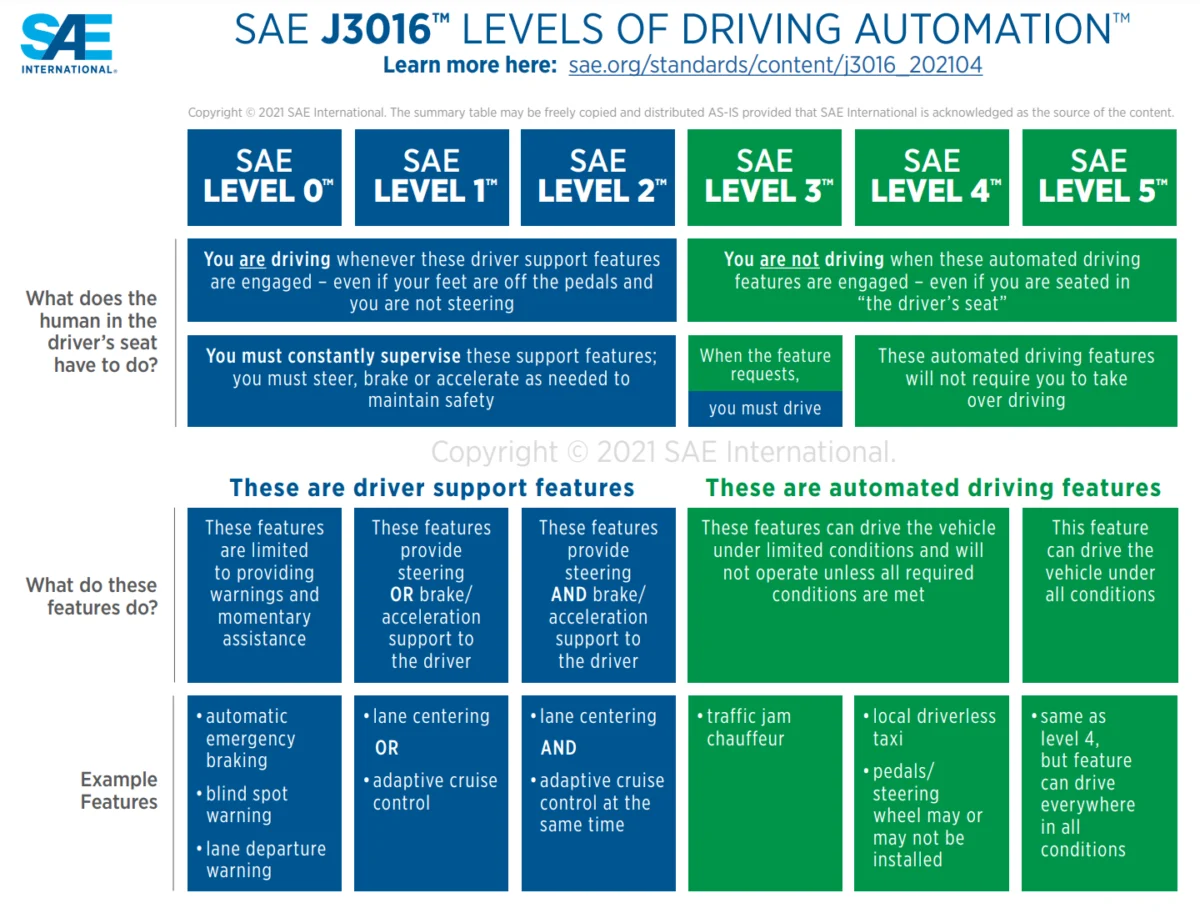
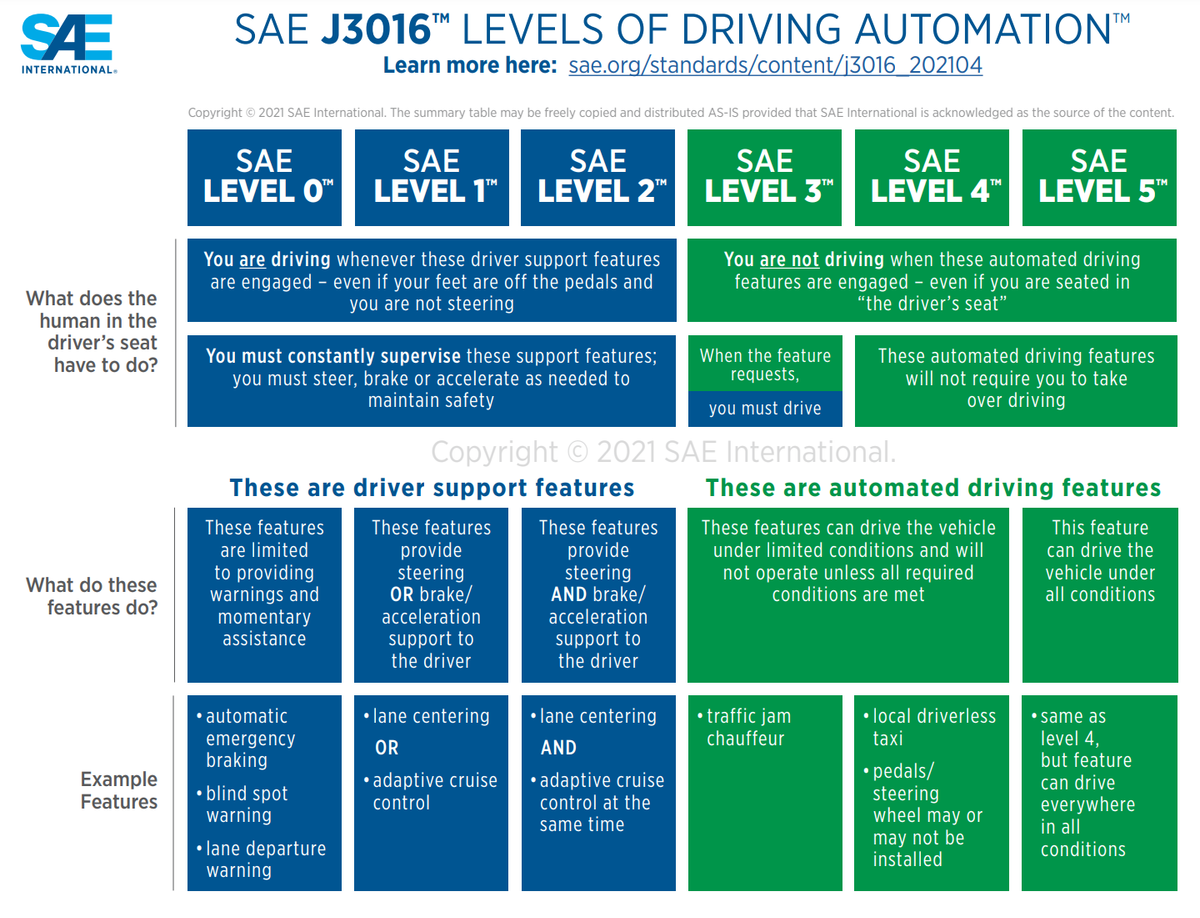
To fully grasp the magnitude of the bet, it’s essential to understand the SAE J3016 standard for driving automation, which categorizes vehicles into six levels:
- Level 0 (No Automation): The human driver performs all driving tasks.
- Level 1 (Driver Assistance): The vehicle has either steering or acceleration/deceleration support (e.g., adaptive cruise control or lane-keeping assist). The human driver is still responsible for monitoring the driving environment and performing all other tasks.
- Level 2 (Partial Automation): The vehicle can perform both steering and acceleration/deceleration simultaneously (e.g., adaptive cruise control with lane centering). The human driver must continuously supervise the system and be ready to intervene at any moment. This is where many advanced driver-assistance systems (ADAS) currently operate.
- Level 3 (Conditional Automation): The vehicle can perform all driving tasks under specific conditions (e.g., highway driving). The human driver does not need to monitor the environment continuously but must be ready to take over when prompted by the system. This level requires a sophisticated hand-off protocol and remains a significant challenge for widespread deployment.
- Level 4 (High Automation): The vehicle can perform all driving tasks and monitor the driving environment under specific conditions, without any human intervention required within its operational design domain (ODD). If the system encounters a situation outside its ODD, it will either safely come to a stop or transfer control to a human driver. Examples include Waymo and Cruise services operating in geofenced areas.
- Level 5 (Full Automation): The vehicle performs all driving tasks under all conditions, without any human intervention whatsoever. There is no expectation for a human driver to take over. This is essentially a robotaxi or personal car that can operate anywhere a human can, in any weather, across any road type, 24/7, without supervision. This is the target of the Carmack-Atwood bet.
The leap from Level 4 to Level 5 is monumental. Level 4 systems, while impressive, still operate within highly constrained environments, often with detailed HD maps and specific weather limitations. Level 5 demands unprecedented resilience, adaptability, and cognitive capability, mirroring or exceeding human driving performance across an infinite array of unpredictable scenarios.
The Current State of Autonomous Driving: Progress and Potholes
As of late 2023 and early 2024, the autonomous vehicle (AV) industry has made significant strides, yet Level 5 remains an elusive goal. Companies like Waymo (an Alphabet subsidiary) and Cruise (majority-owned by General Motors) are leaders in deploying Level 4 robotaxi services in limited operational design domains (ODDs). Waymo operates fully autonomous services in Phoenix and San Francisco, with expansion plans, while Cruise had been active in San Francisco and other cities before facing significant regulatory setbacks and a temporary suspension of its operations due to safety incidents.
Tesla’s "Full Self-Driving" (FSD) beta, despite its name, is widely considered a Level 2 system, requiring constant human supervision. While it showcases impressive capabilities in navigating complex urban environments, it frequently requires human intervention and is not a "set it and forget it" system. Other manufacturers and tech companies, including Mercedes-Benz, BMW, Audi, and numerous startups, are also investing heavily in AV technology, primarily focusing on Level 2 and Level 3 features.

The progress has been substantial, driven by advancements in artificial intelligence, machine learning, sensor fusion (LiDAR, radar, cameras, ultrasonics), and high-performance computing. Billions of dollars have been poured into research and development, with projections often indicating a multi-trillion-dollar market for autonomous vehicles and related services by the mid-21st century. However, the path has been fraught with challenges, including high development costs, regulatory hurdles, public skepticism following accidents, and the sheer complexity of "edge cases" – rare, unpredictable scenarios that are difficult to program for or simulate.
The Skeptic’s Case: Why Level 5 is So Difficult
Atwood’s position, betting against Level 5 by 2030, is rooted in the immense technical, ethical, and regulatory challenges that remain.
- Edge Cases and Unpredictability: The real world is infinitely complex. While AVs excel at common driving scenarios, they struggle with "edge cases" – unusual situations like unexpected road debris, erratic human behavior, ambiguous signage, diverse weather conditions (heavy rain, snow, fog), construction zones, or interactions with non-standard vehicles and pedestrians. A Level 5 system must handle virtually every conceivable scenario flawlessly.
- Perception and Prediction: Accurate perception of the environment is critical. While sensors have improved, reliably interpreting dynamic, cluttered, and unpredictable scenes in all conditions remains a hurdle. Predicting the intentions of other drivers, pedestrians, and cyclists, especially in dense urban environments, is an AI problem that still lacks a perfect solution.
- Regulatory Frameworks: Developing a unified, comprehensive regulatory framework for Level 5 vehicles across all U.S. states, let alone globally, is a monumental task. Questions of liability in accidents, cybersecurity, data privacy, and ethical decision-making in unavoidable crash scenarios still require robust legal and ethical guidelines.
- Validation and Safety Assurance: Proving that a Level 5 system is safer than a human driver across billions of miles of diverse driving conditions is incredibly difficult. Traditional testing methods are insufficient; advanced simulation, formal verification, and rigorous real-world testing are all required, but the sheer scale of validation for Level 5 is unprecedented.
- Public Trust and Acceptance: High-profile accidents, even with lower-level autonomous systems, have eroded public trust. For Level 5 to be commercially viable, public confidence in its absolute safety and reliability must be paramount.
- Infrastructure Requirements: While Level 5 theoretically doesn’t require specialized infrastructure, optimal performance might benefit from smart city integration, vehicle-to-everything (V2X) communication, and high-definition mapping that needs constant updating.
Atwood’s analogy to VR is telling; he acknowledges the potential but suggests the practical application and widespread adoption of truly world-changing technologies often take far longer than initial hype suggests, if they happen at all in their most ambitious forms.
The Optimist’s Perspective: Why 2030 Might Be Achievable
Carmack’s implicit optimism likely stems from several factors:
- Exponential Growth of AI: The rapid advancements in deep learning, neural networks, and reinforcement learning have been transformative. AI models are becoming increasingly sophisticated at pattern recognition, decision-making, and even generating human-like responses, which could be applied to complex driving scenarios.
- Improved Sensor Technology: LiDAR, radar, and camera systems are continually becoming more accurate, smaller, and cheaper. This allows for a richer and more robust understanding of the vehicle’s surroundings.
- Massive Data Accumulation: Companies like Waymo and Tesla have accumulated billions of miles of driving data, both simulated and real-world. This data is crucial for training and validating AI models, helping them learn from a vast array of scenarios.
- Computational Power: The availability of ever-increasing computational power, both in the cloud and within the vehicles themselves, allows for more complex algorithms and faster real-time processing of sensor data.
- Dedicated Investment: The sheer volume of investment from tech giants and automotive manufacturers indicates a strong belief in the eventual success of AV technology. The economic incentives for Level 5 autonomy (reduced accidents, increased efficiency, new business models) are enormous.
- Focused Development: The industry is increasingly focused on solving specific, intractable problems, and the collaborative nature of some research efforts could accelerate breakthroughs.
From this perspective, 2030 represents a plausible, albeit challenging, target for Level 5’s commercial debut, especially if breakthroughs in generalized AI for driving tasks occur.
Broader Implications and the Stakes Beyond $10,000
The Carmack-Atwood bet, while a friendly wager between two prominent tech figures, carries significant symbolic weight. It highlights the inherent tension between technological optimism and pragmatic skepticism that often characterizes disruptive innovation. The outcome of this bet will be a barometer for the broader progress of autonomous technology.
Should Carmack win, it would signify a monumental achievement in engineering and AI, ushering in a new era of transportation with profound implications:
- Safety: The potential to drastically reduce road fatalities and injuries caused by human error.
- Efficiency: Optimized traffic flow, reduced congestion, and more efficient use of road infrastructure.
- Accessibility: Enhanced mobility for the elderly, disabled, and those unable to drive.
- Economic Impact: Transformation of logistics, ride-sharing, and personal vehicle ownership models. New industries would emerge, while others, like professional driving, would undergo significant changes.
- Urban Planning: Reduced need for parking spaces, potentially freeing up valuable urban land.
Conversely, if Atwood wins, it would underscore the immense complexity of achieving human-level autonomy in all conditions. It would suggest that while autonomous features will continue to improve, the leap to truly driverless cars without any operational constraints might still be decades away, necessitating a more gradual, iterative approach to deployment. This outcome would force a re-evaluation of timelines and investment strategies across the industry, potentially shifting focus towards more robust Level 3 and Level 4 systems that complement human drivers rather than fully replacing them in all scenarios.
The bet, therefore, is not just about bragging rights or a charitable donation; it’s a public intellectual contest about the very trajectory of one of the most ambitious technological endeavors of our time. As the January 1st, 2030 deadline approaches, the world will be watching to see whether the optimistic vision of fully autonomous vehicles becomes a commercial reality in America’s largest cities. Regardless of the outcome, the wager serves as a powerful catalyst for discussion, innovation, and continued scrutiny of the promises and challenges inherent in the quest for driverless transportation.
About the Author