For decades, humanity has gazed upon the stars, pondering the profound question of whether we are alone in the vast cosmic expanse. This existential query is encapsulated by the Fermi Paradox, a perplexing contradiction between the high probability estimates for the existence of extraterrestrial civilizations and the stark absence of any observational evidence to date. Despite the universe’s immense age—approximately 13.8 billion years—and the sheer number of galaxies and stars, no verifiable signals or visitations from advanced alien life have been detected, leaving scientists and philosophers alike to ask: "Where is everybody?"
The Genesis of the Paradox: Enrico Fermi’s Simple Question
The paradox takes its name from Nobel Prize-winning physicist Enrico Fermi, who, during a casual lunchtime conversation in 1950 at Los Alamos National Laboratory, famously posed the question, "Where are they?" His colleagues were discussing a New Yorker cartoon depicting aliens stealing public trash cans, leading to a broader discussion about the likelihood of extraterrestrial intelligence. Fermi’s simple query highlighted the stark contrast between theoretical possibilities and empirical reality. Given the age of the universe and the potential for life to have evolved elsewhere billions of years before Earth, it seemed statistically improbable that no other civilization would have advanced sufficiently to explore or signal across the galaxy. Our own planet, a relative newcomer at 4.5 billion years old, has already given rise to technological intelligence; surely, others with a 13-billion-year head start should be far more advanced and thus, more detectable.
Quantifying the Unquantifiable: The Drake Equation
The scientific framework often used to approach the probability of extraterrestrial intelligence is the Drake Equation, formulated in 1961 by astronomer Frank Drake. While not a definitive calculation, it serves as a probabilistic argument, breaking down the question into several quantifiable factors:
- *R:** The rate of formation of stars suitable for the development of intelligent life in our galaxy.
- fp: The fraction of those stars that have planetary systems.
- ne: The average number of planets that can potentially support life per star that has planets.
- fl: The fraction of those planets that could support life on which life actually appears.
- fi: The fraction of planets with life on which intelligent life emerges.
- fc: The fraction of civilizations that develop a technology that releases detectable signs of their existence into space.
- L: The length of time for which such civilizations release detectable signals into space.
Multiplying these factors yields an estimate for N, the number of civilizations in our galaxy with which communication might be possible. The values for each variable are largely speculative, leading to an enormous range of possible outcomes, from N=1 (meaning only Earth) to millions of civilizations. Even with conservative estimates for many variables, the Drake Equation often suggests that the Milky Way should be teeming with intelligent life, intensifying the enigma of the Fermi Paradox.
The Great Filter: A Cosmic Bottleneck

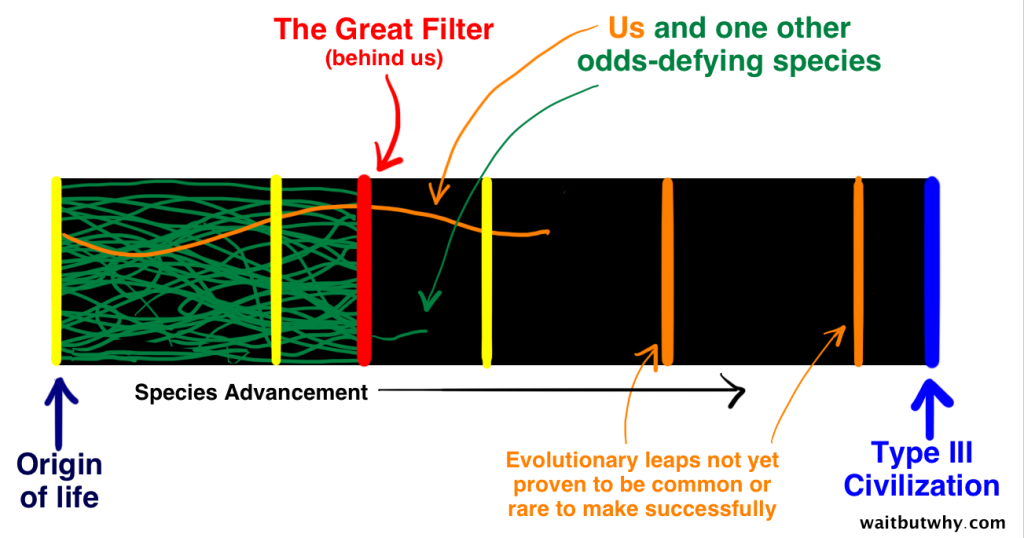
One of the most compelling explanations for the Fermi Paradox is the "Great Filter" hypothesis, proposed by economist Robin Hanson. This theory posits that at some critical juncture in the evolutionary path from the emergence of life to the development of a Type III civilization (one capable of harnessing the energy of its entire galaxy, according to the Kardashev scale), there exists an extremely unlikely or impossible step that nearly all attempts at life fail to overcome. This "filter" could be behind us, ahead of us, or even lie in the present.
The Great Filter can be broadly categorized into three main possibilities:
-
The Filter is in Our Past (We Are Rare): This scenario suggests that one or more extremely difficult steps in the evolution of life occurred on Earth but are incredibly rare elsewhere.
- Abiogenesis: The transition from non-living matter to self-replicating life might be far more improbable than we imagine. Despite significant research, the precise mechanisms for the origin of life remain largely mysterious.
- Complex Multicellular Life: While simple life (prokaryotes) appeared early on Earth, the emergence of complex eukaryotic cells, and subsequently multicellular organisms, took billions of years. This evolutionary leap, potentially requiring unique environmental conditions and genetic innovations, could be a formidable barrier. The "Rare Earth Hypothesis" argues that a complex combination of astronomical and geological events (e.g., a stable star, a large moon to stabilize axial tilt, plate tectonics for nutrient cycling, a suitable planetary mass) are necessary for complex life, making Earth exceptionally unique.
- Development of Intelligence: Even after complex life, the evolution of high-level intelligence capable of technological advancement might be another rare event.
-
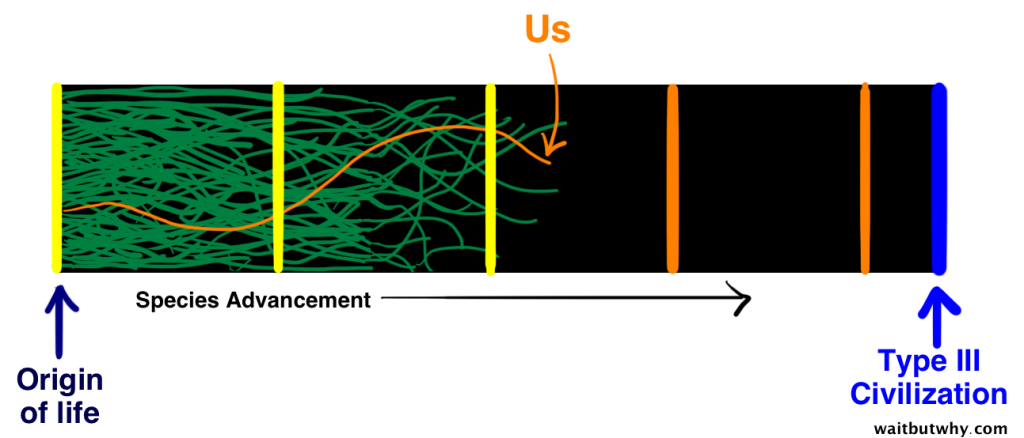
The Filter is in Our Future (The Catastrophe Awaits): This is a more sobering possibility, implying that we have successfully passed the previous filters, but a catastrophic event or inherent flaw in advanced civilizations inevitably leads to their demise before they can expand across the galaxy.
- Self-Destruction: Advanced civilizations might succumb to existential risks of their own making, such as global thermonuclear war, runaway climate change, ecological collapse due to resource depletion, or uncontrolled artificial intelligence. As humanity grapples with these very challenges, the possibility of self-inflicted extinction remains a grim, yet plausible, future filter.
- Natural Catastrophes: While less likely to affect all civilizations uniformly, highly advanced life might still be vulnerable to supervolcano eruptions, asteroid impacts, gamma-ray bursts, or nearby supernova events that could sterilize a planet or system. However, a civilization capable of interstellar travel would presumably have mitigation strategies or multiple settlements.
- Technological Stagnation or Regression: Perhaps advanced societies reach a peak and then, for various reasons (loss of curiosity, societal collapse, resource depletion), regress or become inward-looking, never expanding beyond their home system.
-
The Filter is Now (We Are the First): This optimistic, yet lonely, perspective suggests that humanity is among the first, if not the first, intelligent civilization to emerge in the universe capable of interstellar communication. If life and intelligence are relatively new phenomena on a cosmic timescale, then we simply haven’t had enough time for others to arise, develop, and spread. This implies that the Great Filter is firmly behind us, and our future is potentially boundless, albeit solitary for the foreseeable future.
Beyond the Filter: Other Plausible Explanations
While the Great Filter provides a powerful framework, other theories offer additional perspectives on the cosmic silence:
- The Zoo Hypothesis: This theory, proposed by John Ball, suggests that extraterrestrial civilizations are aware of humanity but choose not to interfere, observing us as if we were animals in a cosmic zoo. This non-intervention policy, akin to Star Trek’s "Prime Directive," would explain the lack of contact, as advanced beings might deem humanity not yet ready for interaction or might wish for our natural development to continue unhindered.
- The Dark Forest Theory: Popularized by Chinese science fiction author Liu Cixin in his novel "The Dark Forest," this grim hypothesis posits that the universe is a dangerous place. Any civilization revealing its presence risks attracting the attention of hostile, more advanced entities that would destroy them out of fear or competition for resources. In this scenario, silence is the ultimate survival strategy, leading all intelligent life to remain hidden in a "dark forest" of the cosmos.
- Temporal Disparity: Civilizations rise and fall over cosmic timescales. It’s possible that countless civilizations existed in the past, flourished, and died out long before humanity emerged. Conversely, future civilizations might arise long after we are gone. The fleeting window of a civilization’s technological detectability could be exceptionally brief compared to the vast age of the universe, making our chances of overlapping with another active civilization incredibly slim.
- Observational Limitations and Methodological Bias: Our current search methods, primarily radio astronomy (SETI), are akin to listening for a specific conversation in a vast, noisy stadium with limited equipment.
- Distance and Signal Attenuation: The sheer distances between stars mean that even powerful signals would be incredibly faint by the time they reach Earth, easily lost in background cosmic noise.
- Wrong Frequencies or Modulation: We might be listening on the wrong frequencies or fail to recognize the structure of an alien signal, which could be vastly different from anything we anticipate.
- Non-Electromagnetic Communication: Advanced civilizations might have moved beyond radio waves, utilizing communication methods we don’t yet understand or have the technology to detect (e.g., neutrinos, quantum entanglement, or gravitational waves).
- The "Small is Better" Theory: As articulated by the original article’s author and echoed by astronomer Seth Shostak, advanced intelligence might evolve towards extreme miniaturization. Just as computers have progressed from room-sized machines to nanometer-scale processors, advanced life might transcend large-scale physical structures. Instead of building Dyson spheres or megastructures visible across light-years, they might choose to operate at microscopic or even sub-atomic scales, becoming undetectable to our current macroscopic observational tools. They might inhabit "the infinite spaces between," residing in digital or quantum realms, detached from physical constraints that slow down or limit expansion. This post-biological evolution would make them virtually invisible to us.
The Ongoing Quest: SETI and Exoplanet Discoveries
Despite the profound silence, humanity’s search for extraterrestrial intelligence continues. The Search for Extraterrestrial Intelligence (SETI) program, initiated in the 1960s, has continuously scanned the skies for artificial signals. Projects like Breakthrough Listen, a privately funded initiative, employ powerful radio telescopes to conduct the most comprehensive search yet, analyzing millions of star systems. While no definitive alien signal has been detected, these efforts refine our understanding of cosmic communication and the challenges involved.
The explosion of exoplanet discoveries in recent decades has dramatically shifted our perspective. Missions like NASA’s Kepler Space Telescope and the Transiting Exoplanet Survey Satellite (TESS) have identified thousands of planets outside our solar system, many of which are rocky and reside in the habitable zones of their stars—the region where liquid water could exist. This abundance of potentially habitable worlds fuels the belief that the raw ingredients for life are common, further sharpening the Fermi Paradox. The upcoming James Webb Space Telescope (JWST) is capable of characterizing the atmospheres of exoplanets, potentially detecting biosignatures or technosignatures that could indicate life or technology.
Implications for Humanity and Science
The Fermi Paradox is more than just an astronomical puzzle; it holds profound implications for humanity’s understanding of its place in the universe. If we are truly alone, it bestows an immense responsibility upon us to protect and cherish the unique intelligence that has arisen on Earth. If the Great Filter lies ahead, it serves as a stark warning, urging us to overcome our existential challenges, from climate change to nuclear proliferation, lest we too become another silent casualty in the cosmic graveyard.
For science, the paradox drives innovation in astrobiology, exoplanet research, and theoretical physics. It forces us to confront fundamental questions about the nature of life, intelligence, and the universe itself. It encourages a multidisciplinary approach, drawing insights from biology, physics, sociology, and philosophy to piece together the cosmic narrative.
The profound silence of the universe remains one of the most enduring mysteries. Whether it signifies our unique rarity, a looming catastrophe, or simply our inability to perceive what is already there, the Fermi Paradox continues to inspire scientific inquiry and philosophical contemplation, pushing the boundaries of human knowledge in our endless quest to understand if we are truly alone.
About the Author