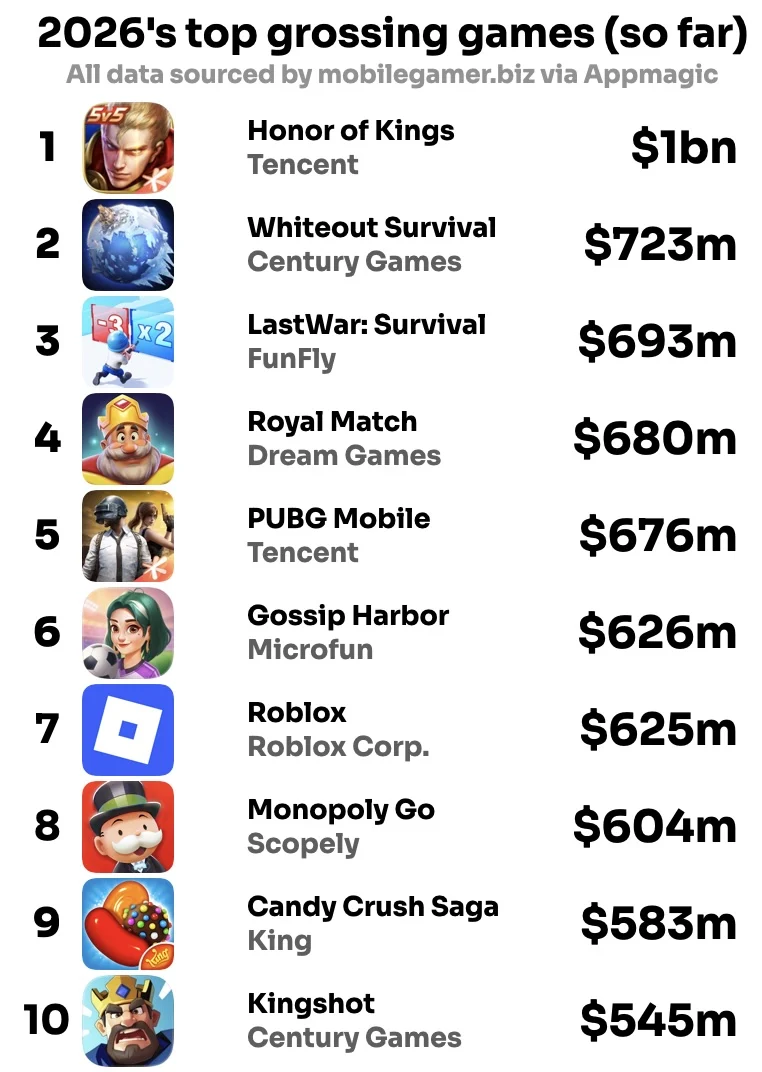
The global mobile gaming landscape in the first half of 2026 has been defined by the continued dominance of established Chinese powerhouses, the emergence of new high-growth titles, and a significant shift in how top-tier publishers manage their revenue streams. According to recent data from AppMagic, the industry’s top ten grossing games for the first six months of the year reveal a market that is both remarkably stable at the summit and increasingly volatile in the mid-to-high tiers. This analysis explores the fiscal performance of these mobile giants, the shifting strategies of their publishers, and the broader economic trends shaping the sector.
To provide an accurate picture of the market, it is essential to understand the parameters of the data provided by AppMagic. The revenue figures cited are based on estimated publisher payouts. This means the totals do not include the 30% commission typically claimed by Apple’s App Store and the Google Play Store. Furthermore, the figures exclude revenue generated through advertising, third-party webshops, and the highly fragmented Android ecosystem in mainland China. Despite these exclusions, the data offers a robust baseline for assessing the relative health and trajectory of the world’s most successful mobile properties.
The Unrivaled Dominance of Honor of Kings
Tencent’s flagship MOBA (Multiplayer Online Battle Arena), Honor of Kings, continues to occupy the top spot on the global charts, maintaining a lead that few competitors can realistically challenge. The game began 2026 with an unprecedented performance in January, setting an all-time record for monthly in-app purchase (IAP) revenue at approximately $194 million. While the title saw a slight cooling period throughout the spring, it consistently generated between $140 million and $160 million per month.
A notable dip occurred in June, where revenue fell to roughly $110 million. Despite this being its lowest-performing month of the year, it was still sufficient to keep the title at the number one position. The strategic significance of Honor of Kings remains heavily tethered to its domestic market; AppMagic estimates that 98% of the game’s lifetime revenue has been generated within China. This highlights both the immense scale of the Chinese gaming audience and the challenges Tencent faces in replicating this level of saturation in Western markets, despite various international localization efforts.

The Strategy Surge: Whiteout Survival and LastWar
The first half of 2026 saw a fierce competition within the 4X strategy genre, with two Chinese-developed titles—Whiteout Survival and LastWar—securing the second and third spots on the grossing list, respectively.
Century Games’ Whiteout Survival has proven to be a model of financial stability. The "frosty" survival strategy game has maintained a remarkably steady earning profile, pulling in approximately $110 million every month throughout the first half of the year. This consistency suggests a highly engaged and loyal player base that responds well to the game’s live-ops and seasonal content updates.
Conversely, FunFly’s LastWar has experienced a more turbulent trajectory. Throughout much of 2025, the title was a powerhouse, consistently earning between $120 million and $135 million monthly. However, 2026 has seen a sharp and somewhat mysterious decline for the title. By June, revenue had plummeted to $71 million—the game’s worst performance since its initial scaling phase. Industry analysts are currently debating whether this drop is due to market saturation, a shift in user acquisition (UA) efficiency, or the emergence of new competitors within the sub-genre.
Consistency in the Casual and Battle Royale Segments
In the casual gaming sector, Dream Games’ Royal Match continues to demonstrate why it is considered a premier asset in the mobile space. The title has maintained a high level of consistency, earning just over $100 million in IAPs nearly every month of 2026 to date. Its ability to maintain these figures without significant fluctuations underscores the effectiveness of its monetization mechanics and its broad appeal across diverse demographics.
In contrast, PUBG Mobile, the "original" mobile battle royale, has exhibited significant volatility. After a sharp decline in IAP revenue at the end of 2025, the game saw a massive resurgence in early 2026. In February, the title earned a staggering $133 million. However, the subsequent months have seen a gradual falling away of these figures. This "spiky" revenue pattern is characteristic of the battle royale genre, where major collaborations, seasonal passes, and limited-time cosmetic events drive massive short-term influxes of cash.

The Rise of Gossip Harbor and the UGC Lull
One of the most notable success stories of 2026 is Microfun’s Gossip Harbor. The merge-puzzle title has officially established itself in the top tier of global earners, regularly generating around $100 million per month. This performance has allowed it to surpass long-standing incumbents like Roblox in terms of direct IAP revenue. The success of Gossip Harbor signals a growing appetite for narrative-driven merge games, a trend that many publishers are now looking to emulate.
Meanwhile, Roblox has experienced a relatively muted first half of the year. Unlike 2025, which was bolstered by viral hits such as "Grow A Garden," the first six months of 2026 have lacked a "runaway" hit to significantly spike the platform’s numbers. While Roblox remains a titan of the industry, its IAP earnings for the first half of 2026 are down compared to the same period in 2025. Analysts expect a potential rebound in the third quarter as the Northern Hemisphere’s school summer holidays provide a traditional boost to the platform’s active user base and spending.
Strategic Shifts: Monopoly Go and the Webshop Movement
Scopely’s Monopoly Go remains a top contender, but its reported IAP revenue tells only part of the story. In February 2026, the game’s native IAP revenue saw a sudden drop, stabilizing at approximately $85 million per month. However, industry experts suggest this is not a sign of declining popularity, but rather a successful strategic pivot.
Scopely has been at the forefront of the movement to transition players from native app store purchases to proprietary webshops. By incentivizing players to buy currency and items directly through their own website, Scopely avoids the 30% fee levied by Apple and Google. Consequently, while the AppMagic data shows a decline in "storefront" revenue, the actual total revenue—including direct-to-consumer sales—is likely significantly higher. This shift represents a broader trend among "Big Mobile" publishers seeking to reclaim margins from platform holders.
The Veterans and the Newcomers: Candy Crush and Kingshot
King’s Candy Crush Saga continues to prove its longevity. Despite being one of the oldest titles on the list, it consistently earns roughly $95 million per month from IAPs. It is important to note that for a game of Candy Crush’s scale, advertising revenue—which is not captured in the AppMagic IAP data—likely accounts for a substantial additional portion of its total income, making it even more profitable than its chart position suggests.

Finally, the top ten is rounded out by a rising star: Kingshot. Also developed in China and published by Century Games, Kingshot has seen a steady climb in revenue since its launch, peaking in May 2026. The game has benefited from an aggressive and highly visible user acquisition campaign on platforms like TikTok. With Century Games now having two titles in the top ten, the publisher is cementing its position as a major force in the global mobile market.
Chronology of Market Trends: H1 2026
- January: Honor of Kings sets a record-breaking pace with $194 million in revenue, signaling a strong start for the mobile sector.
- February: A pivot point for several titles. Monopoly Go sees a shift toward webshop revenue, while PUBG Mobile experiences a $133 million peak. LastWar begins its unexpected descent.
- March – April: Stabilization for Royal Match and Whiteout Survival. Gossip Harbor begins its consistent $100 million-per-month run.
- May: Kingshot reaches its current revenue peak, driven by heavy UA spending.
- June: A general "cooling" month. Honor of Kings hits a yearly low of $110 million, and LastWar drops to $71 million, sparking industry concerns regarding the title’s longevity.
Broader Implications and Future Outlook
The data from the first half of 2026 illustrates several key shifts in the mobile gaming economy. First, the "top heavy" nature of the market remains intact; a small number of titles from a handful of publishers (primarily Tencent, Century Games, and Scopely) control the vast majority of the revenue.
Second, the diversification of revenue streams is becoming a necessity. As platform fees continue to face legal and regulatory scrutiny, more publishers are following Scopely’s lead in developing external payment ecosystems. This makes traditional app store charts an increasingly incomplete metric for measuring a game’s total financial success.
Third, the rise of titles like Gossip Harbor and Kingshot demonstrates that there is still room for new entries to disrupt the status quo, provided they have the right combination of engaging mechanics and aggressive, platform-specific marketing strategies.
As the industry moves into the second half of 2026, all eyes will be on whether Roblox can find its next viral hit, if LastWar can arrest its decline, and how much further the webshop trend will erode the traditional dominance of the Apple and Google storefronts. For now, the mobile market remains a high-stakes arena where consistency is rewarded, but innovation in monetization is becoming the new frontier for growth.
About the Author