The burgeoning field of spatial computing has reached a new milestone with the introduction of 2Sync, a specialized software solution designed to bridge the gap between physical architecture and virtual immersion. Developed by a German-based startup, the 2Sync Software Development Kit (SDK) enables developers to create "responsive" virtual environments that automatically adapt to the layout of a user’s real-world surroundings. By mapping physical furniture and boundaries into functional virtual assets, the technology aims to solve long-standing issues regarding user safety, physical presence, and the integration of "passive haptics" in extended reality (XR) experiences.

While traditional Virtual Reality (VR) often isolates users from their physical environment, 2Sync utilizes Mixed Reality (MR) principles to ensure that every object in a room has a digital counterpart. For example, a kitchen table may be rendered as a tactical crate in a military simulation, or a sofa may appear as a moss-covered stone bench in a fantasy setting. This synchronization allows users to move naturally within their physical space without the risk of collision, while simultaneously enhancing the psychological sense of "presence" through tactile feedback.
Technical Architecture and Room Synchronization
The 2Sync SDK is built to integrate seamlessly with major development platforms, specifically Unity and Unreal Engine. The system functions by leveraging the environmental data captured by modern XR headsets, such as the Meta Quest 3 and Pico 4. During the initial setup, the software utilizes the headset’s internal scene-modeling capabilities—such as the Meta Room Setup—to identify walls, floors, and furniture.

The core innovation of 2Sync lies in its procedural generation rules. Unlike static VR environments that require a fixed "play area," 2Sync-powered applications are dynamic. Developers define a set of transformation rules at the code level; these rules instruct the system on how to interpret various physical volumes. If the system detects a rectangular object of a certain height, it can procedurally scale and place a virtual asset to match those dimensions. This "responsive design" for 3D spaces mirrors the way modern websites adapt their layout to different screen sizes, ensuring a consistent user experience regardless of whether the application is launched in a cramped bedroom or a sprawling commercial arcade.
Chronology of Development and Public Demonstration
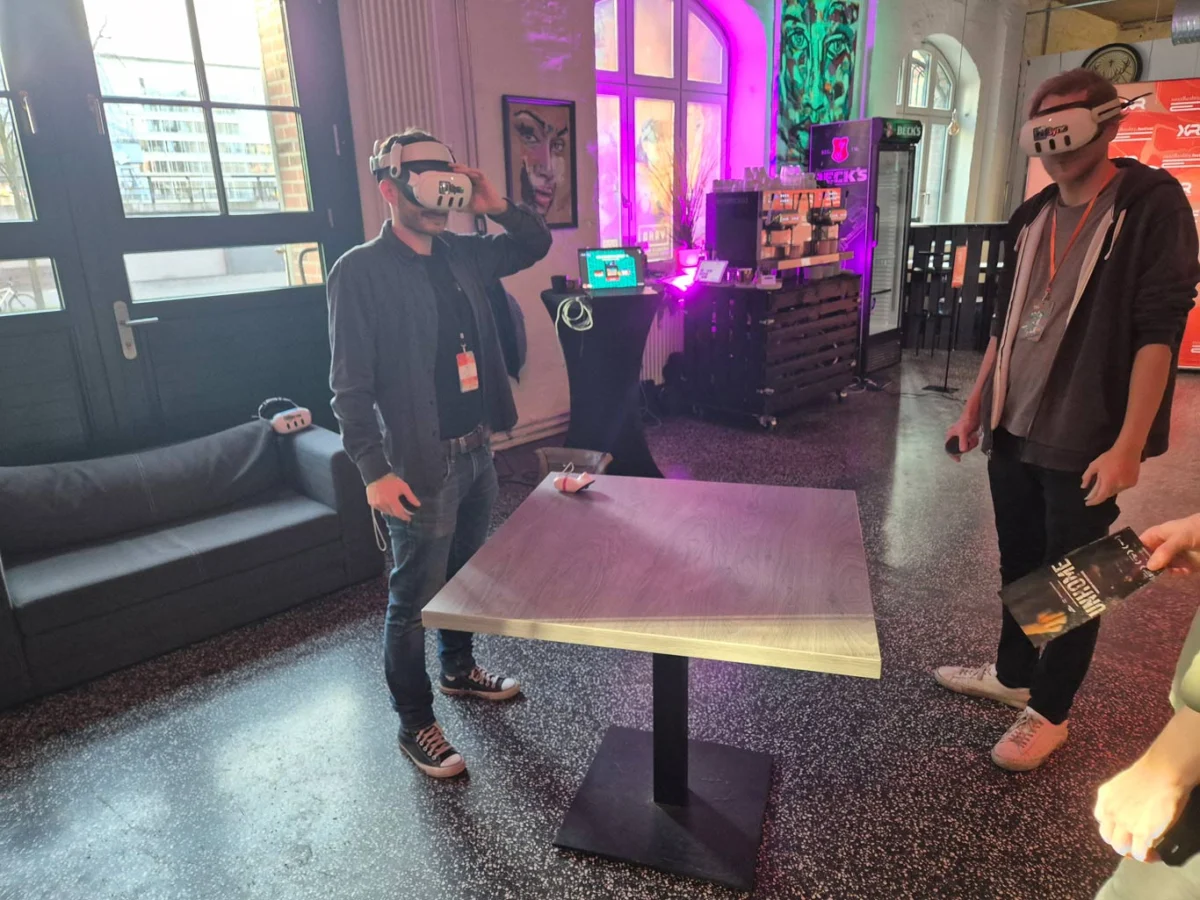
The journey of 2Sync from a conceptual framework to a functional SDK has followed a timeline centered on the rapid advancement of passthrough technology. The startup gained significant momentum following the release of high-fidelity MR headsets in late 2023. In November 2023, the company presented its technology at the NextReality event in Hamburg, Germany, providing industry experts and journalists with a comprehensive hands-on look at the system’s capabilities.

During the Hamburg demonstrations, 2Sync showcased several prototypes, including a wave-based defense shooter. The demonstration environment was a controlled space featuring a sofa and a table. Upon donning the headset, participants observed that the physical furniture had been perfectly integrated into the virtual world’s aesthetic. The table became a functional part of the environment, and the sofa remained a viable place to sit, allowing users to transition between standing and seated gameplay without removing the headset or triggering safety grids.
Following the success of these demonstrations, 2Sync moved into a closed beta phase. The company currently offers a limited-feature demo application on the Meta Quest Store, titled "Mixed Snow Worlds," which serves as a proof of concept for how physical rooms can be transformed into winter landscapes.

Supporting Data: The Rise of Location-Based Entertainment
The emergence of tools like 2Sync is timely, given the projected growth of the Location-Based Entertainment (LBE) and Mixed Reality markets. According to industry analysis, the global LBE VR market is expected to grow at a compound annual growth rate (CAGR) of approximately 25% through 2030. Operators of VR arcades and "free-roam" experiences are increasingly seeking solutions that reduce the need for expensive, custom-built physical sets.
2Sync’s ability to map existing furniture into a game world provides a cost-effective alternative for these businesses. Furthermore, the SDK supports colocated multiplayer, a critical feature for the LBE sector. This allows multiple users to occupy the same physical and virtual space simultaneously, with the system rendering synchronized avatars and environmental assets for all participants. By ensuring that every player sees the same virtual obstacles in the same physical locations, 2Sync significantly mitigates the risk of player-to-player and player-to-object collisions.

Safety and the Concept of Passive Haptics
One of the primary drivers for 2Sync’s development is the enhancement of user safety. Standard VR safety systems, such as Meta’s "Guardian" or SteamVR’s "Chaperone," rely on translucent grids that appear when a user nears a boundary. However, consumer data suggests that these grids are often ignored or misunderstood by novice users, leading to the "VR fail" phenomenon where users strike walls or furniture.
2Sync replaces these abstract warnings with "meaningful obstacles." Because a user sees a solid virtual wall or a large crate where their physical table stands, they are instinctively conditioned to avoid it. This leverages human spatial intuition rather than relying on artificial UI elements.

In addition to safety, 2Sync exploits "passive haptics"—the use of physical objects to provide tactile feedback for virtual ones. Psychological studies in human-computer interaction have shown that when a user touches a physical surface that matches a virtual visual, the level of immersion increases exponentially. By aligning a virtual rock with a real sofa, 2Sync allows the user’s brain to resolve the sensory conflict between sight and touch, a process known as "multisensory integration."
Current Challenges and Industry Implications
Despite the technical promise of the 2Sync SDK, several hurdles remain for widespread adoption. The most prominent challenge is the "sensory mismatch" regarding material properties. While a physical sofa provides a surface to sit on, its soft texture may clash with the visual of a hard stone rock in the virtual world, potentially breaking the user’s immersion.

There is also the logistical issue of clutter. 2Sync requires a relatively clear walking path to function effectively as a "room-scale" experience. In residential settings, where floor space is often limited and unpredictable, the utility of the SDK may be constrained compared to its application in dedicated commercial spaces. Furthermore, the system must account for dynamic environments; if a chair is moved during a session, the software must be capable of real-time re-mapping to maintain safety standards.
From a business perspective, the success of 2Sync will depend on developer adoption. Building "responsive" XR content requires a shift in game design philosophy. Developers must move away from fixed level designs and toward flexible, algorithmic environments that can remain balanced and engaging whether played in a 10-square-meter room or a 50-square-meter hall.

Future Outlook
As the industry moves toward the "Metaverse" and more integrated spatial computing, the demand for software that understands and respects the physical world is expected to rise. 2Sync represents an early but sophisticated attempt to standardize how virtual worlds interact with physical reality.
The startup is currently refining its SDK based on feedback from its closed beta participants. Future updates are expected to improve the speed of room scanning and expand the library of procedural assets available to developers. If 2Sync can successfully navigate the complexities of diverse physical environments and provide a stable, "plug-and-play" solution for developers, it could become a foundational tool in the next generation of Mixed Reality content creation, shifting the focus from escaping reality to enhancing it.
About the Author