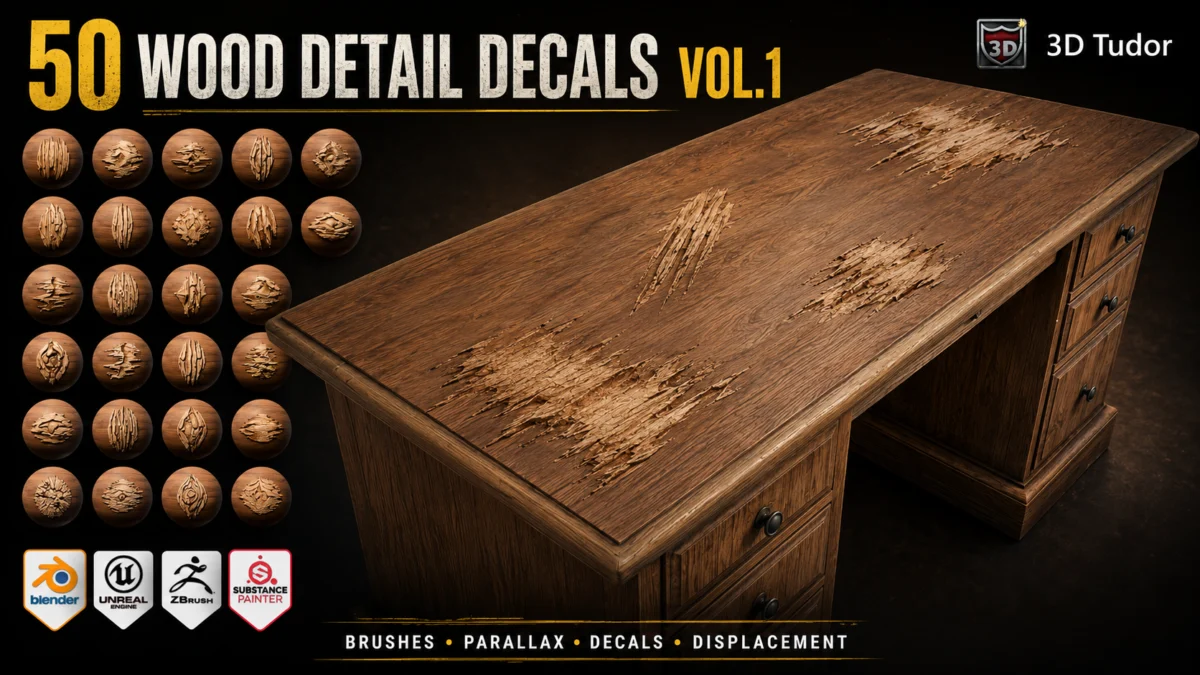
The landscape of digital art and game development is continuously seeking tools that streamline complex workflows and elevate visual fidelity. In this pursuit, 3D Tudor, a notable contributor to the 3D asset community, has unveiled its "WoodDetail Decal Pack Vol.1," a comprehensive library of 50 distinct wood surface detail designs. This meticulously curated collection is engineered to address a pervasive challenge faced by 3D artists: achieving believable and nuanced wooden surfaces that move beyond the sterile appearance of freshly modeled geometry. The pack offers an unprecedented level of flexibility, catering to a wide array of applications from rapid environment dressing to intricate hero asset detailing across major 3D software suites, including Blender, Substance Painter, Unreal Engine 5, and ZBrush.
Addressing a Persistent Gap in Digital Wood Creation
The creation of wooden elements, ranging from robust structural beams and weathered planks to rustic barrels, fences, and the architectural foundations of fantasy villages and taverns, is a ubiquitous task in 3D content creation. While the fundamental modeling and initial texturing stages might progress smoothly, a common pitfall lies in the final surface treatment. A wooden asset, no matter how well-shaped or textured, can appear unfinished if its surface lacks the subtle imperfections that signify age, use, and natural wear. The absence of knots, splits, grain variations, plank seams, worn edges, bark textures, or weathering marks can render even the most ambitious wooden constructions to look as if they were installed by an overly enthusiastic, yet inexperienced, digital carpenter.
This is precisely the void that 3D Tudor’s "WoodDetail Decal Pack Vol.1" aims to fill. Developed by Neil, the driving force behind 3D Tudor, the pack is not merely a collection of textures but a versatile toolkit designed to inject life and history into digital wood. The core objective is to provide artists with the means to execute that critical final surface detail pass, transforming existing assets into elements that feel genuinely aged, handled, damaged, carved, split, weathered, or simply more convincingly real.
A Flexible Approach for Diverse Production Needs
A key tenet underpinning the design of the "WoodDetail Decal Pack Vol.1" is "shot-distance flexibility." Recognizing that not all wooden elements demand the same level of detail or computational resources, the pack is structured around four distinct practical use-modes. This approach acknowledges the varying requirements of different production scenarios, from background assets in vast open-world games to hero props in high-fidelity cinematics.
For quick environment dressing, artists can leverage the designs as flat alpha-cut decals. This method offers the fastest way to impart visual richness to wooden surfaces such as walls, beams, fences, stalls, doors, and larger background elements without altering the underlying mesh. This is particularly beneficial in large-scale environments where performance optimization is paramount.
When dealing with mid-shot assets, where a flat decal might appear too simplistic but full displacement would be computationally prohibitive, the parallax material functionality comes into play. This shader-driven depth provides a convincing illusion of surface relief without the need for additional geometry, striking a balance between visual quality and performance.
For hero close-ups, especially within demanding renderers like Blender Cycles, the real displacement workflow is intended to deliver maximum physical presence. This mode is ideal when the camera is positioned close enough for viewers to discern intricate details like surface relief, edge wear, and subtle texture breakup. This level of detail significantly enhances the perceived materiality of the wood.
Finally, for sculpting workflows, the pack includes specialized Blender sculpt brushes and ZBrush alpha brush presets. This enables artists to directly sculpt details into their meshes before baking or final surfacing, integrating the wood imperfections seamlessly into the geometry itself. This is a crucial step for creating game-ready assets where baked normal maps often capture high-frequency surface detail.
Seamless Integration Across Production Pipelines
The inherent versatility of the "WoodDetail Decal Pack Vol.1" extends beyond individual software applications. The same library of 50 designs can be effectively utilized across different stages of a production pipeline, allowing artists to maintain consistency and efficiency. This means an artist can begin with decals for rough blocking, transition to parallax for mid-stage visualization, and finally employ real displacement or sculpt brushes for final detailing. This adaptability ensures that the chosen wood details remain relevant and effective as the asset evolves from concept to final render or game integration.
It is important to note that artists are not mandated to utilize every software lane or workflow mode. The pack’s design philosophy emphasizes that the same set of wood details can accompany an asset throughout its creation journey, adapting to the specific needs and constraints of each production phase. This flexibility is a significant boon for solo developers, small studios, and larger teams alike, fostering a more agile and responsive workflow.
Stylized Realism for Broad Applicability
3D Tudor explicitly positions the "WoodDetail Decal Pack Vol.1" as being aimed at stylized realism rather than photogrammetry. This distinction is crucial. The collection does not consist of 3D scans of real-world wood, which can sometimes be overly complex or difficult to integrate into stylized art directions. Instead, the details are thoughtfully designed to be clear and impactful at typical game and portfolio viewing distances. They are engineered to complement a wide range of artistic styles, including hand-painted textures, stylized PBR (Physically Based Rendering) workflows, and the characteristic aesthetics of fantasy environments.
The pack’s intended applications are broad and encompass numerous popular genres and asset types. These include, but are not limited to:
- Fantasy villages and settlements
- Interior and exterior detailing for taverns and cabins
- Weathered barrels and crates
- Rustic bridges and boardwalks
- Plank walls and fences with visible seams and imperfections
- Market stalls and vendor booths
- General RPG environment assets
- Detailed hero props that demand close-up scrutiny
- Portfolio showcase scenes
- Cinematic close-up renders
- Game-ready asset detailing workflows
The optimal time to implement these details, according to 3D Tudor, is after the primary modeling and foundational texturing are complete. This is when the asset’s overall form and structure are solidified, allowing the surface details to add narrative and believability. The pack’s designs are intended to tell a "surface story" – a seam to break up an otherwise monotonous plank wall, a knot to imbue a beam with character, a split along an edge to suggest age and stress, bark texture on exposed timber to indicate natural origins, or a worn grain mark to guide the viewer’s eye and suggest interaction. Employed in this manner, the details serve a practical and purposeful role, avoiding the trap of turning every minor surface imperfection into an overly complex geometric challenge.
Technical Considerations and Workflow Integration
The pack’s technical implementation is designed for robust performance and visual quality. While flat decals and parallax materials function effectively in real-time renderers like EEVEE, the real displacement workflow is specifically optimized for offline renderers such as Cycles. This ensures that artists can achieve the highest fidelity for cinematic renders and close-up shots where computational cost is less of a concern. For sculpting workflows, the integration with Blender’s brush system and ZBrush’s alpha capabilities streamlines the process of adding surface variation directly to the mesh.
The preview video accompanying the pack, available on YouTube, further illustrates the diverse applications and visual impact of these wood details. It serves as a practical demonstration of how the pack can be integrated into various workflows and achieve different aesthetic outcomes.
The "WoodDetail Decal Pack Vol.1" is currently available for purchase on Gumroad, providing a direct channel for artists to acquire this powerful new resource. This release signifies a continued commitment from 3D Tudor to providing the 3D art community with practical, high-quality tools that address real-world challenges in digital content creation, empowering artists to build more immersive and believable worlds. The availability of such specialized asset packs democratizes access to advanced detailing techniques, enabling a broader range of artists to achieve professional-grade results. The implications for asset creation speed and quality are significant, potentially reducing development time for projects that heavily feature wooden environments and props. Furthermore, it allows for greater artistic control over the narrative conveyed through surface imperfections, moving beyond generic procedural generation towards curated, intentional detail.
About the Author