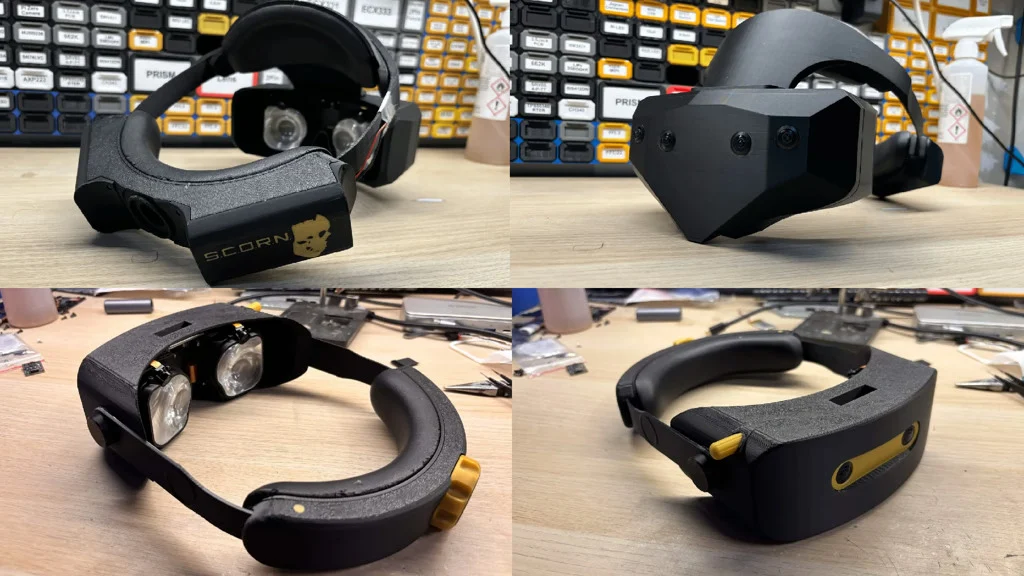
Walker Industries, a Japan-based technology startup, has officially initiated its Kickstarter crowdfunding campaign for the Vector Gear, a fully open-source virtual reality (VR) headset designed to offer a transparent and modifiable alternative to the proprietary ecosystems currently dominating the extended reality (XR) market. The project, which has been in development for several years, seeks to provide enthusiasts, researchers, and developers with a mid-range hardware platform that prioritizes user agency, data privacy, and hardware modularity. Alongside the flagship Vector Gear, the company has also unveiled the Andromeda series, a dedicated PC VR line designed for varying performance tiers.
The Genesis of the Vector Gear Project
The Vector Gear project is the culmination of nearly a decade of conceptualization and development by a team of engineers and VR enthusiasts. The founder of Walker Industries has stated that the vision for a truly open headset was inspired by the immersive depictions of virtual worlds in popular culture over a decade ago, leading to a nine-year journey to bring a functional, production-ready device to market.
The company’s philosophy centers on the "open" nature of both hardware and software. Unlike major industry players such as Meta or Apple, which utilize closed-source operating systems and restricted hardware access, Walker Industries intends to release the full schematics and source code for the Vector Gear. This approach is intended to foster a community-driven ecosystem where users can modify the hardware, develop custom firmware, and ensure the longevity of the device independent of manufacturer support.

Technical Specifications and Hardware Architecture
The Vector Gear is positioned as a versatile hybrid device, capable of functioning as a standalone unit or as a tethered PC VR headset. It is powered by the Qualcomm Snapdragon XR2 Gen 2 chipset, which has become the industry standard for high-performance mobile XR.
Vector Gear Flagship Features:
- Optics and Display: The headset utilizes pancake lenses to maintain a slim form factor, offering a resolution of 2048 x 2048 pixels per eye. It supports a refresh rate of 90Hz and provides a 100-degree field of view (FOV).
- Integrated Tracking: The device features "AstroSLAM," an in-house developed simultaneous localization and mapping (SLAM) system. Notably, this tracking is implemented not only in the headset but also in the controllers, which utilize onboard cameras for independent inside-out tracking.
- Biometric Sensors: The Vector Gear includes integrated eye tracking and face tracking, the latter powered by a proprietary algorithm named "Shinra Meisin." These sensors are designed to facilitate high-fidelity social interactions in platforms like VRChat via OSC (Open Sound Control) data streaming.
- Mechanical Adjustments: To ensure visual clarity and comfort, the headset includes an automatic interpupillary distance (IPD) adjustment system.
The Andromeda Series:
For users who do not require standalone capabilities, Walker Industries has introduced the Andromeda line, which focuses exclusively on PC-tethered experiences. The series is divided into two distinct models:
- Andromeda 2160: A budget-conscious entry offering 2160 x 2160 resolution per eye, designed for users seeking a high-quality tethered experience without the overhead of a mobile processor.
- Andromeda 2560: A high-end variant featuring 2560 x 2560 resolution per eye and 12GB of RAM, targeting enthusiasts who prioritize visual fidelity and low-latency PC VR performance.
Proprietary Software and the XRUIOS Operating System
A significant portion of the development effort has been directed toward the software stack. Rather than relying on a standard Android-based XR distribution, Walker Industries has developed XRUIOS, a custom operating system built on Arch Linux.
The company describes XRUIOS as a "spatial runtime" that allows users to interact with 3D objects and widgets within a persistent virtual environment. A key feature of the OS is the integration of FEX, an emulation layer that allows the ARM64-based headset to execute standard x86 Linux applications. This significantly expands the utility of the device beyond dedicated VR apps, allowing for the use of traditional desktop software in a spatial context.

Furthermore, the "Yuuko Protocol" has been introduced as a cross-platform communication standard. This protocol is intended to create a seamless data and state-sharing environment across multiple devices. For instance, a user could pause a media file on the Vector Gear and resume it from the exact same timestamp on a mobile phone or PC, provided the devices are linked via the protocol. This highlights the company’s ambition to integrate XR into a broader, unified computing workflow.
Market Context and Competitive Landscape
The launch of the Vector Gear comes at a time of transition for the VR industry. While the market is currently led by the Meta Quest series and the recently launched "Steam Frame" from Valve, there is a growing niche for "prosumer" hardware that offers more flexibility than mass-market consumer devices.
Analysts note that the Vector Gear’s specifications are comparable to the Steam Frame in terms of raw processing power and resolution. However, Walker Industries distinguishes itself through its commitment to total openness. While the Steam Frame is noted for its moddability, the Vector Gear is designed to be fully disassembled and reconfigured, appealing to research institutions, privacy advocates, and the "maker" community.
The financial scale of the project is also a point of industry interest. Walker Industries is operating with a budget significantly smaller than established competitors like Pimax or Valve. This "indie" approach allows for rapid iteration and a closer relationship with the core community but carries the inherent risks associated with small-scale hardware manufacturing.

Chronology and Future Roadmap
The Vector Gear project has maintained a transparent development timeline, with the team providing regular updates via community forums and social media for several months prior to the Kickstarter launch.
- Q3 2026: Finalization of the AstroSLAM and Shinra Meisin algorithms.
- Q4 2026: Official Kickstarter campaign launch and prototype demonstrations.
- Q1 2027: Final hardware refinement and component sourcing.
- May 2027: Expected commencement of worldwide shipping for the first production units.
Walker Industries has acknowledged the challenges faced by previous hardware startups, such as Lynx and Tilt Five, which experienced significant delays or financial hurdles during the manufacturing phase. To mitigate these risks, the team has emphasized their modular design, which simplifies the assembly process and allows for more manageable supply chain requirements.
Pricing and Availability
The Kickstarter campaign offers several backing tiers:
- Vector Gear (Standalone/PC VR): $980
- Andromeda 2160 (Entry PC VR): $650
- Andromeda 2560 (High-End PC VR): $1,250
Discounted "Developer Kit" versions are also available for users willing to assemble the units themselves, further emphasizing the project’s roots in the DIY and maker culture.

Broader Implications for the XR Industry
The success of the Vector Gear could signal a shift in the XR hardware market toward more transparent and user-owned systems. By providing an alternative to the "walled garden" models of major tech corporations, Walker Industries is positioning the Vector Gear as a vital tool for academic research, where data privacy and the ability to access raw sensor data are paramount.
Furthermore, the use of an Arch Linux-based OS challenges the dominance of Android in the standalone VR space, potentially opening the door for a more diverse range of software architectures in future devices. As the campaign progresses, the industry will be watching closely to see if this small, dedicated team can successfully navigate the complexities of mass production and deliver on its ambitious technical promises.
About the Author