For billions of years, the universe has spun its intricate tapestry, a vast expanse teeming with countless galaxies, stars, and planets. Given a cosmic head start of approximately 13 billion years on planetary evolution and the formation of complex systems, a profound question echoes through scientific and philosophical discourse: why, despite the immense scale and age of the cosmos, has humanity not yet encountered any definitive evidence of extraterrestrial life, particularly advanced civilizations? This enduring enigma is formally known as the Fermi Paradox.
The Genesis of the Fermi Paradox
The Fermi Paradox traces its origins to a seemingly casual lunch conversation in 1950 involving physicist Enrico Fermi. While discussing flying saucers and the possibility of extraterrestrial life with colleagues at Los Alamos National Laboratory, Fermi famously posed the question, "Where is everybody?" His query highlighted a stark contradiction: on one hand, the sheer number of stars and planets in the Milky Way alone, coupled with the age of the universe, suggests a high probability of life having evolved elsewhere. On the other hand, there is a conspicuous absence of any observable evidence – no alien probes, no radio signals, no megastructures – that would indicate the presence of advanced civilizations.
This paradox gained significant traction with the development of the Drake Equation in 1961 by astronomer Frank Drake. The equation attempts to estimate the number of detectable extraterrestrial civilizations in the Milky Way galaxy by multiplying several astrophysical and biological factors: the rate of star formation, the fraction of stars with planets, the average number of planets that can potentially support life, the fraction of those planets that actually develop life, the fraction of planets with life that develop intelligent life, the fraction of intelligent civilizations that develop technology detectable from space, and the length of time such civilizations release detectable signals into space. While each variable carries enormous uncertainty, even conservative estimates using the Drake Equation often yield a surprisingly high number of potential civilizations, making Fermi’s question even more poignant.
The Enigmatic Great Filter: Where Are the Bottlenecks?
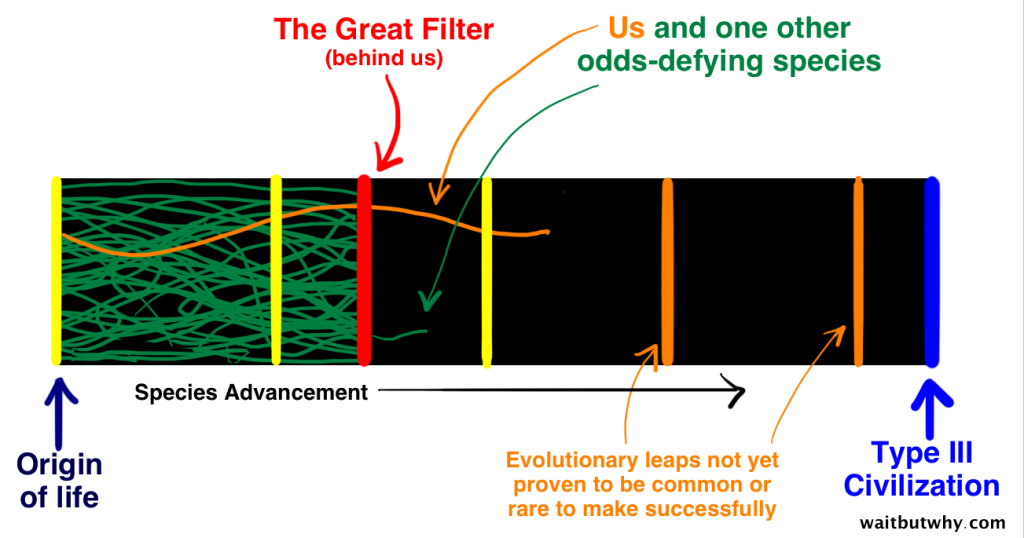
One of the most compelling frameworks proposed to resolve the Fermi Paradox is the "Great Filter" theory. Coined by economist Robin Hanson, this theory posits that at some critical stage in the long evolutionary path from pre-life chemicals to a Type III civilization (a civilization capable of harnessing the energy of an entire galaxy, according to the Kardashev scale), there exists a "wall" or a series of extremely improbable or impossible barriers that almost all attempts at life hit. This "filter" could be a single, overwhelmingly difficult step, or a cumulative effect of multiple challenging hurdles, preventing life from reaching a detectable, interstellar-traveling stage.
The location of this Great Filter is of paramount importance to humanity’s understanding of its own future. There are three primary categories for where this filter might lie:
1. The Filter is Behind Us: Humanity’s Unique Journey
This hypothesis suggests that the most difficult and improbable steps for life to emerge and evolve into intelligent, technological civilizations have already occurred on Earth. If this is the case, then humanity represents an incredibly rare success story, having passed through one or more filters that most other nascent life forms fail to overcome.
Possible "behind us" filters include:
- The Genesis of Life Itself (Abiogenesis): The transition from non-living matter to self-replicating life might be an extraordinarily improbable event. Despite extensive research, scientists have yet to fully replicate abiogenesis in laboratory settings, suggesting its immense complexity.
- The Evolution of Complex Multicellularity: After life forms, the leap from simple single-celled organisms to complex multicellularity, with specialized tissues and organs, took billions of years on Earth and involved numerous evolutionary innovations. This might be a significant bottleneck.
- The Emergence of Intelligence and Tool Use: While life may be abundant, the development of sophisticated intelligence, abstract thought, and the capacity for tool-making and technological advancement could be exceedingly rare. Many species on Earth have existed for millions of years without developing such capabilities.
- The Survival of Cataclysmic Events: Earth has endured multiple mass extinction events. Perhaps the continuous survival through such cosmic bombardments, supervolcano eruptions, or dramatic climate shifts over billions of years is a filter that most other planets’ biospheres fail to navigate.
If the Great Filter is indeed behind us, it implies that humanity is exceptionally fortunate and potentially alone, or among a very few, in the observable universe at our current stage of development. This offers a sense of unique cosmic significance but also a sobering perspective on the rarity of advanced life.

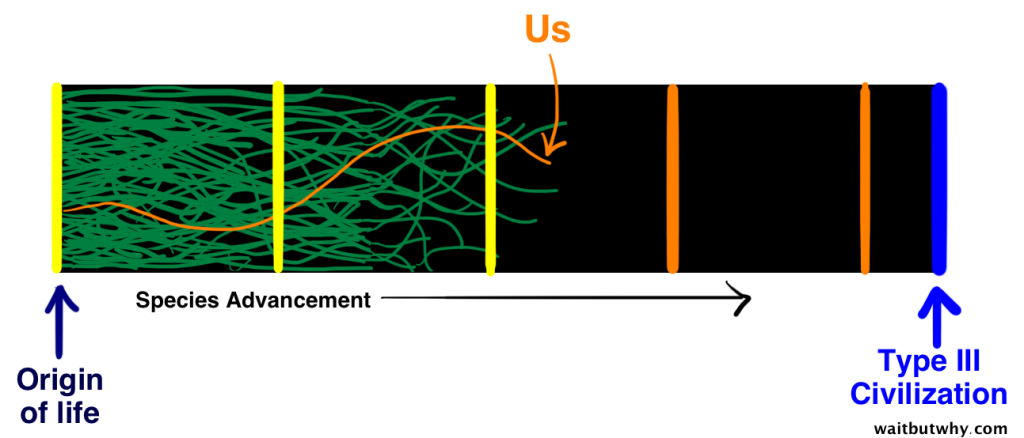
2. The Filter is Ahead of Us: The Looming Threats
Alternatively, the Great Filter could lie in humanity’s future, representing a catastrophic obstacle that nearly all advanced civilizations inevitably encounter and fail to overcome. This is a far more unsettling prospect, as it suggests that humanity’s continued existence and advancement are precarious, and we may be on a path towards an unavoidable self-destruction or extinction event.
Potential "ahead of us" filters include:
- Self-Destruction through Technology: Advanced civilizations might develop technologies that lead to their own demise. This could include nuclear warfare, unchecked artificial intelligence, genetically engineered pandemics, or unintended consequences of terraforming or energy production (e.g., runaway climate change, grey goo scenarios from nanobots).
- Resource Depletion and Environmental Collapse: The unsustainable exploitation of planetary resources, leading to irreversible environmental damage, could be a common trap for industrial civilizations.
- Inability to Manage Global Catastrophes: Even without self-inflicted wounds, advanced civilizations might be unable to withstand inevitable cosmic threats, such as asteroid impacts, supernovas, or gamma-ray bursts, if they haven’t achieved interstellar travel or planetary defense capabilities.
- Technological Stagnation or Loss of Drive: Perhaps advanced civilizations simply lose the drive for expansion or technological progress, retreating into virtual realities or reaching a stable, non-expansive state that makes them undetectable.
This hypothesis serves as a stark warning, urging humanity to carefully consider the long-term implications of its technological progress and societal choices. It frames our current existence as a race against an unknown, potentially universal, barrier.
3. The Filter of Rarity: The Unlikelihood of Life Itself
A third perspective suggests that life, particularly complex or intelligent life, is simply far rarer than generally assumed. This doesn’t necessarily point to a "filter" in the traditional sense, but rather to a fundamental statistical improbability embedded in the cosmos.
Arguments for this include:
- The Rare Earth Hypothesis: This theory posits that the specific combination of astrophysical and geological conditions necessary for complex life to evolve and persist (e.g., a stable star, a planet within the habitable zone, a large moon for tidal stability, plate tectonics for nutrient cycling, a protective magnetic field, the right planetary mass, and a precise galactic location) is exceptionally rare. Many exoplanets might exist, but very few possess the "Goldilocks" conditions required for advanced life.
- The Uniqueness of Biological Evolution: Even with suitable conditions, the specific evolutionary pathways that led to intelligence and technology on Earth might be highly contingent and unlikely to be replicated elsewhere. Evolutionary pressures could favor different forms of life that do not develop technological capabilities.
If life, especially intelligent life, is indeed an extreme cosmic rarity, then the universe could still be vast and ancient, but simply devoid of the numerous intelligent neighbors we might hope for.
The Time Travel Analogy: A Parallel Absence of Evidence
The original article draws a compelling parallel between the Fermi Paradox and the absence of time travelers from the future. Just as the immense age of the universe leads us to expect alien visitors, the enormous stretch of time ahead of us, where time travel might be invented, leads us to expect visitors from the future. The lack of credible evidence for either phenomenon offers a thought-provoking symmetry.
While the physics of time travel remains highly speculative, the argument aligns with the Fermi Paradox’s core logic: if something is possible and highly beneficial (like avoiding a future catastrophe or exploring history), then given enough time and intelligent agents, it should have happened by now. The absence of such evidence, for some, serves as a strong indicator of impossibility or severe limitations, such as the Novikov self-consistency principle, which suggests that time travel might only be possible in ways that do not alter history, making travelers inherently discreet or indistinguishable.
Beyond Grand Engineering: The Hypothesis of Micro-Civilizations
Beyond the Great Filter, other solutions to the Fermi Paradox focus on the nature of advanced civilizations themselves. One intriguing theory, highlighted by Jeff Atwood and further elaborated by astronomer Seth Shostak, suggests that advanced life might not pursue large-scale, easily detectable engineering projects. Instead, they might trend towards the infinitely small and efficient.
This "smallness" hypothesis posits that as civilizations advance technologically, they prioritize efficiency, speed, and miniaturization. Analogous to the evolution of computers from room-sized behemoths to powerful handheld devices, advanced intelligence might shed its need for large physical bodies or colossal structures (like Dyson spheres). Instead, they might inhabit digital realms, sophisticated nanobots, or even exist in highly condensed, energy-efficient forms that operate at scales imperceptible to our current observational capabilities.
Shostak argues, "Why build planet-size anything when the real action is in the small things? Small spaces, small units of time, everything gets smaller." If advanced civilizations transition into a post-biological, highly compact, or even entirely informational existence, they would effectively "disappear" from our conventional methods of detection. They might operate in the "infinite spaces between" – not literally between atoms, but in highly optimized, low-energy states, or within complex computational matrices that leave no discernible signature across interstellar distances. Such civilizations might have no incentive or need to rearrange stars or send out powerful signals, having transcended the limitations that necessitate such grand gestures.
The Search Continues: SETI and Future Prospects
Despite the enduring mystery, humanity’s quest for extraterrestrial intelligence continues. Projects like SETI (Search for Extraterrestrial Intelligence) and Breakthrough Listen actively scan the skies for radio signals or optical pulses that might betray the presence of intelligent life. New generations of telescopes, like the James Webb Space Telescope, are capable of characterizing exoplanet atmospheres, potentially detecting biosignatures or technosignatures (indicators of technology).
The implications of the Fermi Paradox are profound, regardless of its ultimate resolution. If the filter is behind us, it underscores the preciousness and rarity of human existence. If it lies ahead, it serves as an urgent call to action to address global challenges and ensure our long-term survival. If advanced life simply becomes undetectable, it challenges our anthropocentric view of what "advanced" truly means and how it might manifest.
As we continue to gaze into the vast, silent cosmos, the Fermi Paradox remains one of humanity’s most compelling intellectual challenges, forcing us to confront not only the possibilities of life beyond Earth but also the deepest questions about our own origins, destiny, and unique place in the universe.
About the Author