At the most recent Game Developers Conference (GDC), Supercell’s game leads James Back and Aleksandar Markovic delivered a comprehensive post-mortem on the resurgence of Clash Royale, detailing the internal shifts in philosophy, monetization, and systems design that pulled the title back from a period of stagnation. The presentation, which mirrored a similar session regarding the recovery of Brawl Stars, highlighted how one of the world’s most successful mobile developers navigated a period of "diminishing returns" to achieve a massive spike in both player engagement and revenue. The recovery, characterized by bold and often controversial decisions, provides a blueprint for how legacy mobile titles can find new life in an increasingly crowded and expensive market.
The Crisis of Content and the Shift to Novelty
The narrative of Clash Royale’s comeback began with a candid assessment of the game’s state in 2022. According to Markovic, the team was trapped in a cycle of "increasing cost and uncertain demand." For years, the primary method of keeping the game fresh was the introduction of entirely new cards. However, this strategy hit a wall of diminishing returns. New cards required players to learn complex new mechanics from scratch, which often led to confusion and player churn rather than excitement. Furthermore, the production costs associated with balancing and marketing new cards were rising while the impact on revenue and player retention was falling.

Markovic noted that Supercell’s famously small team structures exacerbated this issue. When an initiative has an ever-increasing cost and a diminishing return on investment, the standard operating procedure at Supercell is often to cut it entirely. This led to a stark reality in 2022, where the team only pushed out three pieces of truly novel content. This lack of "newness" resulted in a stagnant meta-game and declining daily active users (DAU).
The turning point arrived in 2023 with the introduction of Card Evolutions. Instead of asking players to learn a new card, Evolutions added a layer of novelty to the cards players already knew and loved. This lowered the cognitive load for returning players while providing a new vertical for progression. The success of Card Evolutions allowed Supercell to scale its production pipeline significantly. By 2025, the team was releasing content at a cadence not seen since the game’s launch year in 2016. Evolutions were eventually integrated into the Battle Pass, providing a powerful incentive for monetization that resulted in a compounding effect on revenue.
Accessible Progression: The Role of Magic Items and Free Events
While adding new content was essential, James Back explained that the team also had to address the "slow crawl" of player progression. By 2021, many long-term players felt that reaching the level cap had become an insurmountable task. This stagnation was a primary driver of churn, as players who were close to maxing out their decks became bored with the lack of perceptible movement.

To combat this, Supercell introduced Magic Items. These items allowed players to bypass the randomness of chest rewards and choose exactly which cards they wanted to upgrade. This shift toward player agency had an immediate impact on returning player retention. Back noted that when players felt they had a clear, manageable path back to competitiveness, they stayed longer. This stabilization of the player base set the stage for the massive spikes in engagement seen in later years.
However, the team also learned that even successful features like Card Evolutions could become barriers if they were too difficult to obtain. In September 2024, the team experimented with a "grind-to-earn" model for the Mega Knight Evolution. While the event generated significant excitement among the core player base, it also highlighted a flaw: the barrier to entry was still too high for the average player. Back admitted that while the event was popular, it only put the new content in the hands of a small percentage of the community.
This lesson was applied in February 2025 with the Barbarian Evolution event, which made the card much easier to unlock. By lowering the friction for high-value content, Supercell saw a dramatic increase in the retention of returning players. This move, combined with a surge in support from the game’s creator community—including high-profile influencers like Jynxzi—gave Clash Royale a powerful start to the 2025 calendar year.

The Philosophy of Simplification and the "Short-Term Pain"
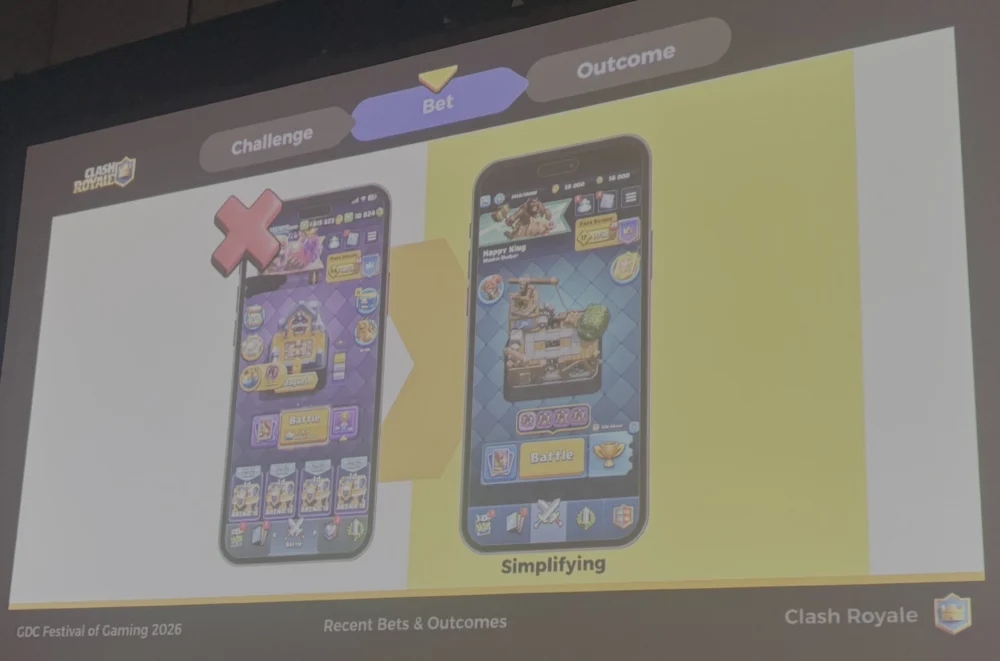
Perhaps the most controversial aspect of the comeback was the team’s decision to aggressively simplify the game’s user interface and systems. Markovic explained that for a returning player, a cluttered home screen can be an immediate deterrent. However, simplification comes at a high "opportunity cost." The time spent streamlining existing features is time not spent building new ones.
In March 2025, the team took the drastic step of removing the Season Shop entirely, followed by the removal of the dedicated "Events" tab. Markovic acknowledged that these moves triggered "some of the worst outrage" the team had ever seen from the community. Despite the backlash, the team pushed forward, moving event access into the main mode selector.
The logic behind this was twofold: to simplify the user experience and to force more players to interact with different game modes. The result, according to internal metrics, was a more active player base that engaged with a wider variety of content. Markovic even joked about a button in the current game labeled "Under Construction," revealing that it was a placeholder for a removed feature with no immediate plans for replacement—a testament to the team’s commitment to a leaner, more focused experience.

Data Analysis: MAU Fluctuations and Viral Spikes
The data presented by Back and Markovic illustrated a volatile but ultimately upward trajectory. One notable experiment was the "Goblin Queen’s Journey" in 2024, which introduced a separate trophy road system. Contrary to expectations, this feature did not provide the sustained monthly active user (MAU) spike the team had hoped for; instead, it caused a temporary dip.
In contrast, the introduction of "Merge Tactics"—a streamlined version of mechanics from the discontinued project Clash Mini—delivered significantly better results. This taught the team that players preferred integrated, streamlined experiences over entirely separate systems. Markovic noted that when the team hit the "sweet spot" between monetization and gameplay impact, they achieved "viral spikes" in engagement that were not only high but also sustainable over several months.
Chronology of the Clash Royale Comeback (2022–2025)
- 2022: The Low Point. Stagnation in content delivery with only three major updates. High production costs and diminishing returns on new card releases lead to a rethink of the development pipeline.
- Early 2023: The Evolution Era. Launch of Card Evolutions. The focus shifts from "new cards" to "upgrading existing favorites." Revenue begins to stabilize as Evolutions are added to the Pass Royale.
- Late 2023: Production Scaling. The team increases in size and efficiency, moving to a monthly release cadence for Evolutions and adding synergistic elements like Tower Troops.
- 2024: Experimental Peaks and Valleys. The Goblin Queen’s Journey is launched to mixed results, causing a temporary MAU dip. However, the introduction of Magic Items and improved progression systems leads to the fastest DAU growth in years.
- September 2024: The Mega Knight Test. A high-intensity grind event for the Mega Knight Evolution shows strong core engagement but highlights accessibility issues for casual players.
- February 2025: Accessibility and Creator Support. The Barbarian Evolution event lowers the barrier to entry. Massive support from the creator community leads to a major influx of new and returning players.
- March 2025: Aggressive Simplification. The Season Shop and Events tab are removed to streamline the UI, leading to initial community backlash but eventually resulting in higher overall game activity.
Broader Impact and Industry Implications
The recovery of Clash Royale serves as a significant case study for the broader mobile gaming industry. It demonstrates that "forever games"—titles that have been in the market for five years or more—cannot rely solely on the strategies that made them successful at launch. The shift from "breadth" (more cards) to "depth" (evolutions of existing cards) is a strategy likely to be emulated by other developers facing similar stagnation.

Furthermore, Supercell’s willingness to endure "short-term pain" for "long-term gains" highlights a culture of risk-taking that is often absent in large-scale corporate game development. By prioritizing the long-term health of the game’s systems over immediate player sentiment, the Clash Royale team was able to strip away years of "feature creep" that had made the game inaccessible to anyone but the most dedicated veterans.
The role of the creator community also cannot be understated. While the game leads only briefly mentioned creators during the GDC session, the data suggests that influencer-driven "viral spikes" were a key component of the 2025 growth. This underscores the necessity of a holistic approach to live ops that combines solid systems design with a robust external marketing and community ecosystem.
In conclusion, the "big comeback" of Clash Royale was not the result of a single feature, but a series of calculated bets on novelty, accessibility, and simplicity. As James Back concluded, the team could only learn these lessons by having the space to make mistakes and the courage to ignore short-term metrics in favor of a sustainable future. For the mobile gaming sector, the message is clear: even the most established giants must be willing to tear down their own structures to build something that can survive in the modern era.
About the Author