Nearly two decades into the mobile advertising revolution, the humble banner ad continues to defy predictions of obsolescence. Despite persistent discussions about "banner blindness" for over a quarter-century, and even in the shadow of more dynamic ad formats like playable and video ads, banner ads remain a foundational element of mobile advertising strategies. Their continued relevance is underscored by steady growth, mirroring the overall expansion of the mobile advertising industry.
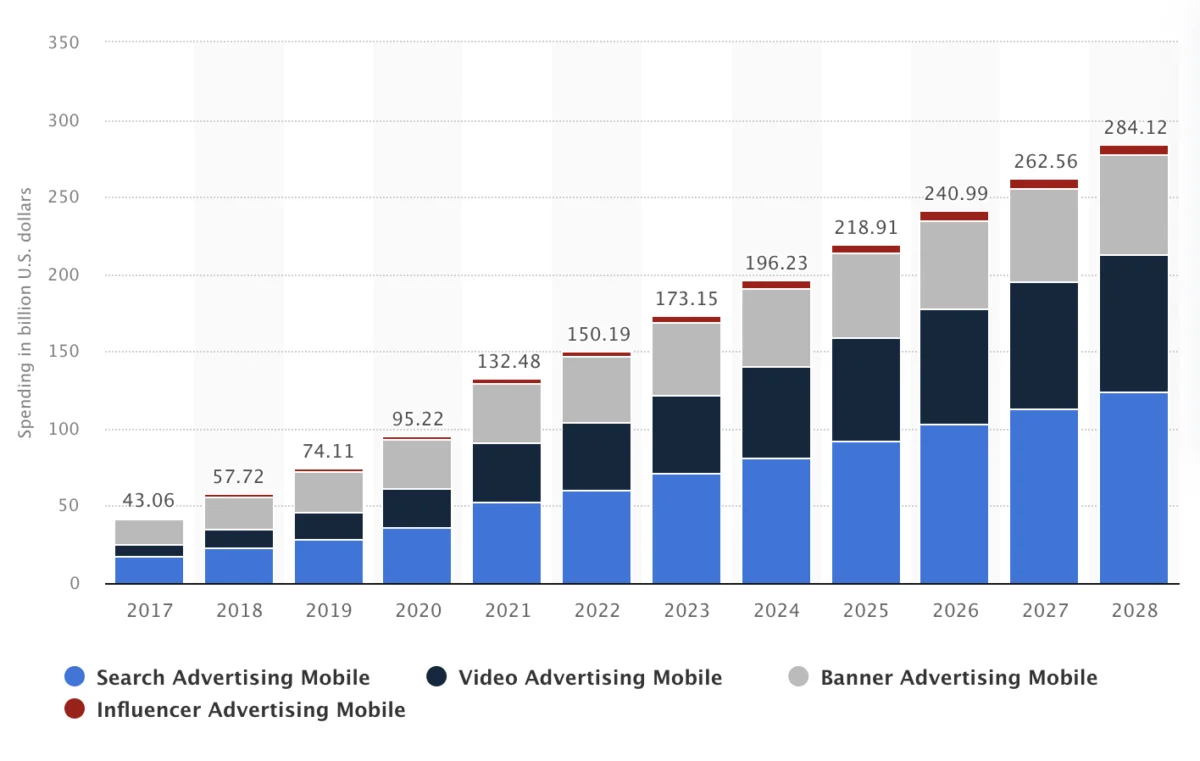
Mobile advertising spending in the United States from 2017 to 2028, by format (in billion U.S. dollars)
Source: Statista
The sustained presence of mobile banner ads can be attributed to a confluence of factors, including their inherent cost-effectiveness, strategic role in the advertising funnel, and their adaptability to evolving creative capabilities. Data from Statista projects continued growth in mobile advertising, with various formats contributing to an expanding market. While search and video advertising command larger shares, banner ads, alongside influencer marketing, are projected to maintain a consistent presence and contribute to the overall revenue.
The Strategic Value of Screen Real Estate and User Familiarity
One of the primary drivers for the enduring appeal of banner ads is the increasing value of screen real estate on mobile devices. As screens have progressively shrunk from desktop monitors to smartphones, the limited space available for advertising has amplified its importance. This phenomenon has, paradoxically, led to enhanced performance for mobile banner ads compared to their desktop counterparts. Research indicates that as screen sizes diminish, both message recall and ad recognition can improve, suggesting that users are more attuned to advertisements on smaller displays.
While immersive, full-screen formats like video and playable ads excel at driving direct conversions, the initial stages of the marketing funnel—awareness and consideration—still require effective solutions. Banner ads are exceptionally well-suited to fill this crucial top-of-funnel role. They offer a means to deliver quick, easily digestible information at a significantly lower cost per thousand impressions (CPM) than more elaborate ad formats. This cost-effectiveness makes them an attractive option for advertisers looking to build brand awareness and introduce their products or services to a broad audience without an exorbitant expenditure.
Furthermore, banner ads are particularly advantageous for brands that possess strong visual identities, such as recognizable logos and distinctive imagery. The constrained space inherent to banner formats necessitates a focus on impactful visuals and concise messaging, allowing these brands to leverage their established recognition effectively.
Unpacking the Continued Success of Banner Ads
Despite the proliferation of attention-grabbing, full-screen advertising experiences, banner ads continue to offer substantial benefits to both advertisers and ad-supported mobile applications.

Non-Intrusive Monetization and Enhanced User Experience: For mobile game developers and app publishers, banner ads represent a valuable, non-intrusive monetization strategy. Their placement, often at the periphery of the screen, allows them to generate revenue without disrupting the user’s primary activity, such as gameplay. This approach is crucial for maintaining user engagement and satisfaction, as intrusive ads can lead to frustration and abandonment. For advertisers, this non-intrusive nature translates into increased visibility, particularly when strategically positioned on an app’s main interface, thereby serving as an effective tool for brand awareness. Moreover, banners can effectively drive traffic to landing pages or websites, acting as a direct call to action.
Cost-Effectiveness in a Competitive Market: The global mobile ad spend has surged, reaching an estimated $362 billion worldwide in 2023, according to Sensor Tower. This escalating investment signifies a robust market but also leads to increased competition for premium ad inventory, driving up costs. In this environment, banner ads stand out for their affordability. They deliver a substantial volume of impressions at a fraction of the cost of other ad formats. For app developers, this translates into a consistent and predictable revenue stream without the need for costly, high-impact in-app ad placements. This economic advantage allows smaller businesses and emerging brands to participate effectively in the mobile advertising ecosystem.
Established User Recognition and Comfort: The long-standing presence of banner ads in the digital advertising landscape has fostered a high degree of user familiarity and comfort. App users have come to recognize and accept banner advertisements as a standard component of their mobile experience. While unobtrusive, these ads retain the potential to capture attention and prompt action, demonstrating a balance between visibility and user acceptance.
Driving In-App Actions and Mid-Funnel Engagement: While perhaps not always the most potent format for driving direct sales or app downloads, banner ads demonstrate considerable effectiveness in encouraging in-app actions. Their suitability for testing different calls to action and prompting mid-funnel engagement makes them a valuable tool for advertisers seeking to nurture user interest and guide them further down the conversion path. For instance, a banner ad might encourage users to "Learn More," "Sign Up for Updates," or "Explore Features," activities that contribute to a deeper brand connection without the immediate pressure of a purchase.
Evolving Creative Possibilities: The perception of banner ads as static and uninspired is increasingly outdated. Modern creative tools and technologies have empowered advertisers to develop visually engaging and interactive banner campaigns. Animation, dynamic content, and even interactive elements can be incorporated into banner designs, transforming them from passive displays into compelling calls to engagement. Furthermore, the advent of artificial intelligence (AI) in ad creation simplifies the process of developing high-performing banners tailored to specific target user preferences and past engagement behaviors. This allows for greater personalization and relevance, enhancing their effectiveness.
Facilitating A/B Testing and Optimization: The inherent simplicity of banner ads makes them an ideal format for A/B testing. Advertisers can readily experiment with different messaging, visuals, and calls to action to identify the most effective combinations. This iterative testing process is crucial for refining campaign strategies, optimizing creative assets, and maximizing return on investment. Similarly, app developers can leverage A/B testing on banner placements to determine the most lucrative positions within their applications, thereby enhancing their overall monetization efficiency.
Boosting Overall Revenue Streams: For app developers, banner ads serve as a consistent and reliable revenue stream that complements other monetization methods, such as interstitial ads and rewarded video ads. This diversified approach to ad monetization can lead to a more stable and robust revenue model. For advertisers, banners provide a cost-effective avenue for scaling campaigns, increasing brand visibility across a wider audience, and reinforcing brand messaging throughout the user journey.
Conclusion: A Strategic Component in the Mobile Marketing Arsenal
While banner ads may not be the optimal choice for every single advertising objective, they have firmly cemented their position as a vital component of any comprehensive mobile marketing strategy. Their ability to deliver clear, concise messaging, provide cost-effective impressions, and foster significant in-app engagement ensures their continued relevance, even in an era increasingly dominated by video and playable ad formats. Savvy advertisers and forward-thinking app developers recognize the enduring value of banners, integrating them strategically to achieve maximum impact and drive measurable results across the marketing funnel. The evolution of creative possibilities and the ease with which they can be tested and optimized further solidify their status as a powerful and adaptable tool in the dynamic world of mobile advertising.
About the Author