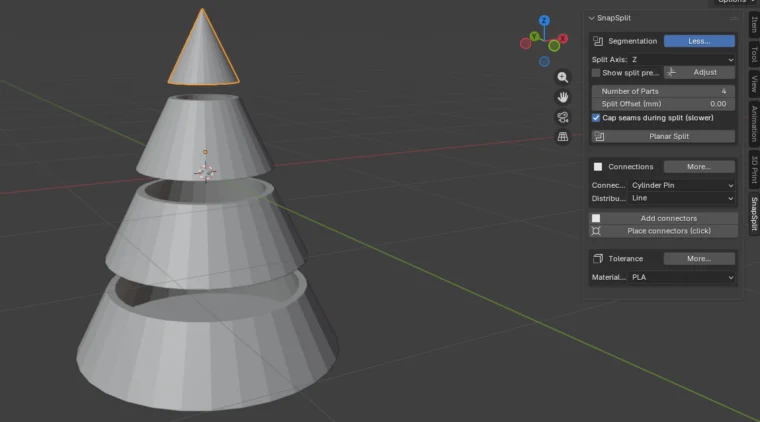
A groundbreaking new free add-on for Blender, named SnapSplit, is poised to revolutionize the workflow for 3D printing enthusiasts and professionals alike. Developed by Christoph Medicus, SnapSplit addresses a common challenge in the additive manufacturing community: the need to divide large or modular 3D models into smaller, manageable pieces that fit within the confines of standard 3D printing beds. More significantly, the add-on automates the creation of robust, precisely interlocking snap-fit connectors, eliminating the need for traditional gluing or complex assembly processes.
Addressing a Critical Bottleneck in 3D Printing
The ability to print objects larger than the build volume of a 3D printer is a fundamental requirement for a wide range of applications, from functional prototypes and large-scale art installations to intricate mechanical components and cosplay armor. Historically, this has involved laborious manual model segmentation and the subsequent design and implementation of joining mechanisms. This often entails trial-and-error processes to achieve a secure and aesthetically pleasing fit, especially when dealing with different filament materials that exhibit varying shrinkage and expansion properties.
SnapSplit, developed by Christoph Medicus, seeks to streamline this entire process within the intuitive 3D modeling environment of Blender. The add-on leverages robust Boolean operations to precisely cut models, while simultaneously generating integrated snap-fit connectors. This not only simplifies the printing preparation phase but also enhances the structural integrity and ease of assembly of the final printed object.
Key Features and Technical Capabilities
At its core, SnapSplit is designed to automate the creation of precise, glue-free snap-fit connectors. This is achieved through a sophisticated algorithm that analyzes the geometry of the model and the desired split points. Users can define where the model should be divided, and the add-on then intelligently generates interlocking features that ensure a secure connection without the need for external adhesives or fasteners.
A standout feature of SnapSplit is its material-aware tolerance presets. The add-on comes equipped with pre-configured settings for commonly used 3D printing filaments, including PLA, PETG, ABS, TPU, and SLA resins. This is a crucial advancement, as each material has unique thermal expansion coefficients and printing tolerances. By accounting for these material properties, SnapSplit ensures that the generated connectors will fit snugly and reliably, minimizing post-processing adjustments and potential printing failures. For example, a connector designed for the rigid PLA might have tighter tolerances than one intended for the more flexible TPU, which may require a slight give to snap into place.

The add-on is built upon a foundation of robust Boolean operations, a standard technique in 3D modeling for combining or subtracting geometric shapes. SnapSplit utilizes these operations to create clean cuts and precisely defined connector geometries, ensuring that the resulting parts are manifold and suitable for 3D printing.
Development and Compatibility
Christoph Medicus, the creator of SnapSplit, has been actively testing the add-on across various Blender versions. As of its recent release, SnapSplit has demonstrated stable performance with Blender 4.5.3 LTS, 5.0.1, and 5.1.0. Medicus has encouraged users to report their experiences with other Blender versions to help compile a comprehensive compatibility list. This collaborative approach to development suggests a commitment to ensuring broad accessibility and usability within the Blender community.
The initiative to develop SnapSplit stems from a desire to integrate a powerful tool directly into the existing 3D printing workflow. Medicus expressed his goal clearly: "Its goal is to integrate into a 3D printing workflow using robust booleans, material-aware tolerance presets, and various options for splits and connections." This focus on workflow integration means that designers and makers can transition from modeling to print preparation with minimal disruption.
User Testimonials and Early Reactions
While specific user testimonials are still emerging, the announcement of SnapSplit has generated significant interest within 3D printing forums and online communities. Early discussions highlight the potential time-saving benefits and the relief from the common frustration of designing and fitting connectors. Many users have expressed excitement about the material-aware presets, recognizing the importance of accounting for filament properties in achieving successful prints.
"This is exactly what the community has been asking for," commented one user on a popular 3D printing subreddit. "Manually designing interlocking parts for large prints is a nightmare, and it’s always a gamble with tolerances. A tool that handles this automatically, and with material considerations, is a game-changer."
Another user, a hobbyist who frequently prints large cosplay props, noted, "The ability to split complex models and have reliable snap-fits built-in means I can finally tackle those ambitious projects without worrying about endless sanding and gluing. This could significantly reduce my project timelines."

Broader Implications for the 3D Printing Ecosystem
The advent of tools like SnapSplit has far-reaching implications for the broader 3D printing ecosystem.
- Democratization of Large-Scale Printing: By simplifying the process of preparing large models for printing, SnapSplit makes advanced additive manufacturing capabilities more accessible to a wider audience, including hobbyists, educators, and small businesses. This can foster innovation and enable the creation of larger, more complex objects that were previously impractical to produce.
- Enhanced Design Flexibility: Designers can now conceptualize and create larger, more ambitious projects with the confidence that their models can be efficiently sectioned and assembled. This opens up new possibilities for product design, architectural modeling, and artistic expression.
- Improved Efficiency and Reduced Waste: The automation of split and connector generation can significantly reduce the time and effort required for print preparation. Furthermore, by ensuring precise fits, SnapSplit can minimize the need for post-processing, thereby reducing material waste and the environmental impact of 3D printing.
- Standardization of Assembly: The material-aware presets hint at a future where connector design can be more standardized across different materials and printing technologies. This could lead to a more predictable and reliable 3D printing experience for users.
- Potential for Commercial Applications: While currently a free add-on, the robust functionality of SnapSplit suggests potential for integration into professional 3D modeling and slicing software. This could lead to more streamlined commercial workflows for product development and manufacturing.
Future Development and Community Involvement
The ongoing development and testing of SnapSplit, driven by Christoph Medicus and the Blender community, indicate a promising future for the add-on. The call for user feedback on version compatibility is a testament to the collaborative spirit of open-source development. As more users engage with SnapSplit, it is likely that new features and improvements will emerge, further enhancing its capabilities.
Potential areas for future development could include more advanced control over connector types (e.g., hinge joints, threaded connectors), algorithmic optimization for structural strength, and integration with advanced slicing software features. The ability to automatically generate support structures specifically designed for split parts could also be a valuable addition.
Conclusion
SnapSplit represents a significant step forward in making large-scale 3D printing more accessible and efficient. By automating the complex tasks of model segmentation and the creation of precise, material-aware snap-fit connectors, Christoph Medicus has provided a valuable tool for the global 3D printing community. This free Blender add-on not only addresses a long-standing challenge but also has the potential to unlock new creative possibilities and drive innovation in the additive manufacturing space. As the tool matures and its user base grows, SnapSplit is poised to become an indispensable part of many 3D printing workflows.
About the Author